

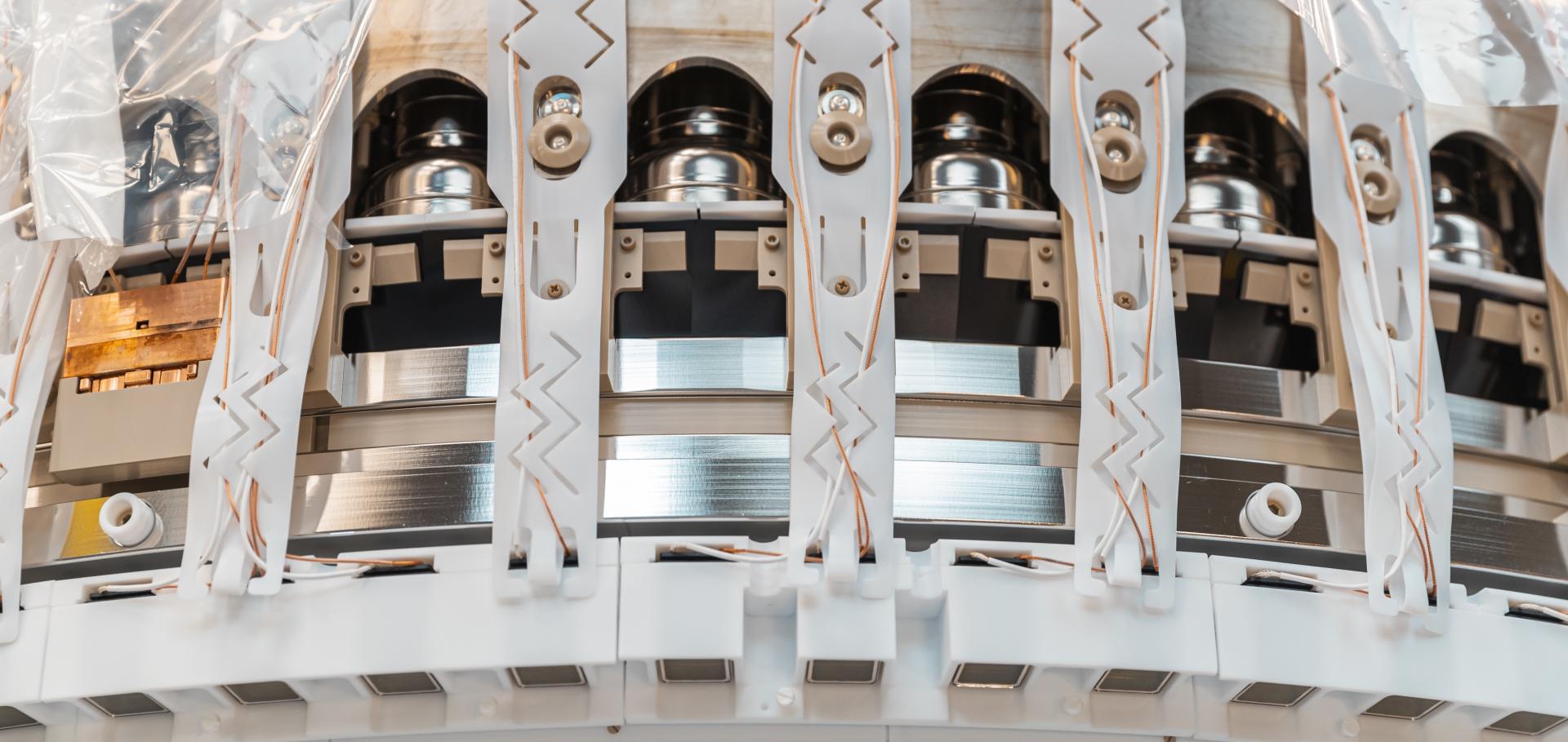
Identification of Radiopure Titanium for the LZ Dark Matter Experiment and Future Rare Event Searches
(2017)
Results from a Search for Dark Matter in the Complete LUX Exposure
Physical Review Letters American Physical Society (APS) 118:2 (2017) 021303
Scintillation properties and X-ray luminescence spectra of zinc telluride at cryogenic temperatures
Journal of Physical Studies 21:4 (2017) 4201-1-4201-5-4201-1-4201-5
Abstract:
© 2017, Ivan Franko National University of Lviv. All rights reserved. The paper is devoted to the study of X-ray luminescence spectra, the scintillation light output and the decay time characterisation of undoped ZnTe at low temperatures down to 6 K. Also, the photoconductivity spectrum in a visible region has been investigated. Due to significant thermal quenching, the scintillations at α-particle excitation were detected in the sample only below T = 150 K. The emission of the crystal is attributed to the radioactive recombination of the holes trapped by Zn vacancies and electrons captured at the shallow levels of impurities or defects. The scintillation efficiency increased with further cooling. It has been found that at α-particle excitation undoped ZnTe exhibits a fairly competitive light output equal to 117 ± 20% of CaWO4reference scintillator. This finding underpins potential applications of ZnTe as a scintillation detector in the cryogenic experiments, particularly for the cryogenic search for neutrinoless double beta decay of130Te. It has been also found that ZnTe will be attractive as a conventional scintillation detector at the temperature of liquid nitrogen (T = 77 K). At this temperature, the scintillator exhibits a reasonably short decay time and a sufficient scintillation response to particle excitation. A practical implementation of this idea poses no real technical challenge since photomultipliers and Si-based photodetectors are proven to operate reliably and efficiently at this temperature.Search for low mass dark matter particles with the cresst experiment
Proceedings of Science (2017)