New limits on double electron capture of 40 Ca and 180 W

Journal of Physics G: Nuclear and Particle Physics Institute of Physics 43:9 (2016) 095202

Authors:

Godehard Angloher, Matthias Bauer, Philipp Bauer, Irina Bavykina, Antonio CSSM Bento, Carlo Bucci, Lucia Canonica, Christian Ciemniak, Xavier Defay, Gerhard Deuter, Andreas Erb, Franz von Feilitzsch, Nahuel Ferreiro Iachellini, Achim Gütlein, Christian Isaila, Margit Kiefer, Hans Kraus, Franz Pröbst, Sabine Roth, Christian Sailer, Anja Tanzke, Thi-Hieu Ho, Andreas Ulrich, Michael Willers, Mark Wüstrich

Abstract:

We analyzed low-background data from the CRESST-II experiment with a total net exposure of 730 kg days to extract limits on double electron capture processes. We established new limits for 40Ca with T1/22v2K > 9.9 × 10²¹ y and T1/20v2EC > 1.4 × 10²² y and for 180W T1/22v/2K > 3.1 × 10¹⁹ with y and T1/20v2ED > 9.4 × 10¹⁸ y at 90% CL. Depending on the process, these values improve the currently best limits by a factor of ∼1.4-30.

The CRESST-III low-mass WIMP detector

Journal of Physics: Conference Series Institute of Physics 718:4 (2016) 042048

Authors:

Godehard Angloher, Antonio Bento, Carlo Bucci, Lucia Canonica, Xavier Defay, Andreas Erb, Franz von Feilitzsch, Nahuel Ferreiro Iachellini, Paolo Gorla, Achim Gütlein, Dieter Hauff, Josef Jochum, Margit Kiefer, Holger Kluck, Hans Kraus, Jean-Come Lanfranchi, Jurek Loebell, Andrea Münster, Carmine Pagliarone, Federica Petricca, Christian Strandhagen, Anja Tanzke, Hong H Trinh Thi, Cenk Türkoğlu, Martin Uffinger

Abstract:

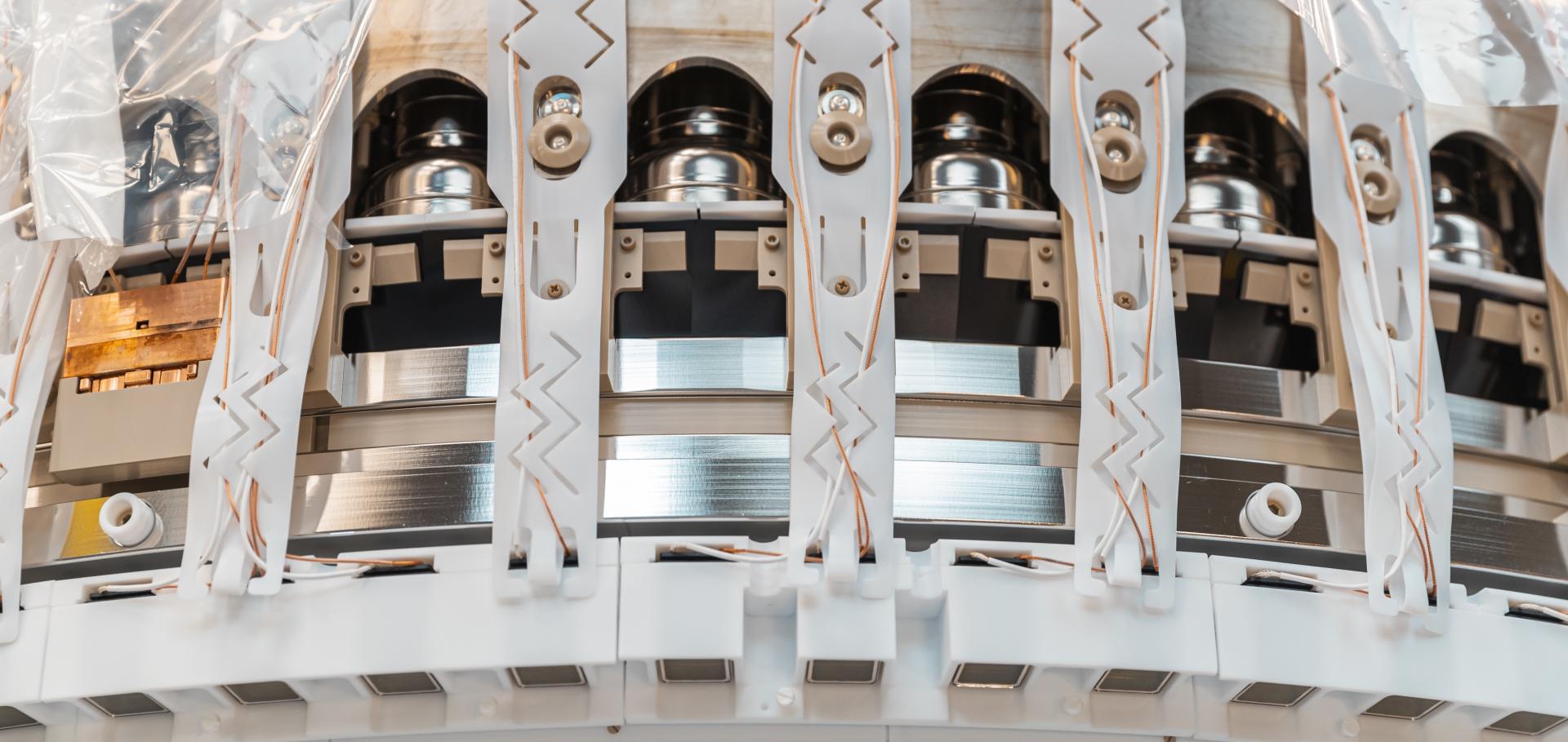
The next generation direct dark matter experiment CRESST-III has a high potential to significantly increase the sensitivity to low-mass WIMPs (mx ≲10 GeV/c2). We present the new CRESST detector module: it consists of a 24 g CaWO4 crystal operated as a phonon detector and a 20x20 mm^2 silicon-on-sapphire light detector. The phonon energy threshold is lowered to ~100 eV and a light detector resolution of typically 5 eV is achieved. A fully-scintillating inner detector housing is realised which efficiently rejects events from surface alpha decays. The CaWO4 sticks holding the target crystal are also operated as calorimeters to discriminate all possible artefacts related to the support structure. A projection for the sensitivity to spin-independent WIMP-nucleon scattering is given for the first phase of CRESSTIII which will start beginning of 2016.

Exploring Low-Mass Dark Matter with CRESST

Journal of Low Temperature Physics Springer Nature 184:3-4 (2016) 866-872

Authors:

R Strauss, G Angloher, A Bento, C Bucci, L Canonica, X Defay, A Erb, FV Feilitzsch, N Ferreiro Iachellini, P Gorla, A Gütlein, D Hauff, J Jochum, M Kiefer, H Kluck, H Kraus, JC Lanfranchi, J Loebell, A Münster, C Pagliarone, F Petricca, W Potzel, F Pröbst, F Reindl, K Schäffner, J Schieck, S Schönert, W Seidel, L Stodolsky, C Strandhagen, A Tanzke, HH Trinh Thi, C Türkoglu, M Uffinger, A Ulrich, I Usherov, S Wawoczny, M Willers, M Wüstrich, A Zöller

Improved EDELWEISS-III sensitivity for low-mass WIMPs using a profile likelihood approach

(2016)

Authors:

EDELWEISS Collaboration, L Hehn, E Armengaud, Q Arnaud, C Augier, A Benoît, L Bergé, J Billard, J Blümer, T de Boissière, A Broniatowski, P Camus, A Cazes, M Chapellier, F Charlieux, M De Jésus, L Dumoulin, K Eitel, N Foerster, J Gascon, A Giuliani, M Gros, G Heuermann, Y Jin, A Juillard, C Kéfélian, M Kleifges, V Kozlov, H Kraus, VA Kudryavtsev, H Le-Sueur, S Marnieros, X-F Navick, C Nones, E Olivieri, P Pari, B Paul, M-C Piro, D Poda, E Queguiner, S Rozov, V Sanglard, B Schmidt, S Scorza, B Siebenborn, D Tcherniakhovski, L Vagneron, M Weber, E Yakushev

Limits on Momentum-Dependent Asymmetric Dark Matter with CRESST-II.

Physical review letters 117:2 (2016) 021303-021303

Authors:

G Angloher, A Bento, C Bucci, L Canonica, X Defay, A Erb, FV Feilitzsch, N Ferreiro Iachellini, P Gorla, A Gütlein, D Hauff, J Jochum, M Kiefer, H Kluck, H Kraus, J-C Lanfranchi, J Loebell, A Münster, C Pagliarone, F Petricca, W Potzel, F Pröbst, F Reindl, K Schäffner, J Schieck, S Schönert, W Seidel, L Stodolsky, C Strandhagen, R Strauss, A Tanzke, HH Trinh Thi, C Türkoğlu, M Uffinger, A Ulrich, I Usherov, S Wawoczny, M Willers, M Wüstrich, A Zöller

Abstract:

The usual assumption in direct dark matter searches is to consider only the spin-dependent or spin-independent scattering of dark matter particles. However, especially in models with light dark matter particles O(GeV/c^{2}), operators which carry additional powers of the momentum transfer q^{2} can become dominant. One such model based on asymmetric dark matter has been invoked to overcome discrepancies in helioseismology and an indication was found for a particle with a preferred mass of 3  GeV/c^{2} and a cross section of 10^{-37}  cm^{2}. Recent data from the CRESST-II experiment, which uses cryogenic detectors based on CaWO_{4} to search for nuclear recoils induced by dark matter particles, are used to constrain these momentum-dependent models. The low energy threshold of 307 eV for nuclear recoils of the detector used, allows us to rule out the proposed best fit value above.