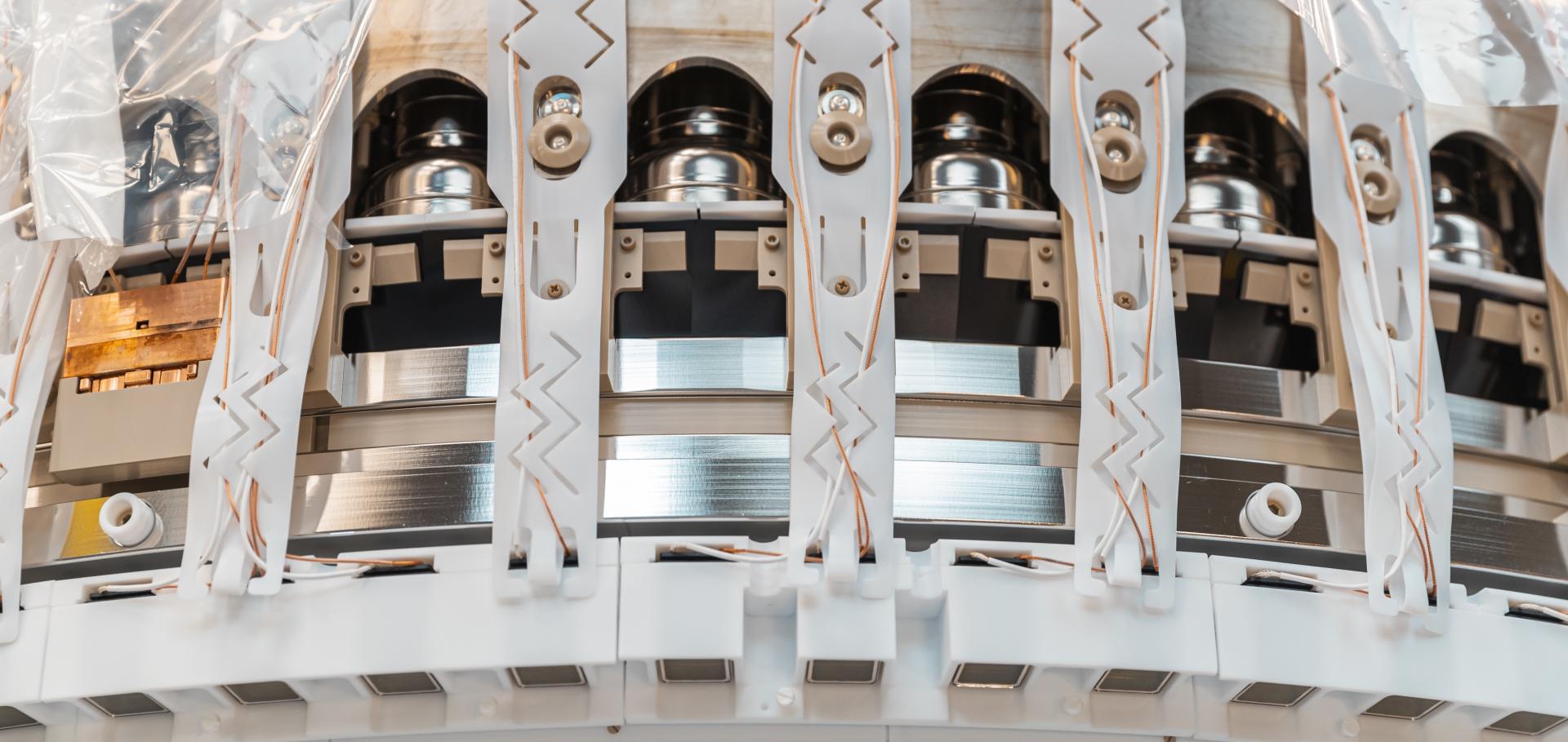
Non-contact luminescence lifetime microthermometry using scintillation sensors
Acta Physica Polonica A Polish Academy of Sciences Institute of Physics 133:4 (2017) 1108-1111
Abstract:
The paper describes an original technique for non-contact in situ monitoring of the temperature developed for experiments in a vacuum environment at the tender X-ray beamline I23 of the Diamond Light Source. The sample temperature is established by determining the luminescence decay constant of a Bi4Ge3O12 (BGO) scintillation sensor. BGO is ideally suited for a temperature range of 30 K to 130 K, in which its decay constant shows a strong temperature dependence. The principle of the method, system design and application examples are discussed and the performance and potential of the technique is assessed.Measurement of the cosmogenic activation of germanium detectors in EDELWEISS-III
Astroparticle Physics Elsevier 91 (2017) 51-64
Abstract:
We present a measurement of the cosmogenic activation in the cryogenic germanium detectors of the EDELWEISS III direct dark matter search experiment. The decay rates measured in detectors with different exposures to cosmic rays above ground are converted into production rates of different isotopes. The measured production rates in units of nuclei/kg/day are 82 ± 21 for 3H, 2.8 ± 0.6 for 49V, 4.6 ± 0.7 for 55Fe, and 106 ± 13 for 65Zn. These results are the most accurate for these isotopes. A 90% C.L. lower limit on the production rate of 68Ge of 71 nuclei/kg/day is also presented. They are compared to model predictions present in literature and to estimates calculated with the ACTIVIA code.Non-contact luminescence lifetime cryothermometry for macromolecular crystallography
(2017)