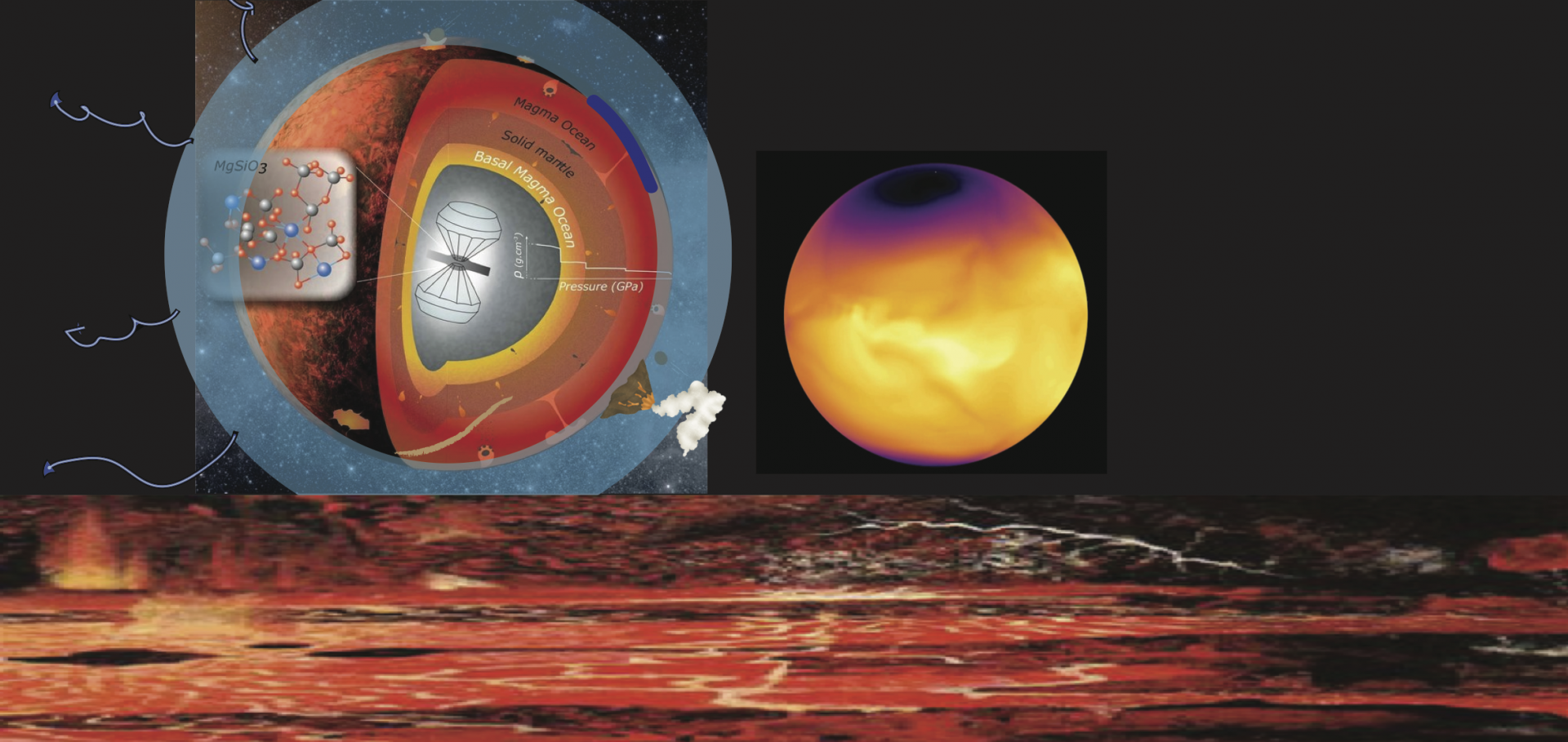
Effects of latent heating on atmospheres of brown dwarfs and directly imaged planets
Astrophysical Journal American Astronomical Society 835:2 (2017) 186-186
Abstract:
The growing number of observations of brown dwarfs (BDs) has provided evidence for strong atmospheric circulation on these objects. Directly imaged planets share similar observations and can be viewed as low-gravity versions of BDs. Vigorous condensate cycles of chemical species in their atmospheres are inferred by observations and theoretical studies, and latent heating associated with condensation is expected to be important in shaping atmospheric circulation and influencing cloud patchiness. We present a qualitative description of the mechanisms by which condensational latent heating influences circulation, and then illustrate them using an idealized general circulation model that includes a condensation cycle of silicates with latent heating and molecular weight effect due to the rainout of the condensate. Simulations with conditions appropriate for typical T dwarfs exhibit the development of localized storms and east–west jets. The storms are spatially inhomogeneous, evolving on a timescale of hours to days and extending vertically from the condensation level to the tropopause. The fractional area of the BD covered by active storms is small. Based on a simple analytic model, we quantitatively explain the area fraction of moist plumes and show its dependence on the radiative timescale and convective available potential energy (CAPE). We predict that if latent heating dominates cloud formation processes, the fractional coverage area of clouds decreases as the spectral type goes through the L/T transition from high to lower effective temperature. This is a natural consequence of the variation of the radiative timescale and CAPE with the spectral type.Three‐dimensional turbulence‐resolving modeling of the Venusian cloud layer and induced gravity waves
Journal of Geophysical Research: Planets John Wiley and Sons, Ltd. 122:1 (2016) 134-149
Abstract:
The impact of the cloud convective layer of the atmosphere of Venus on the global circulation remains unclear. The recent observations of gravity waves at the top of the cloud by the Venus Express mission provided some answers. These waves are not resolved at the scale of global circulation models (GCM); therefore, we developed an unprecedented 3‐D turbulence‐resolving large‐eddy simulations (LES) Venusian model using the Weather Research and Forecast terrestrial model. The forcing consists of three different heating rates: two radiative ones for solar and infrared and one associated with the adiabatic cooling/warming of the global circulation. The rates are extracted from the Laboratoire de Météorlogie Dynamique Venus GCM using two different cloud models. Thus, we are able to characterize the convection and associated gravity waves in function of latitude and local time. To assess the impact of the global circulation on the convective layer, we used rates from a 1‐D radiative‐convective model. The resolved layer, taking place between 1.0 × 10⁵ and 3.8 × 10⁴ Pa (48–53 km), is organized as polygonal closed cells of about 10 km wide with vertical wind of several meters per second. The convection emits gravity waves both above and below the convective layer leading to temperature perturbations of several tenths of kelvin with vertical wavelength between 1 and 3 km and horizontal wavelength from 1 to 10 km. The thickness of the convective layer and the amplitudes of waves are consistent with observations, though slightly underestimated. The global dynamics heating greatly modify the convective layer.Ertel potential vorticity versus Bernoulli streamfunction on Mars
Quarterly Journal of the Royal Meteorological Society Wiley 143:702 (2016) 37-52
Abstract:
Scatter plots of Ertel potential vorticity, Q, versus Bernoulli streamfunction, B, on potential temperature surfaces, θ, are investigated for Mars using the global Mars Analysis Correction Data Assimilation (MACDA) reanalysis, which spans Mars Year (MY) 24.39 to 27.24. In midlatitudes, Mars exhibits monotonic, function-like Q(B) correlations on θ surfaces similar to those observed for Earth. We quantify this with linear regressions of Q versus B over the vertical range θ=400 to 900 K (∼30 to 60 km). In autumn, winter and spring, in both hemispheres, the non-dimensionalized correlation generally lies between zero and unity and gradually decreases with height, whereas in northern summer, it swings negative. These characteristics match Earth's lower mesosphere (θ= 2000 to 3000 K; z≈ 48 to 62 km) during the same seasons. The exception is southern summer, when the correlation on Mars nearly vanishes. In time series, the transition into and out of northern summer is sinuous and centred just after solar longitude Ls = 90°, whereas in southern summer it is abrupt and spans ΔLs≈120°, which is one third of a Mars year. A striking feature seen on Mars but not on Earth is a large range of Q over the narrow domain of B poleward of each winter polar jet, particularly in the north, which is consistent with the known annular structure of the Martian polar vortex. Froude number calculations suggest the existence of a planetary-scale hydraulic jump associated with the winter polar jet.Isotopic enrichment of forming planetary systems from supernova pollution
Monthly Notices of the Royal Astronomical Society Oxford University Press (OUP) 462:4 (2016) 3979-3992
Exploring the Venus global super-rotation using a comprehensive general circulation model
Planetary and Space Science Elsevier 134 (2016) 1-18