Synthesis of Five-Porphyrin Nanorings by Using Ferrocene and Corannulene Templates

Angewandte Chemie 128:29 (2016) 8498-8502

Authors:

P Liu, Y Hisamune, MD Peeks, B Odell, JQ Gong, LM Herz, HL Anderson

Synthesis of Five-Porphyrin Nanorings by Using Ferrocene and Corannulene Templates.

Angewandte Chemie (International ed. in English) 55:29 (2016) 8358-8362

Authors:

P Liu, Y Hisamune, MD Peeks, B Odell, JQ Gong, LM Herz, HL Anderson

Abstract:

The smallest and most strained member of a family of π-conjugated cyclic porphyrin oligomers was synthesized by using pentapyridyl templates based on ferrocene and corannulene. Both templates are effective for directing the synthesis of the butadiyne-linked cyclic pentamer, despite the fact that the radii of their N5 donor sets are too small by 0.5 Å and 0.9 Å, respectively (from DFT calculations). The five-porphyrin nanoring exhibits a structured absorption spectrum and its fluorescence extends to 1200 nm, reflecting strong π conjugation and Herzberg-Teller vibronic coupling.

Size-Independent Energy Transfer in Biomimetic Nanoring Complexes.

ACS nano 10:6 (2016) 5933-5940

Authors:

P Parkinson, N Kamonsutthipaijit, HL Anderson, LM Herz

Abstract:

Supramolecular antenna-ring complexes are of great interest due to their presence in natural light-harvesting complexes. While such systems are known to provide benefits through robust and efficient energy funneling, the relationship between molecular structure, strain (governed by nuclear coordinates and motion), and energy dynamics (arising from electronic behavior) is highly complex. We present a synthetic antenna-nanoring system based on a series of conjugated porphyrin chromophores ideally suited to explore such effects. By systematically varying the size of the acceptor nanoring, we reveal the interplay between antenna-nanoring binding, local strain, and energy dynamics on the picosecond time scale. Binding of the antenna unit creates a local strain in the nanoring, and this strain was measured as a function of the size of the nanoring, by UV-vis-NIR titration, providing information on the conformational flexibility of the system. Strikingly, the energy-transfer rate is independent of nanoring size, indicating the existence of strain-localized acceptor states, spread over about six porphyrin units, arising from the noncovalent antenna-nanoring association.

Electron–phonon coupling in hybrid lead halide perovskites

Nature Communications Nature Publishing Group: Nature Communications 7 (2016)

Authors:

Adam DM Wright, Laura M Herz, Rebecca L Milot, Carla Verdi, Michael B Johnston, Giles E Eperon, Henry J Snaith, Feliciano Giustino, Miguel A Perez-Osorio

Abstract:

Phonon scattering limits charge-carrier mobilities and governs emission line broadening in hybrid metal halide perovskites. Establishing how charge carriers interact with phonons in these materials is therefore essential for the development of high-efficiency perovskite photovoltaics and low-cost lasers. Here we investigate the temperature dependence of emission line broadening in the four commonly studied formamidinium and methylammonium perovskites, HC(NH2)2PbI3, HC(NH2)2PbBr3,CH3NH3PbI3 and CH3NH3PbBr3, and discover that scattering from longitudinal optical phonons via the Fröhlich interaction is the dominant source of electron–phonon coupling near room temperature, with scattering off acoustic phonons negligible. We determine energies for the interacting longitudinal optical phonon modes to be 11.5 and 15.3 meV, and Fro¨hlich coupling constants ofB40 and 60 meV for the lead iodide and bromide perovskites, respectively. Our findings correlate well with first-principles calculations based on many-body perturbation theory, which underlines the suitability of an electronic band-structure picture for describing charge carriers in hybrid perovskites.

Charge-Carrier Dynamics in Organic-Inorganic Metal Halide Perovskites.

Annual review of physical chemistry 67 (2016) 65-89

Abstract:

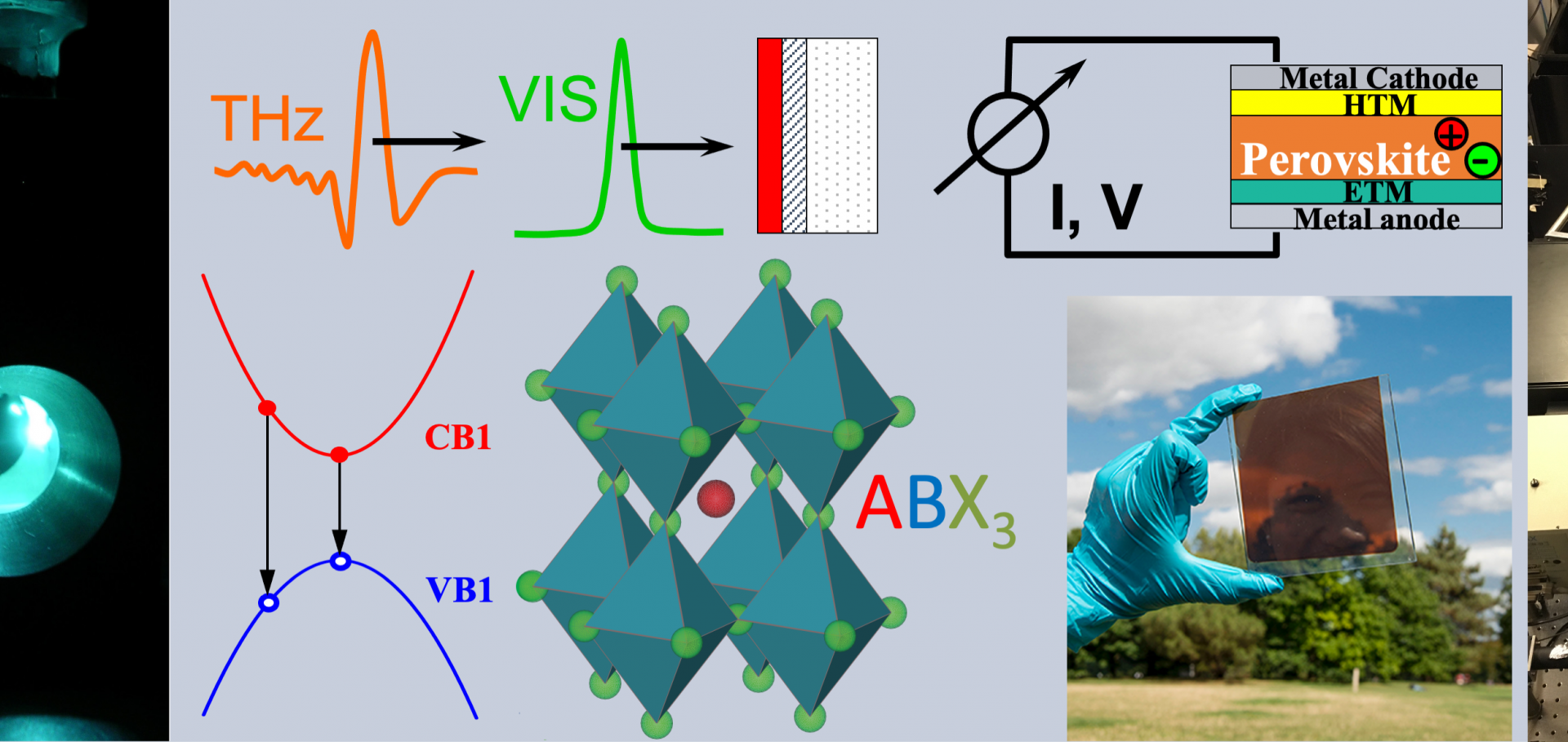
Hybrid organic-inorganic metal halide perovskites have recently emerged as exciting new light-harvesting and charge-transporting materials for efficient photovoltaic devices. Yet knowledge of the nature of the photogenerated excitations and their subsequent dynamics is only just emerging. This article reviews the current state of the field, focusing first on a description of the crystal and electronic band structure that give rise to the strong optical transitions that enable light harvesting. An overview is presented of the numerous experimental approaches toward determining values for exciton binding energies, which appear to be small (a few milli-electron volts to a few tens of milli-electron volts) and depend significantly on temperature because of associated changes in the dielectric function. Experimental evidence for charge-carrier relaxation dynamics within the first few picoseconds after excitation is discussed in terms of thermalization, cooling, and many-body effects. Charge-carrier recombination mechanisms are reviewed, encompassing trap-assisted nonradiative recombination that is highly specific to processing conditions, radiative bimolecular (electron-hole) recombination, and nonradiative many-body (Auger) mechanisms.