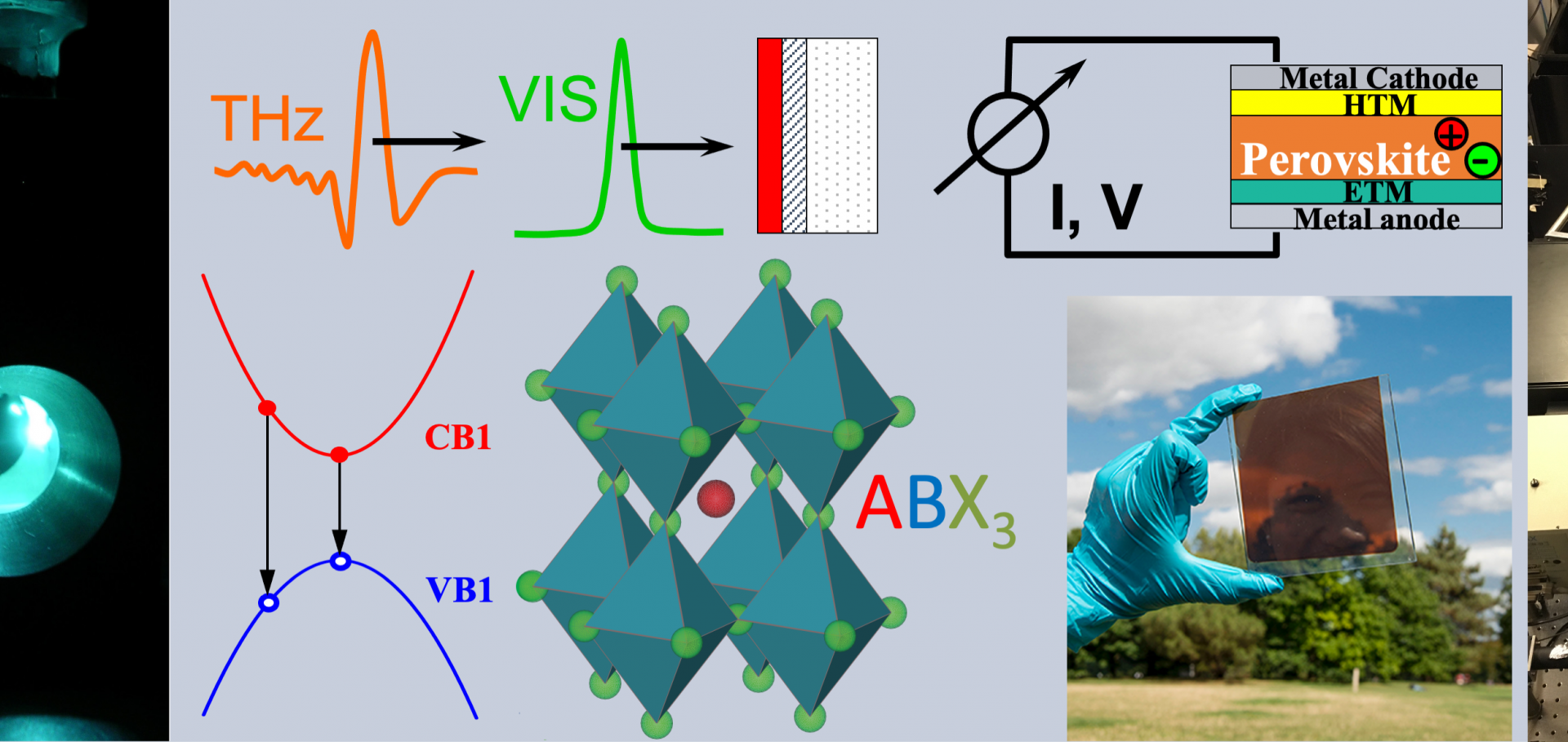
Modulating non-radiative recombination related to shallow traps in halide perovskites

Applied Physics Reviews 13:1 (2026)

Authors:

D Guo, AR Bowman, S Gorgon, C Cho, YK Jung, J Zhao, L Dai, J Park, KM Yeom, S Nagane, S Macpherson, W Xu, JH Noh, SI Seok, T Savenije, SD Stranks

Abstract:

Halide perovskite solar cells have demonstrated a rapid increase in power conversion efficiencies. Understanding and mitigating remaining carrier losses in halide perovskites is now crucial to enable further increases to approach their practical efficiency limits. Recent observations in halide perovskites have revealed processes such as shallow carrier trapping, which give rise to an apparent non-radiative bimolecular channel that is difficult to distinguish from intrinsic radiative recombination. Here, we quantify this shallow-trap manifestation by jointly analyzing time-resolved photoluminescence and quantum efficiency to separate the total second-order term into radiative (ηesck2r) and shallow-trap-mediated non-radiative contributions (k2non), and evaluate their device impact. We show that k2non is strongly modulated by temperature and surface chemistry and thus depends on extrinsic factors and its origin is independent from deep traps, whereas the intrinsic radiative coefficient and intrinsic second-order recombination follow detailed-balance expectations and align with theoretical evaluations through van Roosbroeck–Shockley relations. Based on density functional theory simulations and Quasi-Fermi level calculations, we propose that surface states are the primary origin of this shallow-trap-related second-order component, contributing up to ∼80 mV of the overall reduction in Voc at room temperature. This work reveals that the origin of carrier losses from two non-radiative recombination types (first and second order) are not linked, emphasizing the need for distinctive mitigation strategies targeting each type to unlock the full efficiency potential of perovskite solar cells.

Impact of residual triphenylphosphine oxide on the crystallization of vapor-deposited metal halide perovskite films

Journal of Vacuum Science & Technology B Nanotechnology and Microelectronics Materials Processing Measurement and Phenomena American Vacuum Society 44:1 (2026) 012203

Authors:

Sarah J Scripps, Siyu Yan, Qimu Yuan, Laura M Herz, Nakita K Noel, Michael B Johnston

Abstract:

Thermal evaporation is an industrially compatible technique for fabricating metal halide perovskite thin films, without the requirement for hazardous solvents. It offers precise control over film thickness and is a good candidate for large-scale production of commercial optoelectronic metal halide perovskite devices, such as solar cells. The use of additives to passivate electronic defects in solution-processed metal halide perovskite has led to dramatic increases in device performance. However, there are a few reports of vapor-deposited films with coevaporated passivating agents. Triphenylphosphine oxide (TPPO) has been used as an effective surface passivating agent in solution-processed metal halide perovskite films. It is a promising candidate passivating agent for coevaporation, where it is beginning to be used with encouraging results. However, here we report that triphenylphosphine oxide is incompatible with thermal deposition in the same deposition chamber. Such TPPO remnants are found to result in severe suppression of the perovskite phase, long-range crystalline ordering, and optical absorption of lead halide perovskite films subsequently deposited in the same chamber. TPPO contamination persists even through repeated baking cycles, with the reduction of the contaminant to acceptable levels requiring vacuum chamber dismantling and manual cleaning. We conclude that TPPO should not be coevaporated in order to prevent the contamination of future batches.

Discovery of two new Cu–Sn chalco–halides for potential solar absorber applications

Journal of Materials Chemistry A Royal Society of Chemistry (RSC) (2026)

Authors:

Brinda Kuthanazhi, Debalina Banerjee, Dmitry Maslennikov, Andrij Vasylenko, Jan P Scheifers, Cara J Hawkins, Daniel Ritchie, Craig M Robertson, Marco Zanella, Troy D Manning, Luke M Daniels, Marina R Filip, Matthew S Dyer, Laura M Herz, John B Claridge, Matthew J Rosseinsky

Abstract:

New compounds are discovered in the under-explored d 10 –s 2 (Cu–Sn) family using exploratory synthesis guided by computational tools. Band-gaps in the visible region with moderate charge-carrier mobilities make these potential solar absorbers. We explore multiple-cation chalco–halide phase fields evaluated by their synthetic accessibility using machine learning models. Exploratory synthesis guided by computational tools leads to the discovery of two new compounds; CuSn 2 SI 3 and Cu 0.35 Sn 5.29 S 2 I 7 , their structures, and electronic and optical properties are reported herein. This is the first report of a stable quaternary compound in the Cu–Sn–S–I phase field. The two new compounds show related crystal structures where Sn 4 S 2 I 4 layers are a common structural motif in both. These Sn 4 S 2 I 4 layers are connected by Cu 2 I 2 layers and disordered Cu–Sn–I layers, forming the three-dimensional structures of CuSn 2 SI 3 and Cu 0.35 Sn 5.29 S 2 I 7 respectively. Electronic band structure calculations using density functional theory show the presence of a direct band gap in CuSn 2 SI 3 and suggest anisotropic transport, in line with the layered structure of the compound. A mixture of the two compounds with ∼86% CuSn 2 SI 3 , shows a band gap in the visible region, close to 2.1 eV and a significant photo-induced charge carrier mobility of ∼1.3 cm 2 V −1 s −1 . This demonstrates Cu–Sn chalco–halides can form a promising phase space to explore for solar absorber materials, with further design and tuning of band gap.

Halide segregation governs interfacial charge-transfer pathways in mixed-halide perovskites

EES Solar Royal Society of Chemistry (RSC) (2026)

Authors:

Jae Eun Lee, Robert DJ Oliver, Joshua RS Lilly, Rehmat Sood-Goodwin, Aleksander M Ulatowski, Alexandra J Ramadan, Henry J Snaith, Michael B Johnston, Laura M Herz

Abstract:

In mixed-halide perovskites, halide segregation results in rapid funnelling of charge carriers to the I-rich phase, increasing radiative recombination and slightly lowering their mobility, while sustaining effective charge-carrier extraction pathways. Mixed-halide perovskites offer ideal bandgaps for tandem solar cells, but they suffer from light-induced halide segregation, which compromises their operational stability. Here, we directly probe the impact of halide segregation on charge-carrier dynamics at the interface between a mixed-halide perovskite and charge transport layers by using a free-space synchronous multimodal spectroscopy approach, combining time-resolved microwave conductivity, time-resolved photoluminescence (PL) and steady-state PL. We present a method to distinguish directly between charge-carrier dynamics dominated by either majority or minority carriers, enabling us to isolate effects arising from charge-selective extraction from the perovskite to commonly used hole- or electron transport layers, i.e. poly[bis(4-phenyl)(2,4,6-trimethylphenyl)amine] (PTAA) and SnO 2 , respectively. We show that halide segregation creates iodide-rich phases that capture charge carriers within sub-nanoseconds, which slightly reduces their mobilities at microwave frequencies. We reveal that charge extraction from such iodide-rich domains is still surprisingly feasible, but competes with enhanced radiative recombination resulting from higher charge concentrations caused by funnelling into these minority phases. We demonstrate that together such effects reduce charge diffusion lengths and can account for the widely observed reduction in open-circuit voltages and short-circuit currents in solar cells under operational conditions. Our findings unravel the causes underpinning the adverse impact of halide segregation and provide guidelines to improve device performance.

Decoupling Optical and Thermal Dynamics in Dielectric Metasurfaces for Self-Encoded Photonic Control

Laser and Photonics Reviews 19:24 (2025)

Authors:

OC Karaman, GN Naidu, AR Bowman, EN Dayi, G Tagliabue

Abstract:

Thermo-optical nonlinearities (TONL) in metasurfaces enable dynamic control of optical properties—such as transmitted power, phase, and polarization—through external stimuli like laser irradiation or temperature. Due to the inherently slow thermal dynamics of extended systems, research has primarily focused on steady-state effects, as rapid modulation is typically considered challenging. In this study, photo-driven TONL is investigated in amorphous silicon (a-Si) metasurfaces under both steady-state and, more importantly, dynamic conditions using a modulated 488 nm continuous-wave pump laser. First, a non-monotonic change is observed in transmission as a function of irradiation intensity at a wavelength red-shifted by 15 nm from the electric-dipole resonance. Specifically, transmission initially decreases by 30% before increasing by 30% as the laser intensity reaches 5 mW/ (Formula presented.). Next, it is demonstrated that TONL decouple thermal and optical response times, with the optical response being up to seven times faster than the thermal response under tested conditions ((Formula presented.) (Formula presented.) vs. (Formula presented.) (Formula presented.)). Most remarkably, it is experimentally shown that the interplay of these effects enables optical modulation at twice (100 kHz) the excitation laser's modulation frequency (50 kHz). Finally, it is shown that exploiting these unique conditions allow thermo-optical metasurfaces to intrinsically encode multiple optical states within a single modulation cycle, realizing a self-modulating photonic platform. TONL thus open new avenues for engineering active metasurfaces that combine fast, high-amplitude modulation with self-modulating optical dynamics, making them promising for next-generation optical switching, dynamic holography, optical information processing, and neuromorphic computing.