

Engineering technology development in the UK for HARMONI: An E-ELT first light instrument
Proceedings of SPIE - The International Society for Optical Engineering 8450 (2012)
Abstract:
HARMONI is an integral field spectrograph working at visible and near-infrared wavelengths, over a range of spatial scales from ground layer corrected to fully diffraction-limited. The instrument has been chosen to be part of the first-light complement at the European Extremely Large Telescope (E-ELT1). This paper describes the engineering technology development being undertaken at the UKATC and Oxford to support E-ELT HARMONI2 instrument in its pre-phase-B stage. This includes the description of technology demonstrators for a tracking optical de-rotator to be located within the instrument vacuum vessel, a cryogenic shutter and a compact thermally compensating lens mount system. In addition the material testing facilities available at the UKATC are described which will enable the measurement of material and bolted joint thermal conductivities to 4K and friction/wear properties of material combinations to 20K. This work is undertaken to improve the instrument performance and reduce technical, cost and schedule risk. © 2012 SPIE.Latitudinal variation of upper tropospheric NH3 on Saturn derived from Cassini/CIRS far-infrared measurements
Planetary and Space Science 73:1 (2012) 347-363
Abstract:
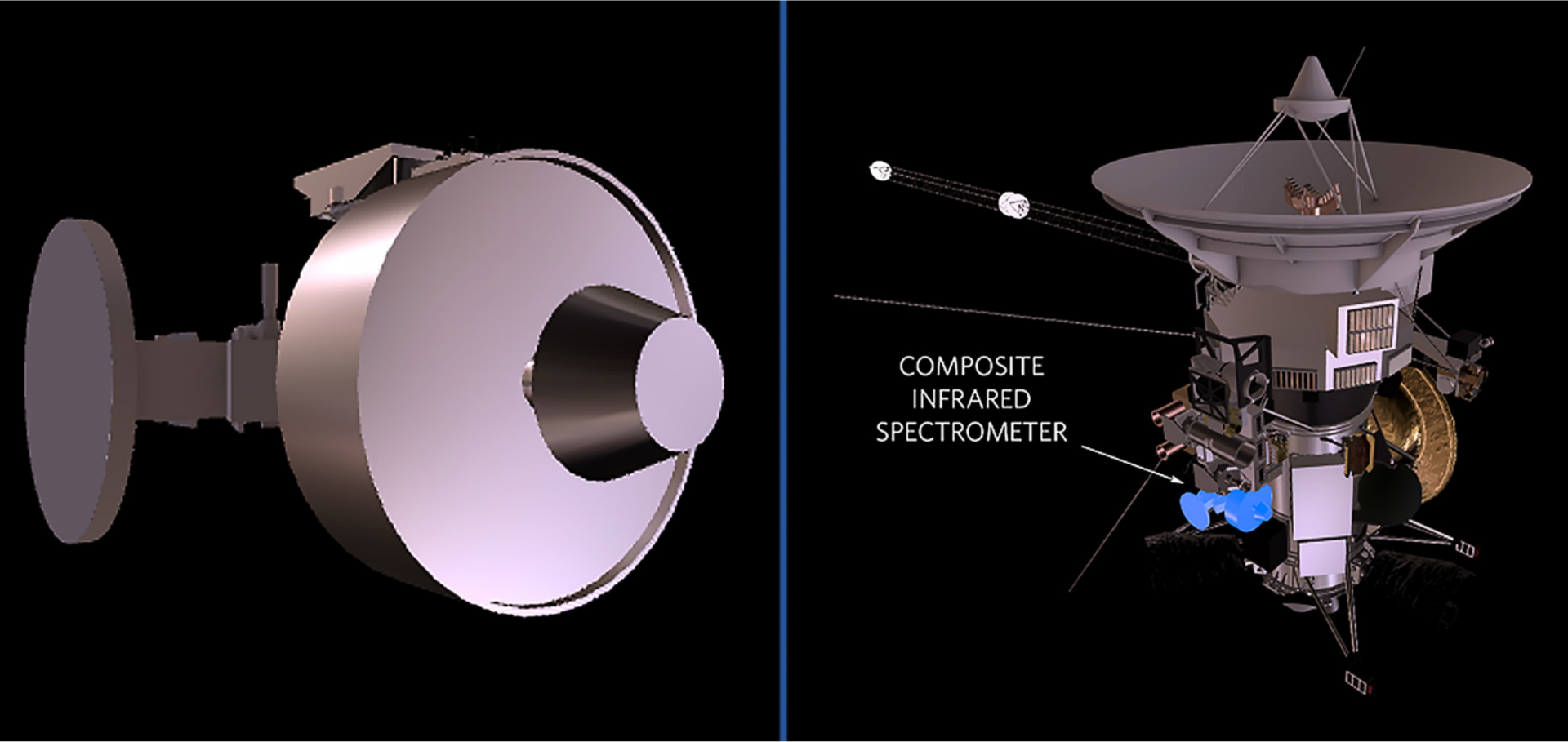
Ammonia (NH3) has been detected both on Saturn and Jupiter, and although its concentration and distribution has been well-studied on Jupiter, it has proven more difficult to do so on Saturn due to higher sensitivity requirements resulting from Saturn's lower atmospheric temperatures and the dominance of Saturn's phosphine which masks the ammonia signal. Using far-infrared measurements of Saturn taken by Cassini/CIRS between February 2005 and December 2010, the latitudinal variations of upper tropospheric ammonia on Saturn are studied. Sensitivity to NH3 in the far-infrared is explored to provide estimates of temperature, para-H2 and PH 3, from 2.5 cm-1 spectral resolution measurements alone, 0.5 cm-1 spectral-resolution measurements alone, and 0.5 cm -1 measurements degraded to 2.5 cm-1 spectral resolution. The estimates of NH3 from these three different datasets largely agree, although there are notable differences using the high emission angle 0.5 cm-1 data, which are asserted to result from a reduction in sensitivity at higher emission angles. For low emission angles, the 0.5 cm -1-retrieved values of NH3 can be used to reproduce the 2.5 cm-1 spectra with similar efficacy as those derived directly from the 2.5 cm-1 resolution data itself, and vice versa. Using low emission angle data, NH3 is observed to have broad peak abundances at ±25°latitude, attributed to result from condensation and/or photolytic processes. Lack of data coverage at equatorial latitudes precludes analysis of NH3 abundance at less than about 10°latitude. Noise levels are not sufficient to distinguish fine zonal features, although it seems that NH3 cannot trace the zonal belt/zone structure in the upper troposphere of Saturn. © 2012 Elsevier Ltd. All rights reserved.Multiplexing 32,000 spectra onto 8 detectors: The HARMONI field splitting, image slicing and wavelength selecting optics
Proceedings of SPIE - The International Society for Optical Engineering 8450 (2012)
Abstract:
HARMONI, the High Angular Resolution Monolithic Optical & Near-infrared Integral field spectrograph is one of two first-light instruments for the European Extremely Large Telescope. Over a 256x128 pixel field-of-view HARMONI will simultaneously measure approximately 32,000 spectra. Each spectrum is about 4000 spectral pixels long, and covers a selectable part of the 0.47-2.45 μm wavelength range at resolving powers of either R=4000, 10000, or 20000. All 32,000 spectra are imaged onto eight HAWAII4RG detectors using a multiplexing scheme that divides the input field into four sub-fields, each imaged onto one image slicer that in turn re-arranges a single sub-field into two long exit slits feeding one spectrograph each. In total we require eight spectrographs, each with one HAWAII4RG detector. A system of articulated and exchangeable fold-mirrors and VPH gratings allows one to select different spectral resolving powers and wavelength ranges of interest while keeping a fixed geometry between the spectrograph collimator and camera avoiding the need for an articulated grating and camera. In this paper we describe both the field splitting and image slicing optics as well as the optics that will be used to select both spectral resolving power and wavelength range. © 2012 SPIE.The opto-mechanical design of HARMONI: A first light integral field spectrograph for the E-ELT
Proceedings of SPIE - The International Society for Optical Engineering 8446 (2012)
Abstract:
HARMONI is a visible and near-IR integral field spectrograph, providing the E-ELT's spectroscopic capability at first light. It obtains simultaneous spectra of 32000 spaxels, at a range of resolving powers from R∼4000 to R∼20000, covering the wavelength range from 0.47 to 2.45 ìm. The 256 ? 128 spaxel field of view has four different plate scales, with the coarsest scale (40 mas) providing a 5? ? 10? FoV, while the finest scale is a factor of 10 finer (4mas). We describe the opto-mechanical design of HARMONI, prior to the start of preliminary design, including the main subsystems - namely the image de-rotator, the scale-changing optics, the splitting and slicing optics, and the spectrographs. We also present the secondary guiding system, the pupil imaging optics, the field and pupil stops, the natural guide star wavefront sensor, and the calibration unit. © 2012 SPIE.A new experimental setup for making thermal emission measurements in a simulated lunar environment.
Rev Sci Instrum 83:12 (2012) 124502