HARMONI- the Extremely Large Telescope first light integral field spectrograph: a novel control architecture to integrate the science instrument control system with that of adaptive optics

Proceedings of SPIE--the International Society for Optical Engineering SPIE, the international society for optics and photonics 12187 (2022) 1218707-1218707-20

Authors:

Hermine Schnetler, Charlotte Bond, Haresh Chulani, Fraser Clarke, Anne Costille, Graciela Delgado Garcia, Jose Miguel Delgado, Sofia Dimoudi, Andrew Dunn, Elizabeth George, Alberto Estrada Piqueras, Sylvain Guieu, Enrique Joven, Marie Larrieu, Yolanda Martin Hernando, Cecilia Martinez Martin, Saul Menendez-Mendoza, Chris Miller, Tim Morris, Arlette Pecontal, Javier Piqueras Lopez, Luis Fernando Rodriguez Ramos, Jörg Stegmeier, Matthew Townson, Teodora Viera, Thierry Fusco, David Le Mignant, Benoît Neichel, Dave Melotte, Matthias Tecza, Niranjan Thatte

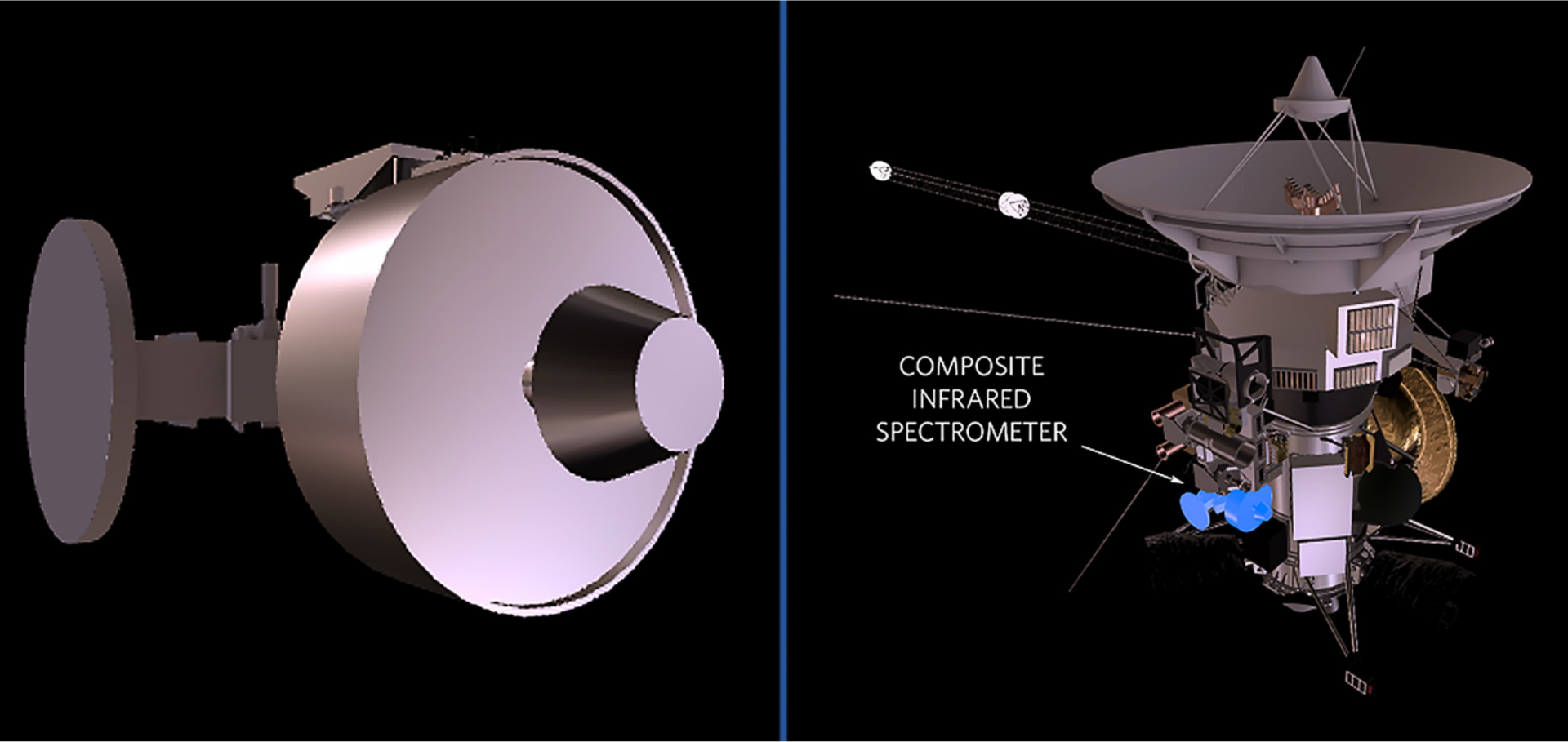
Dione's thermal inertia and bolometric Bond albedo derived from Cassini/CIRS observations of solar eclipse ingress

The Planetary Science Journal IOP Publishing 3:8 (2022) 192

Authors:

Carly JA Howett, John R Spencer

Abstract:

On 2010 May 18 Cassini's Composite Infrared Spectrometer (CIRS) observed Dione's leading hemisphere as its surface went into solar eclipse. Surface temperatures derived from each of CIRS' focal plane 3 (FP3, 600−1100 cm−1) show a rapid decrease in Dione's surface temperature upon eclipse ingress. This change was compared to the model surface emission to constrain bolometric Bond albedo and thermal inertia. Seven FP3 detectors were able to constrain the observed surface's thermophysical properties. The bolometric Bond albedo derived from these detectors are consistent with one another (0.54 ± 0.05 to 0.62 ± 0.03) and that of diurnal studies (e.g., 0.49 ± 0.11, Howett et al. 2014). This indicates that Dione's albedo is uniform to within the uncertainties across the observed region of its leading hemisphere. The derived thermal inertias are consistent across detectors, 9 ± 4 J m−2 K−1 s−1/2 (MKS) to 16 ± 8 MKS, and with previous diurnal studies (e.g., 8 to 12 MKS, Howett et al. 2014). The skin depth probed by the eclipse thermal wave is ∼0.6–1 mm, which is much shallower than that probed by diurnal cycles (∼50 mm). Thus, the agreement in thermal inertia between the eclipse and diurnal studies indicates that Dione's subsurface structure is uniform from submillimeter to subcentimeter depths. This is different from the Jovian system, where eclipse-derived thermal inertias are much lower than those derived from diurnal studies. The cause of this difference is not known, but one possibility is that the E-ring grains that bombard Dione's leading hemisphere overturn it, causing uniformity to centimeter depths.

Visible and infrared spectral analysis of the Winchcombe Meteorite for comparison with planetary Surfaces

Proceedings of the 85th Annual Meeting of the Meteoritical Society (MetSoc 2022) Wiley 57:S1 (2022)

Authors:

Ka Shirley, Rj Curtis, Hc Bates, Aj King, Ne Bowles

Modeling Thermal Emission under Lunar Surface Environmental Conditions

The Planetary Science Journal American Astronomical Society 3:7 (2022) 180

Authors:

Parvathy Prem, Benjamin T Greenhagen, Kerri L Donaldson Hanna, Katherine A Shirley, Timothy D Glotch

Charon’s refractory factory

Science Advances American Association for the Advancement of Science 8:24 (2022) eabq5701

Authors:

Ujjwal Raut, Benjamin D Teolis, Joshua A Kammer, Caleb J Gimar, Joshua S Brody, G Randall Gladstone, Carly JA Howett, Silvia Protopapa, Kurt D Retherford

Abstract:

We combine novel laboratory experiments and exospheric modeling to reveal that “dynamic” Ly-α photolysis of Plutonian methane generates a photolytic refractory distribution on Charon that increases with latitude, consistent with poleward darkening observed in the New Horizons images. The flux ratio of the condensing methane to the interplanetary medium Ly-α photons, φ, controls the distribution and composition of Charon’s photoproducts. Mid-latitude regions are likely to host complex refractories emerging from low-φ photolysis, while high-φ photolysis at the polar zones primarily generate ethane. However, ethane being colorless does not contribute to the reddish polar hue. Solar wind radiolysis of Ly-α–cooked polar frost past spring sunrise may synthesize increasingly complex, redder refractories responsible for the unique albedo on this enigmatic moon.