

Relationships between HCl, H2 O, aerosols, and temperature in the Martian atmosphere Part II: quantitative correlations
University of Oxford (2024)
Abstract:
Data generated for and supporting the the Publication: Relationships between HCl, H2O, aerosols, and temperature in the Martian atmosphere Part II: quantitative correlationsTailoring Infrared Filters for Global Mapping of Enceladus' Surface Temperatures
Curran Associates (2024) 935-941
Helene's surface properties from a photometric multi-wavelength analysis
Icarus 392 (2023)
Abstract:
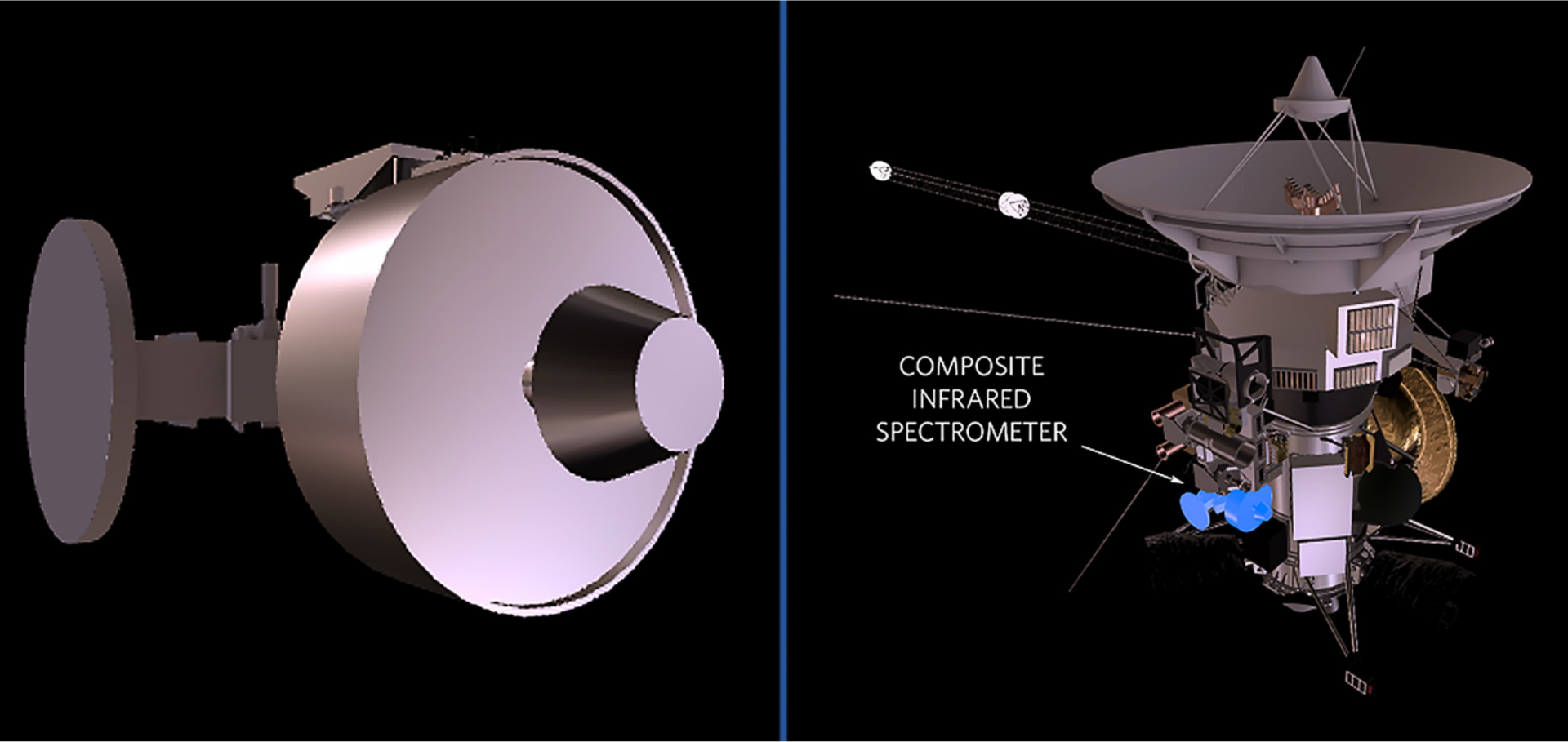
On January 31, 2011, the remote-sensing instruments onboard the Cassini spacecraft (UVIS (Ultraviolet Imaging Spectrograph; ISS (Imaging Science Subsystem); VIMS (Visual and Infrared Mapping Spectrometer) and CIRS (Composite Infrared Spectrometer)) observed Helene, Dione's leading Lagrangian moon. We report here on the photometric characteristics of Helene between 0.11 μm and 5.2 μm. We find that Helene's spectrum is dominated by the signature of water-ice and we retrieve a grain size of 3.4 μm in the ultraviolet. At all wavelengths, Helene shows signs of being a relatively fresh surface less affected by space weathering effects than other observed surfaces in the Saturn system. We present the first phase curve of Helene at 0.61 μm and place our ultraviolet and near-IR results in a wider spectral context toward a better understanding of Helene's surface evolution. Previous studies suggested that either a recent impact on Helene or an asymmetric flux of E-ring particles could explain the satellite high surface brightness (Hedman et al., 2020). Results from this study favor the impactor hypothesis to explain Helene's photometric behavior.Ultraviolet and visible reflectance spectra of Phobos and Deimos as measured by the ExoMars-TGO/Nomad-UVIS spectrometer
Journal of Geophysical Research: Planets Wiley 128:12 (2023) e2023JE008002
Abstract:
Spectroscopic measurements are a powerful tool to investigate the surface composition of airless bodies and provide clues of their origin. The composition and origin of Phobos and Deimos are still unknown and are currently widely debated. We present spectroscopic measurements of Phobos and Deimos at ultraviolet and visible wavelengths (250–650 nm) made by the NOMAD-Ultraviolet and Visible Spectrometer (UVIS) on the ExoMars TGO mission. These new spectra cover multiple areas on Phobos and Deimos, and are of generally higher spectral resolution and signal-to-noise than previous spectra, and extend to lower wavelengths than most previous measurements. The UVIS spectra confirm a red-sloped spectrum lacking any strong absorption features; however, we confirm the presence of a previously identified absorption feature near 0.65 μm and tentative absorption near 0.45 μm. The observed Phobos and Deimos spectra are similar to D- and T-type asteroids, adding weight to the captured asteroid hypothesis for the moons' origins. We also find, however, that the UVIS Phobos reflectance spectra of Phobos' red unit is a relatively close match to the olivine-rich, highly shocked Mars meteorite NWA 2737, with a low overall reflectance, a red-sloped spectrum, and lack of olivine-associated absorption bands in the UVIS spectral range. This meteorite, however, exhibits spectral features at longer wavelengths that not observed in the Martian moon spectra, indicating a need for further investigation at longer wavelengths to interpret whether this material could inform our understanding of Phobos' origin.The radiometric environment for Mars limb observations by the Mars Sample Return Earth Return Orbiter
Advances in Space Research Elsevier 72:9 (2023) 4048-4063