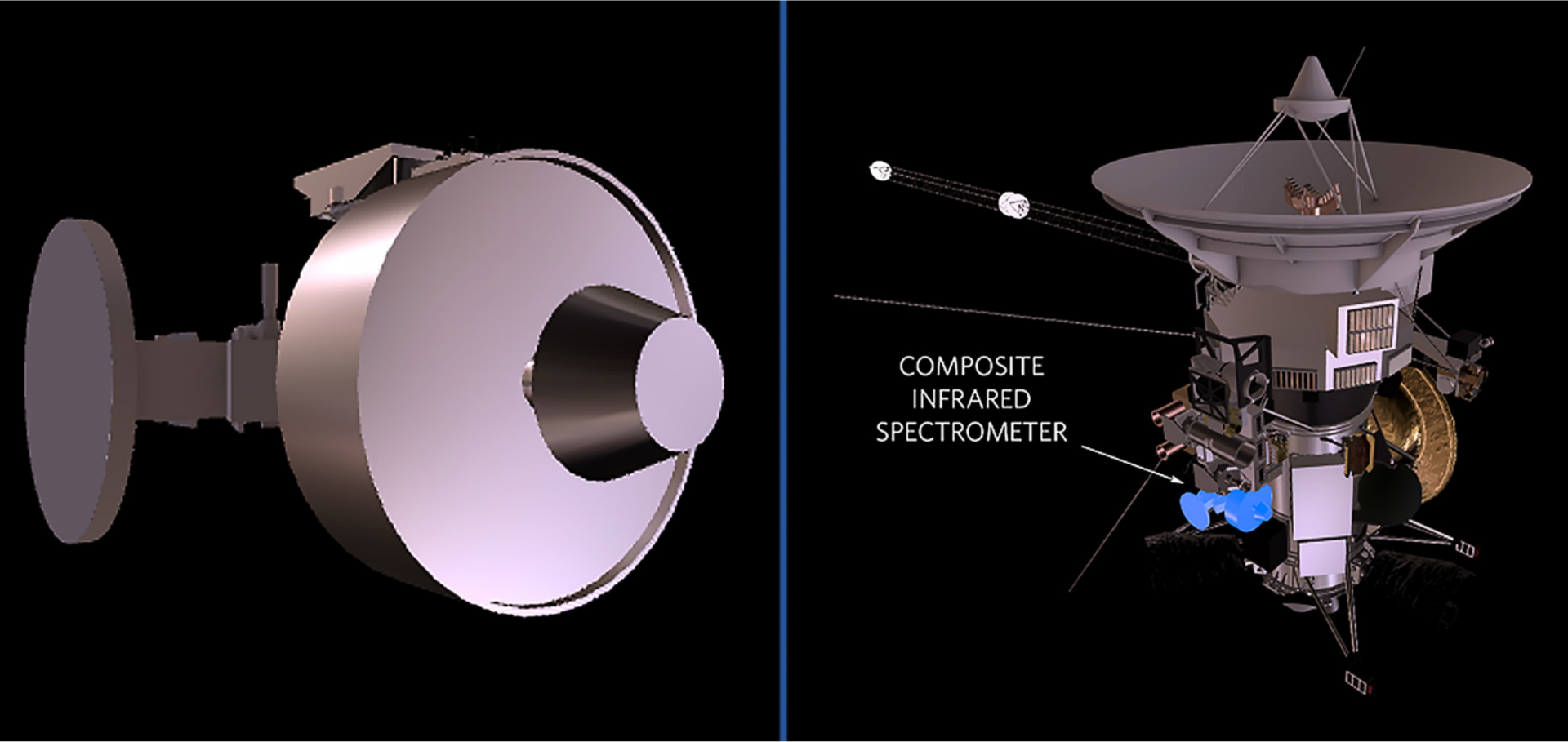
Cassini composite infrared spectrometer: correcting an offset error and refining the pointing parameters for the midinfrared detectors.

Applied Optics Optica Publishing Group 62:22 (2023) 5882-5888

Authors:

John C Pearl, Conor A Nixon, Donald E Jennings, Shahid Aslam, Simon Calcutt, Monte S Kaelberer, Nicolas Gorius, Richard K Achterberg, Paul N Romani, Gordon L Bjoraker, Michael Flasar

Abstract:

Based on preflight laboratory testing, an unexpectedly large positional offset between the two midinfrared (mid-IR) detector arrays in the Cassini composite infrared spectrometer (CIRS) instrument has been noted in the literature. A much smaller offset was measured in-flight. We investigate this discrepancy by estimating several spatial relationships among the detectors and comparing these results with three independent data sets. This enables us to infer the probable cause of this offset and to derive a new reduced value. We comment on the effect that this change could have on previously published results involving CIRS data. We also present a graphical display of the arrays projected on the sky as CIRS would see it.

Solar Energetic Particle Events Detected in the Housekeeping Data of the European Space Agency's Spacecraft Flotilla in the Solar System

Space Weather American Geophysical Union (AGU) 21:8 (2023)

Authors:

Beatriz Sánchez‐Cano, Olivier Witasse, Elise W Knutsen, Dikshita Meggi, Shayla Viet, Mark Lester, Robert F Wimmer‐Schweingruber, Marco Pinto, Richard Moissl, Johannes Benkhoff, Hermann Opgenoorth, Uli Auster, Jos de Brujine, Peter Collins, Guido De Marchi, David Fischer, Yoshifumi Futaana, James Godfrey, Daniel Heyner, Mats Holmstrom, Andrew Johnstone, Simon Joyce, Daniel Lakey, Santa Martinez, David Milligan, Elsa Montagnon, Daniel Müller, Stefano A Livi, Timo Prusti, Jim Raines, Ingo Richter, Daniel Schmid, Peter Schmitz, Håkan Svedhem, Matt GGT Taylor, Elena Tremolizzo, Dimitri Titov, Colin Wilson, Simon Wood, Joe Zender

Bolometric Hemispherical Albedo Map of Pluto from New Horizons Observations

The Planetary Science Journal IOP Publishing 4:7 (2023) 132-132

Authors:

Jason D Hofgartner, Bonnie J Buratti, Ross A Beyer, Kimberly Ennico, Will M Grundy, Carly JA Howett, Perianne E Johnson, Tod R Lauer, Catherine B Olkin, John R Spencer, S Alan Stern, Harold A Weaver, Leslie A Young

Abstract:

The New Horizons encounter with the Pluto system revealed Pluto to have an extremely spatially variable surface with expansive dark, bright, and intermediate terrains, refractory and volatile ices, and ongoing/recent endogenous and exogenous processes. Albedo is useful for understanding volatile transport because it quantifies absorbed solar energy; albedo may also provide insights into surface processes. Four filters of the New Horizons LORRI and MVIC imagers are used to approximate the bolometric (flux-weighted, wavelength-integrated) albedo. The bolometric hemispherical albedo (local energy balance albedo) as a function of the incidence angle of the solar illumination is measured for both Cthulhu and Sputnik Planitia, which are extensive, extreme dark and extreme bright terrains on Pluto. For both terrains, the bolometric hemispherical albedo increases by >30% from 0° to 90° incidence. The incidence-angle-average bolometric hemispherical albedo of Cthulhu is 0.12 ± 0.01, and that of Sputnik Planitia is 0.80 ± 0.06, where uncertainties are estimates based on scatter from different photometric functional approximations. The bolometric Bond albedo (global energy balance albedo) of Cthulhu is 0.12 ± 0.01, and that of Sputnik Planitia is 0.80 ± 0.07. A map of Pluto’s incidence-angle-average bolometric hemispherical albedo is produced. The incidence-angle-average bolometric hemispherical albedo, spatially averaged over areas north of ≈30° S, is ≈0.54. Pluto has three general albedo categories: (1) very low albedo southern equatorial terrains, including Cthulhu; (2) high-albedo terrains, which constitute most of Pluto’s surface; and (3) very high albedo terrains, including Sputnik Planitia. Pluto’s extraordinary albedo variability with location is also spatially sharp at some places

Bidirectional reflectance distribution function measurements of the Winchcombe meteorite using the Visible Oxford Space Environment Goniometer

Meteoritics and Planetary Science Wiley 59:5 (2023) 1029-1042

Authors:

Rowan Curtis, Hc Bates, TJ Warren, KA Shirley, EC Brown, Aj King, NE Bowles

Abstract:

A laboratory study was performed using the Visible Oxford Space Environment Goniometer in which the broadband (350–1250 nm) bidirectional reflectance distribution function (BRDF) of the Winchcombe meteorite was measured, across a range of viewing angles—reflectance: 0°–70°, in steps of 5°; incidence: 15°, 30°, 45°, and 60°; and azimuthal: 0°, 90°, and 180°. The BRDF dataset was fitted using the Hapke BRDF model to (1) provide a method of comparison to other meteorites and asteroids, and (2) to produce Hapke parameter values that can be used to extrapolate the BRDF to all angles. The study deduced the following Hapke parameters for Winchcombe: w = 0.152 ± 0.030, b = 0.633 ± 0.064, and hS = 0.016 ± 0.008, demonstrating that it has a similar w value to Tagish Lake (0.157 ± 0.020) and a similar b value to Orgueil (0.671 ± 0.090). Importantly, the surface profile of the sample was characterized using an Alicona 3D® instrument, allowing two of the free parameters within the Hapke model φ and (Formula presented.), which represent porosity and surface roughness, respectively, to be constrained as φ = 0.649 ± 0.023 and (Formula presented.) = 16.113° (at 500 μm size scale). This work serves as part of the characterization process for Winchcombe and provides a reference photometry dataset for current and future asteroid missions.

Photochemical depletion of heavy CO isotopes in the Martian atmosphere

Nature Astronomy Springer Nature 7:7 (2023) 867-876

Authors:

Juan Alday, Alexander Trokhimovskiy, Manish R Patel, Anna A Fedorova, Franck Lefevre, Franck Montmessin, James A Holmes, Kylash Rajendran, Jon P Mason, Kevin S Olsen, Denis A Belyaev, Oleg Korablev, Lucio Baggio, Andrey Patrakeev, Alexey Shakun

Abstract:

The atmosphere of Mars is enriched in heavy isotopes with respect to Earth as a result of the escape of the atmosphere to space over billions of years. Estimating this enrichment requires a rigorous understanding of all atmospheric processes that contribute to the evolution of isotopic ratios between the lower and upper atmosphere, where escape processes take place. We combine measurements of CO vertical profiles obtained by the Atmospheric Chemistry Suite on board the ExoMars Trace Gas Orbiter with the predictions of a photochemical model and find evidence of a process of photochemistry-induced fractionation that depletes the heavy isotopes of C and O in CO (δ13C = −160 ± 90‰ and δ18O = −20 ± 110‰). In the upper atmosphere, accounting for this process reduces the escape fractionation factor by ~25%, suggesting that less C has escaped from the atmosphere of Mars than previously thought. In the lower atmosphere, incorporation of this 13C-depleted CO fractionation into the surface could support the abiotic origin of recently found Martian organics.