Bayes versus the virial theorem: inferring the potential of a galaxy from a kinematical snapshot
Monthly Notices of the Royal Astronomical Society 437:3 (2014) 2230-2248
Abstract:
I present a new framework for estimating a galaxy's gravitational potential, Phi, from its stellar kinematics. It adopts a fully non-parametric model for the galaxy's unknown phase-space distribution function, f, that takes full advantage of Jeans' theorem. Given an expression for the joint likelihood of Phi and f, the likelihood of Phi is calculated by using a Dirichlet process mixture to represent the prior on f and marginalising. I demonstrate that modelling machinery constructed using this framework is successful at recovering the potentials of some simple systems given perfect kinematical data, a situation handled effortlessly by traditional moment-based methods, such as the virial theorem, but in which the more modern extended-Schwarzschild method fails. Unlike moment-based methods, however, the models constructed using this framework can easily be generalised to take account of realistic observational errors and selection functions.A NEW STELLAR CHEMO-KINEMATIC RELATION REVEALS THE MERGER HISTORY OF THE MILKY WAY DISK
ASTROPHYSICAL JOURNAL LETTERS 781:1 (2014) ARTN L20
CoRoT 223992193: A new, low-mass, pre-main sequence eclipsing binary with evidence of a circumbinary disk
(2013)
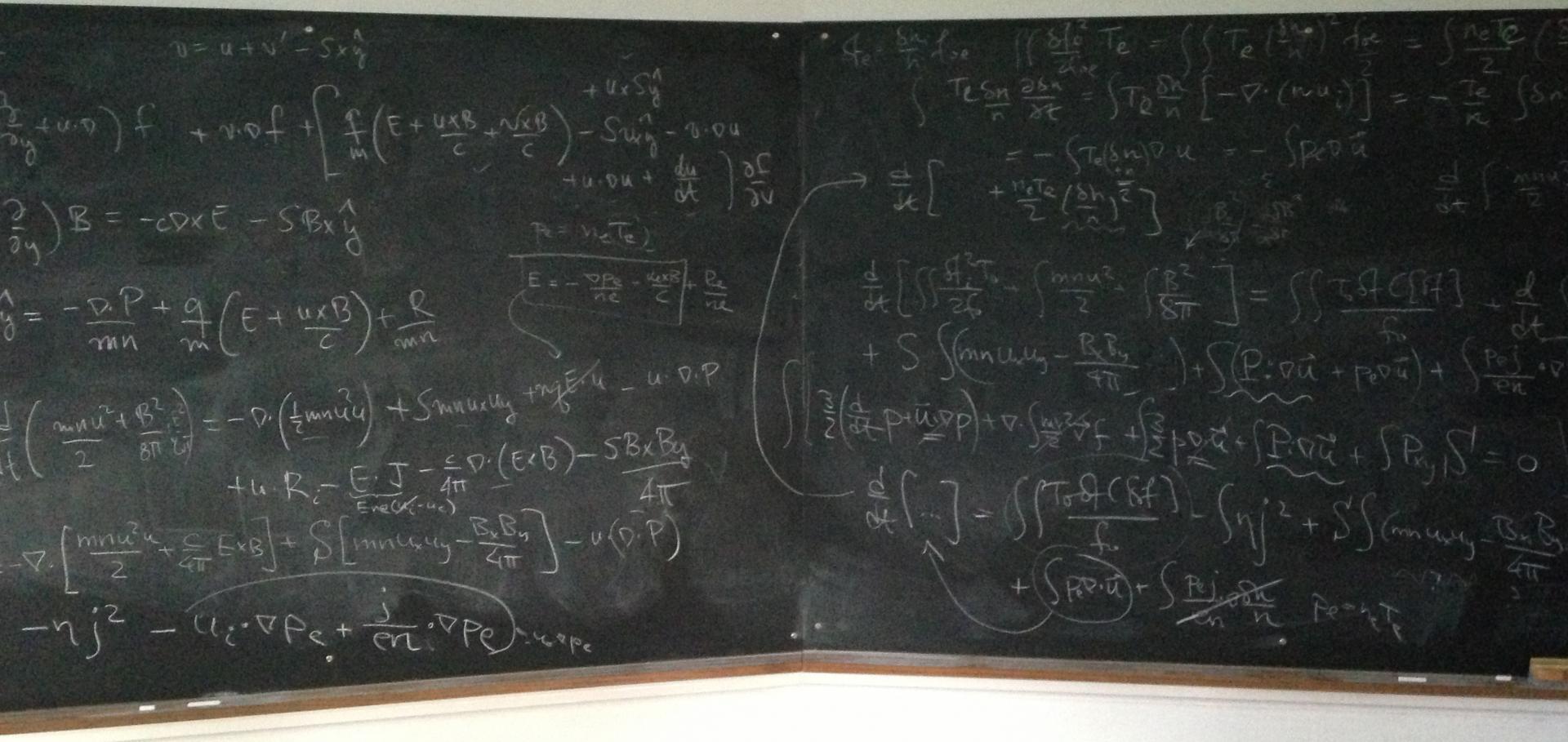
Multiscale gyrokinetics for rotating tokamak plasmas: fluctuations, transport and energy flows
Reports on Progress in Physics IOP Publishing 76:11 (2013) 116201
The radial velocity experiment (RAVE): Fourth data release
Astronomical Journal 146:5 (2013)