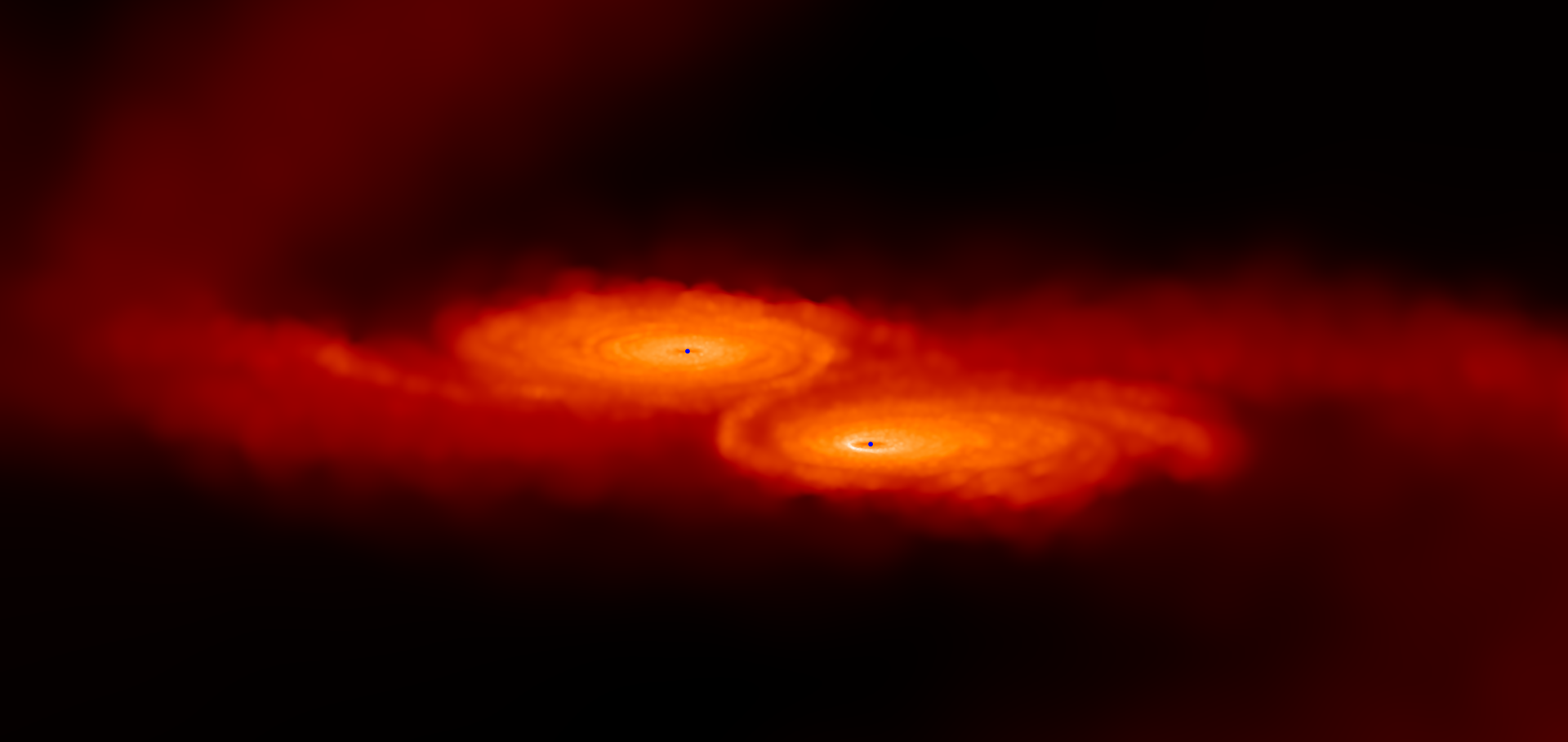
Prompt gravitational-wave mergers aided by gas in Active Galactic Nuclei: The hydrodynamics of binary-single black hole scatterings

(2025)

Authors:

Connar Rowan, Henry Whitehead, Gaia Fabj, Pankaj Saini, Bence Kocsis, Martin Pessah, Johan Samsing

Efficient micromirror confinement of sub-teraelectronvolt cosmic rays in galaxy clusters

Nature Astronomy Nature Research 9:3 (2025) 438-448

Authors:

Patrick Reichherzer, Archie Bott, Robert Ewart, Gianluca Gregori, Kempski Philipp, Kunze Matthew, Alexander Schekochihin

Abstract:

Cosmic rays (CRs) play a pivotal role in shaping the thermal and dynamical properties of astrophysical environments, such as galaxies and galaxy clusters. Recent observations suggest a stronger confinement of CRs in certain astrophysical systems than predicted by current CR-transport theories. Here, we show that the incorporation of microscale physics into CR-transport models can account for this enhanced CR confinement. We develop a theoretical description of the effect of magnetic microscale fluctuations originating from the mirror instability on macroscopic CR diffusion. We confirm our theory with large-dynamical-range simulations of CR transport in the intracluster medium (ICM) of galaxy clusters and kinetic simulations of CR transport in micromirror fields. We conclude that sub-teraelectronvolt CR confinement in the ICM is far more effective than previously anticipated on the basis of Galactic-transport extrapolations. The transformative impact of micromirrors on CR diffusion provides insights into how microphysics can reciprocally affect macroscopic dynamics and observable structures across a range of astrophysical scales.

Massive stellar triples on the edge

Astronomy & Astrophysics EDP Sciences 693 (2025) a14

Authors:

CW Bruenech, T Boekholt, F Kummer, S Toonen

Variability in footpoint mapping of bursty bulk flows using Tsyganenko models: impact on swarm conjunctions

Journal of Space Weather and Space Climate EDP Sciences 15 (2025) 41-41

Authors:

Vanina Lanabere, Andrew P Dimmock, Louis Richard, Stephan Buchert, Yuri V Khotyaintsev, Octav Marghitu

Abstract:

Magnetospheric-ionospheric coupling studies often rely on multi-spacecraft conjunctions, which require accurate magnetic field mapping tools. For example, linking measurements from the magnetotail with those in the ionosphere involves determining when the orbital magnetic footpoint of THEMIS or Magnetospheric Multiscale (MMS) intersects with the footpoint of Swarm. The Tsyganenko models are commonly used for tracing magnetic field lines. In this study, we aim to analyze how the footpoint locations are impacted by the input parameters of these models, including solar wind conditions, geomagnetic activity, and the location in the magnetotail. A dataset of 2394 bursty bulk flows (BBFs) detected by MMS was mapped to Earth’s ionosphere with six different Tsyganenko models. Approximately 90% of the ionospheric footpoints are concentrated within 70° ± 5° magnetic latitude (MLAT) and ±3 h of magnetic local time (MLT) around midnight, with a pronounced peak in the pre-midnight sector. The MLT position showed a difference of approximately ±1 h MLT across the models. Footpoint locations were linked to the dawn-dusk position of the BBFs, with differences between models associated with variations in the interplanetary magnetic field clock angle. The MLAT values exhibited similar differences of approximately ±4° around the mean value, with a systematic shift toward lower latitudes in the T89 model. This position is also influenced by the input parameters of the model representing the dynamics of Earth’s magnetosphere, where stronger magnetospheric activity typically corresponds to lower latitudes. The uncertainty on the BBF footpoint location impacts the number of conjunctions with Swarm. Generally, Swarm B exhibited more conjunctions than Swarm A or C in the Northern Hemisphere. However, when considering only Swarm-BBF conjunctions where the distance between footpoints computed with T89 and TA15n is smaller than the size of the BBF footprint, the number of conjunctions is reduced to less than half of the total.

Gargantuan chaotic gravitational three-body systems II. Dependence on angular momentum and astrophysical scale

Monthly Notices of the Royal Astronomical Society Oxford University Press (OUP) 536:3 (2024) 2993-3006

Authors:

TCN Boekholt, SF Portegies Zwart