

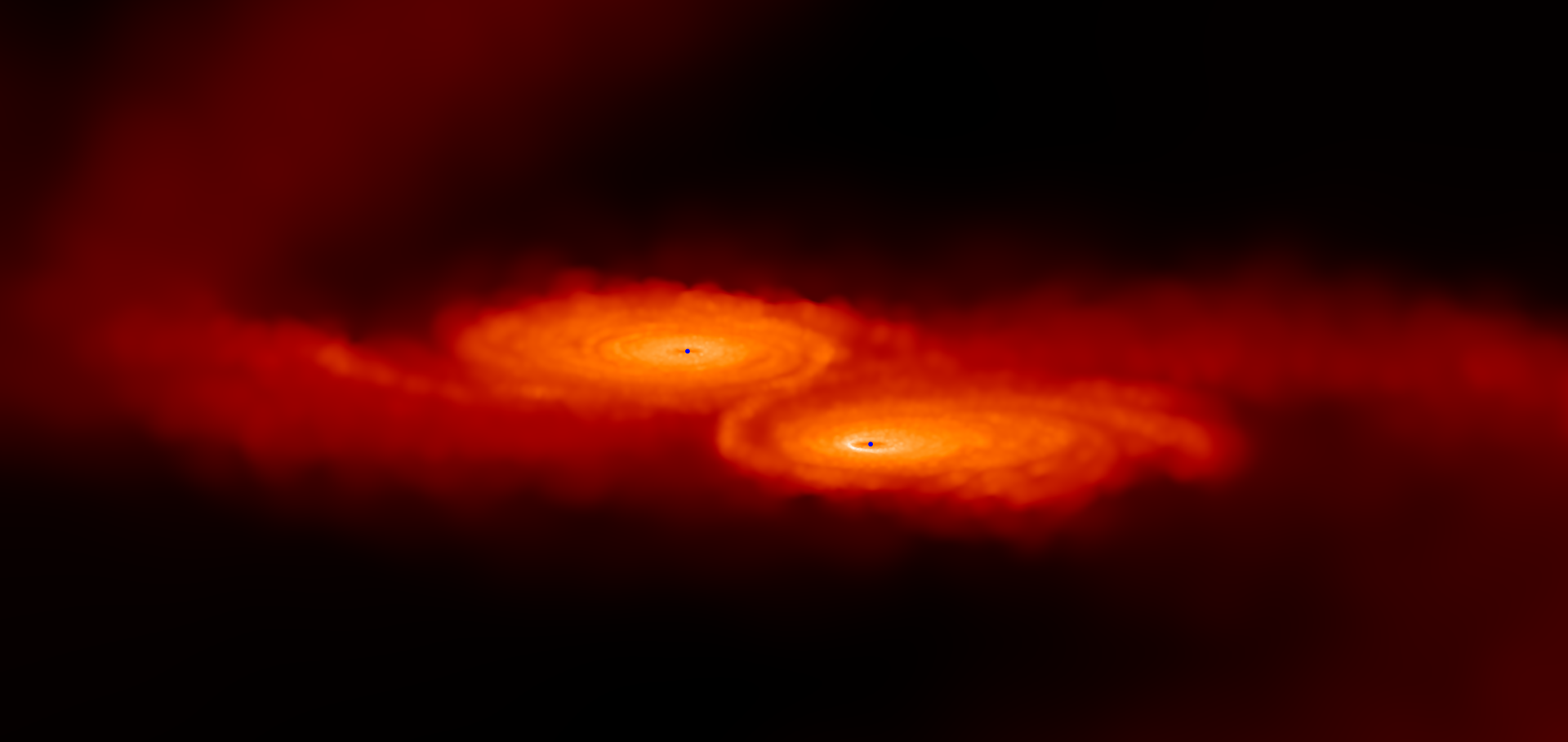
Stellar triples on the edge: Comprehensive overview of the evolution of destabilised triples leading to stellar and binary exotica
Astronomy and Astrophysics European Southern Observatory 661:5 (2022) A61
Abstract:
Context. Hierarchical triple stars are ideal laboratories for studying the interplay between orbital dynamics and stellar evolution. Both mass loss from stellar winds and strong gravitational perturbations between the inner and outer orbit cooperate to destabilise triple systems.Aims. Our current understanding of the evolution of unstable triple systems is mainly built upon results from extensive binary-single scattering experiments. However, destabilised hierarchical triples cover a different region of phase space. Therefore, we aim to construct a comprehensive overview of the evolutionary pathways of destabilised triple-star systems.
Methods. Starting from generic initial conditions, we evolved an extensive set of hierarchical triples using the code TRES, combining secular dynamics and stellar evolution. We detected those triples that destabilise due to stellar winds and/or gravitational perturbations. Their evolution was continued with a direct N-body integrator coupled to stellar evolution.
Results. The majority of triples (54–69%) preserve their hierarchy throughout their evolution, which is in contradiction with the commonly adopted picture that unstable triples always experience a chaotic, democratic resonant interaction. The duration of the unstable phase was found to be longer than expected (103 − 4 crossing times, reaching up to millions), so that long-term stellar evolution effects cannot be neglected. The most probable outcome is dissolution of the triple into a single star and binary (42–45%). This occurs through the commonly known democratic channel, during which the initial hierarchy is lost and the lightest body usually escapes, but also through a hierarchical channel, during which the tertiary is ejected in a slingshot, independent of its mass. Collisions are common (13–24% of destabilised triples), and they mostly involve the two original inner binary components still on the main sequence (77–94%). This contradicts the idea that collisions with a giant during democratic encounters dominate (only 5–12%). Together with collisions in stable triples, we find that triple evolution is the dominant mechanism for stellar collisions in the Milky Way. Lastly, our simulations produce runaway and walk-away stars with speeds up to several tens of km/s, with a maximum of a few 100 km s−1. We suggest that destabilised triples can explain – or at least alleviate the tension behind – the origin of the observed (massive) runaway stars.
Conclusions. A promising indicator for distinguishing triples that will follow the democratic or hierarchical route, is the relative inclination between the inner and outer orbits. Its influence can be summed up in two rules of thumb: (1) prograde triples tend to evolve towards hierarchical collisions and ejections, and (2) retrograde triples tend to evolve towards democratic encounters and a loss of initial hierarchy, unless the system is compact, which experience collision preferentially. The trends found in this work complement those found previously from binary-single scattering experiments, and together they will help to generalise and improve our understanding on the evolution of unstable triple systems of various origins.
Extended electron tails in electrostatic microinstabilities and the nonadiabatic response of passing electrons
Plasma Physics and Controlled Fusion IOP Publishing 64:5 (2022) 055004-055004
Abstract:
Interpreting radial correlation Doppler reflectometry using gyrokinetic simulations
Plasma Physics and Controlled Fusion 64:5 (2022)
Abstract:
A linear response, local model for the DBS amplitude applied to gyrokinetic simulations shows that radial correlation Doppler reflectometry measurements (RCDR, Schirmer et al 2007 Plasma Phys. Control. Fusion 49 1019) are not sensitive to the average turbulence radial correlation length, but to a correlation length that depends on the binormal wavenumber k⊥ selected by the Doppler backscattering (DBS) signal. Nonlinear gyrokinetic simulations show that the turbulence naturally exhibits a nonseparable power law spectrum in wavenumber space, leading to a power law dependence of the radial correlation length with binormal wavenumber lr∼Ck⊥-α(α≈1) which agrees with the inverse proportionality relationship between the measured lr and k⊥ observed in experiments (Fernández-Marina et al 2014 Nucl. Fusion 54 072001). This new insight indicates that RCDR characterizes the eddy aspect ratio in the perpendicular plane to the magnetic field. It also motivates future use of a nonseparable turbulent spectrum to quantitatively interpret RCDR and potentially other turbulence diagnostics. The radial correlation length is only measurable when the radial resolution at the cutoff location Wn satisfies Wn≪lr, while the measurement becomes dominated by Wn for Wn≫lr . This suggests that lr is likely to be inaccessible for electron-scale DBS measurements (k⊥ρs>1 ). The effect of Wn on ion-scale radial correlation lengths could be nonnegligible.Magnetic massive stars from stellar mergers
Proceedings of the International Astronomical Union Cambridge University Press (CUP) 18:S361 (2022) 212-217
Spontaneous magnetization of collisionless plasma.
Proceedings of the National Academy of Sciences of the United States of America 119:19 (2022) e2119831119