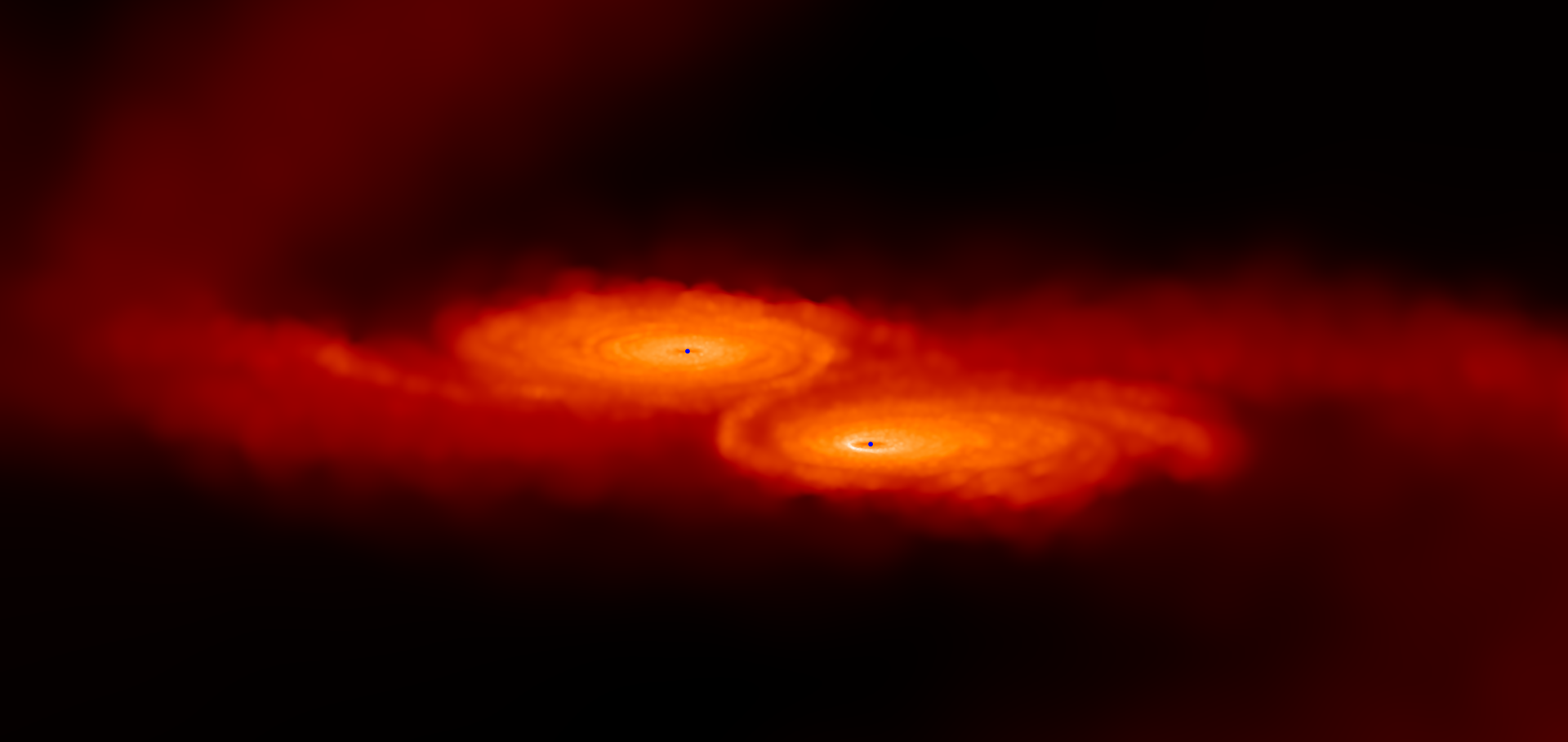
AGN as Potential Factories for Eccentric Black Hole Mergers

(2020)

Authors:

J Samsing, I Bartos, DJ D'Orazio, Z Haiman, B Kocsis, NWC Leigh, B Liu, ME Pessah, H Tagawa

Observations of Pressure Anisotropy Effects within Semi-Collisional Magnetized-Plasma Bubbles

(2020)

Authors:

ER Tubman, AS Joglekar, AFA Bott, M Borghesi, B Coleman, G Cooper, CN Danson, P Durey, JM Foster, P Graham, G Gregori, ET Gumbrell, MP Hill T Hodge, S Kar, RJ Kingham, M Read, CP Ridgers, J Skidmore, C Spindloe, AGR Thomas, P Treadwell, S Wilson, L Willingale, NC Woolsey

Elasticity of tangled magnetic fields

Journal of Plasma Physics Cambridge University Press 86:5 (2020) 905860511

Authors:

DN Hosking, Aa Schekochihin, Steven Balbus

Abstract:

The fundamental difference between incompressible ideal magnetohydrodynamics and the dynamics of a non-conducting fluid is that magnetic fields exert a tension force that opposes their bending; magnetic fields behave like elastic strings threading the fluid. It is natural, therefore, to expect that a magnetic field tangled at small length scales should resist a large-scale shear in an elastic way, much as a ball of tangled elastic strings responds elastically to an impulse. Furthermore, a tangled field should support the propagation of ‘magnetoelastic waves’, the isotropic analogue of Alfvén waves on a straight magnetic field. Here, we study magnetoelasticity in the idealised context of an equilibrium tangled field configuration. In contrast to previous treatments, we explicitly account for intermittency of the Maxwell stress, and show that this intermittency necessarily decreases the frequency of magnetoelastic waves in a stable field configuration. We develop a mean-field formalism to describe magnetoelastic behaviour, retaining leading-order corrections due to the coupling of large- and small-scale motions, and solve the initial-value problem for viscous fluids subjected to a large-scale shear, showing that the development of small-scale motions results in anomalous viscous damping of large-scale waves. Finally, we test these analytic predictions using numerical simulations of standing waves on tangled, linear force-free magnetic-field equilibria.

Probability distribution of astrophysical gravitational-wave background fluctuations

Physical Review D American Physical Society (APS) 102:8 (2020) 083501

Authors:

Yonadav Barry Ginat, Vincent Desjacques, Robert Reischke, Hagai B Perets

Detecting Kozai–Lidov Imprints on the Gravitational Waves of Intermediate-mass Black Holes in Galactic Nuclei

The Astrophysical Journal American Astronomical Society 901:2 (2020) 125-125

Authors:

Barnabás Deme, Bao-Minh Hoang, Smadar Naoz, Bence Kocsis