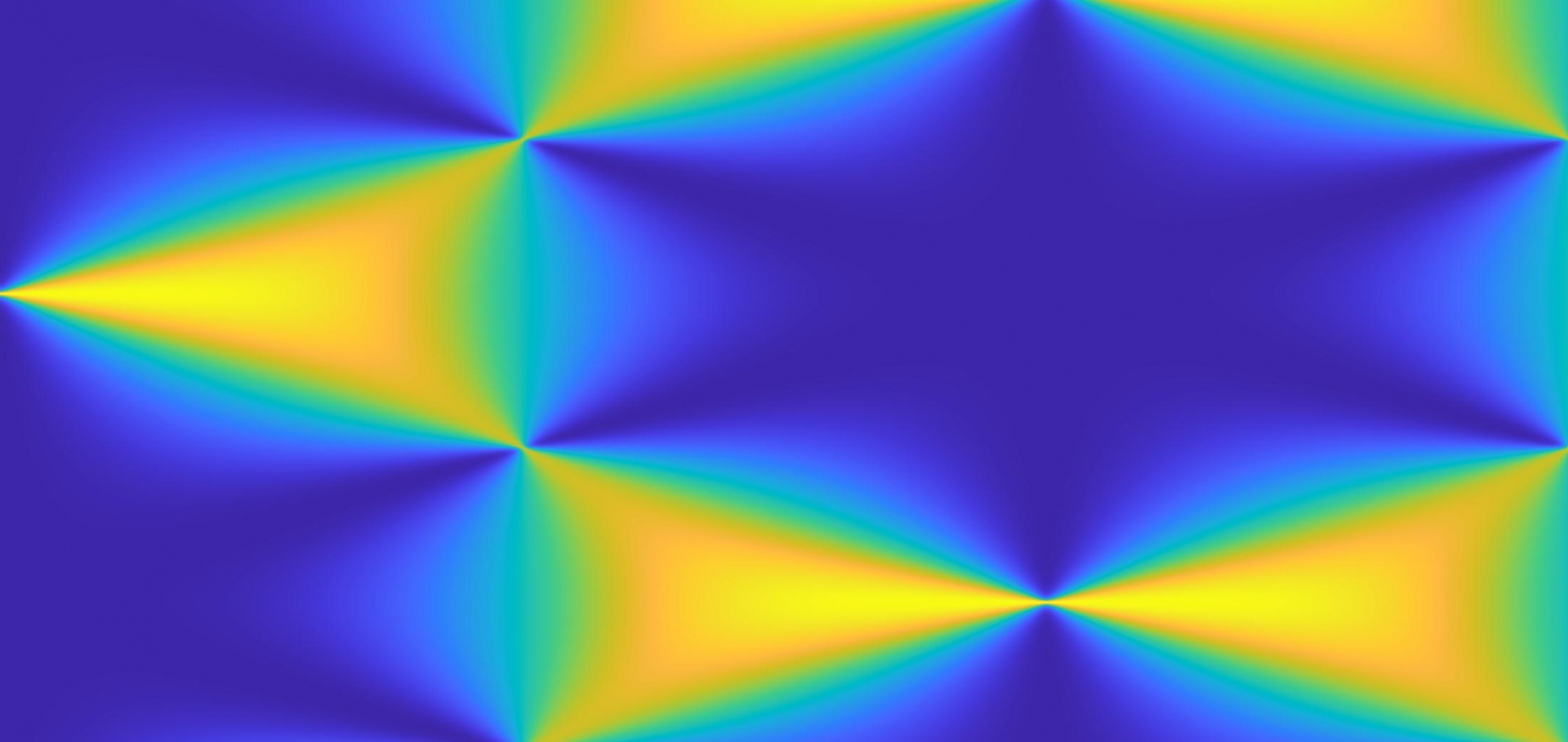
From equilibrium multistability to spatiotemporal chaos in channel flows of nematic fluids
Journal of Fluid Mechanics Cambridge University Press (CUP) 1038 (2026) A51
Abstract:
Multi-phase field model reveals internal dissipation is crucial for spontaneous hole formation in cell monolayers
Nature Communications Springer Nature (2026)
Abstract:
Although cell monolayers typically remain confluent, they can spontaneously develop persistent holes as a result of collective cellular motion. Recent studies on MDCK monolayers cultured on soft substrates have revealed that cells can align to create regions of local nematic order, and topological defects that generate localised mechanical stresses which can spontaneously trigger hole formation. To investigate this process, we develop a continuum multi-phase field model that incorporates internal dissipation and active dipolar forces that drive cell shape anisotropy. Our simulations show that reducing substrate friction enhances cell-cell velocity correlations. In the low-friction regime, topological defects generate spiral flow patterns that concentrate stress and can trigger hole formation. By contrast, in the high-friction regime, holes do not nucleate. We further demonstrate that the number and stability of the holes—whether they close or persist—depends on both substrate friction and cellular activity, through a non-dimensional friction number. These findings highlight the importance of internal dissipation in modelling collective cell motion and the critical role of collective dynamics in maintaining tissue integrity.Efficient quantum thermal state preparation via local driving: Lindbladian simulation with provable guarantees
Physical Review B American Physical Society (APS) 114:1 (2026) 14302
Abstract:
<jats:p> Preparing the thermal density matrix <a:math xmlns:a="http://www.w3.org/1998/Math/MathML"> <a:mrow> <a:msub> <a:mi>ρ</a:mi> <a:mi>β</a:mi> </a:msub> <a:mo>∝</a:mo> <a:msup> <a:mi>e</a:mi> <a:mrow> <a:mo>−</a:mo> <a:mi>β</a:mi> <a:mi>H</a:mi> </a:mrow> </a:msup> </a:mrow> </a:math> corresponding to a given Hamiltonian <b:math xmlns:b="http://www.w3.org/1998/Math/MathML"> <b:mi>H</b:mi> </b:math> is a task of central interest across quantum many-body physics, and is particularly salient when attempting to study it with quantum computers. Although solved in principle by recent constructions of efficiently simulable Lindblad master equations—that provably have <c:math xmlns:c="http://www.w3.org/1998/Math/MathML"> <c:msub> <c:mi>ρ</c:mi> <c:mi>β</c:mi> </c:msub> </c:math> as a steady state [C.-F. Chen , ]—the implementation of these “exact Gibbs samplers” requires large-scale quantum computing resources and is hence challenging in practice on current or even near-term quantum devices. Here, we propose a scheme for approximately simulating an exact Gibbs sampler up to a rigorously bounded error that only requires the (repeated) implementation of three readily available ingredients: (a) analog simulation of <d:math xmlns:d="http://www.w3.org/1998/Math/MathML"> <d:mi>H</d:mi> </d:math> ; (b) strictly local but time-dependent couplings to ancilla qubits; and (c) reset of the ancillas. We give rigorous guarantees on the difference between the fixed point reached by our protocol and the exact thermal state, which only depend on parameters of the protocol and its . The procedure is efficiently implementable on near-term devices if <e:math xmlns:e="http://www.w3.org/1998/Math/MathML"> <e:mi>H</e:mi> </e:math> is local and the mixing time scales mildly with both system size and protocol parameters. While guaranteeing the latter for Hamiltonians of interest remains an important problem for future work, here we lay the groundwork for developing fully efficient thermal state preparation protocols on quantum simulators. </jats:p>A minimal mechanically consistent model of smoothly dividing disk-shaped cells
npj Systems Biology and Applications Springer Nature 12:1 (2026) 91