

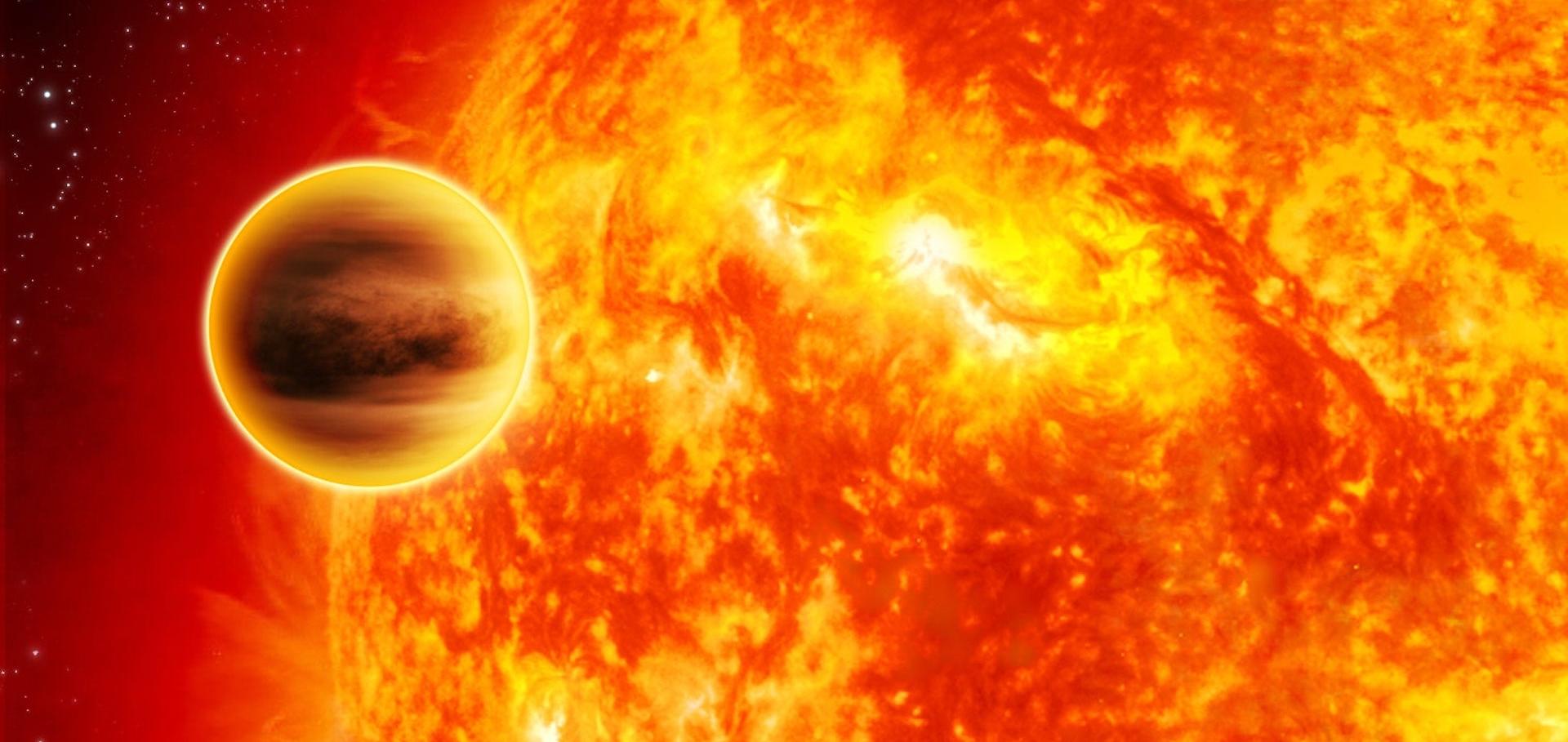
A reflective, metal-rich atmosphere for GJ 1214b from its JWST phase curve
Nature Springer Nature 620 (2023) 67-71
Abstract:
There are no planets intermediate in size between Earth and Neptune in our Solar System, yet these objects are found around a substantial fraction of other stars [1]. Population statistics show that close-in planets in this size range bifurcate into two classes based on their radii [2, 3]. It is hypothesized that the group with larger radii (referred to as "sub-Neptunes") is distinguished by having hydrogen-dominated atmospheres that are a few percent of the total mass of the planets [4]. GJ 1214b is an archetype sub-Neptune that has been observed extensively using transmission spectroscopy to test this hypothesis [5-14]. However, themeasured spectra are featureless, and thus inconclusive, due to the presence of high-altitude aerosols in the planet's atmosphere. Here we report a spectroscopic thermal phase curve of GJ 1214b obtained with JWST in the mid-infrared. The dayside and nightside spectra (average brightness temperatures of 553 ± 9 and 437 ± 19 K, respectively) each show >3σ evidence of absorption features, with H2O as the most likely cause in both. The measured global thermal emission implies that GJ 1214b's Bond albedo is 0.51 ± 0.06. Comparison between the spectroscopic phase curve data and three-dimensional models of GJ 1214b reveal a planet with a high metallicity atmosphere blanketed by a thick and highly reflective layer of clouds or haze.Applying a temporal systematics model to vector Apodizing Phase Plate coronagraphic data: TRAP4vAPP
(2023)
Applying a temporal systematics model to vector Apodizing Phase Plate coronagraphic data: TRAP4vAPP
Astronomy & Astrophysics EDP Sciences 674 (2023) A115-A115
Abstract:
The vector Apodizing Phase Plate (vAPP) is a pupil plane coronagraph that suppresses starlight by forming a dark hole in its point spread function (PSF). The unconventional and non-axisymmetrical PSF arising from the phase modification applied by this coronagraph presents a special challenge to post-processing techniques. We aim to implement a recently developed post-processing algorithm, temporal reference analysis of planets (TRAP) on vAPP coronagraphic data. The property of TRAP that uses non-local training pixels, combined with the unconventional PSF of vAPP, allows for more flexibility than previous spatial algorithms in selecting reference pixels to model systematic noise. Datasets from two types of vAPPs are analysed: a double grating-vAPP (dgvAPP360) that produces a single symmetric PSF and a grating-vAPP (gvAPP180) that produces two D-shaped PSFs. We explore how to choose reference pixels to build temporal systematic noise models in TRAP for them. We then compare the performance of TRAP with previously implemented algorithms that produced the best signal-to-noise ratio (S/N) in companion detections in these datasets. We find that the systematic noise between the two D-shaped PSFs is not as temporally associated as expected. Conversely, there is still a significant number of systematic noise sources that are shared by the dark hole and the bright side in the same PSF. We should choose reference pixels from the same PSF when reducing the dgvAPP360 dataset or the gvAPP180 dataset with TRAP. In these datasets, TRAP achieves results consistent with previous best detections, with an improved S/N for the gvAPP180 dataset.Comment: 15 pages, 10 figures, accepted to A&Photochemically produced SO2 in the atmosphere of WASP-39b
Nature Nature Research 617:7961 (2023) 483-487
Abstract:
Photochemistry is a fundamental process of planetary atmospheres that regulates the atmospheric composition and stability1. However, no unambiguous photochemical products have been detected in exoplanet atmospheres so far. Recent observations from the JWST Transiting Exoplanet Community Early Release Science Program2,3 found a spectral absorption feature at 4.05 μm arising from sulfur dioxide (SO2) in the atmosphere of WASP-39b. WASP-39b is a 1.27-Jupiter-radii, Saturn-mass (0.28 MJ) gas giant exoplanet orbiting a Sun-like star with an equilibrium temperature of around 1,100 K (ref. 4). The most plausible way of generating SO2 in such an atmosphere is through photochemical processes5,6. Here we show that the SO2 distribution computed by a suite of photochemical models robustly explains the 4.05-μm spectral feature identified by JWST transmission observations7 with NIRSpec PRISM (2.7σ)8 and G395H (4.5σ)9. SO2 is produced by successive oxidation of sulfur radicals freed when hydrogen sulfide (H2S) is destroyed. The sensitivity of the SO2 feature to the enrichment of the atmosphere by heavy elements (metallicity) suggests that it can be used as a tracer of atmospheric properties, with WASP-39b exhibiting an inferred metallicity of about 10× solar. We further point out that SO2 also shows observable features at ultraviolet and thermal infrared wavelengths not available from the existing observationsCarbon monoxide emission lines reveal an inverted atmosphere in the ultra hot Jupiter WASP-33 b consistent with an eastward hot spot
Monthly Notices of the Royal Astronomical Society Oxford University Press (OUP) 522:2 (2023) 2145-2170