

Revisiting K2-233 spectroscopic time-series with multidimensional Gaussian processes
Monthly Notices of the Royal Astronomical Society Oxford University Press 522:3 (2023) 3458-3471
Abstract:
Detecting planetary signatures in radial velocity time-series of young stars is challenging due to their inherently strong stellar activity. However, it is possible to learn information about the properties of the stellar signal by using activity indicators measured from the same stellar spectra used to extract radial velocities. In this manuscript, we present a reanalysis of spectroscopic High Accuracy Radial Velocity Planet Searcher data of the young star K2-233, which hosts three transiting planets. We perform a multidimensional Gaussian process regression on the radial velocity and the activity indicators to characterize the planetary Doppler signals. We demonstrate, for the first time on a real data set, that the use of a multidimensional Gaussian process can boost the precision with which we measure the planetary signals compared to a one-dimensional Gaussian process applied to the radial velocities alone. We measure the semi-amplitudes of K2-233 b, c, and d as 1.31+0.81−0.74, 1.81+0.71−0.67, and 2.72+0.66−0.70 m s−1, which translate into planetary masses of 2.4+1.5−1.3, 4.6+1.8−1.7, and 10.3+2.4−2.6 M⊕, respectively. These new mass measurements make K2-233 d a valuable target for transmission spectroscopy observations with JWST. K2-233 is the only young system with two detected inner planets below the radius valley and a third outer planet above it. This makes it an excellent target to perform comparative studies, to inform our theories of planet evolution, formation, migration, and atmospheric evolution.Discovering planets with PLATO: comparison of algorithms for stellar activity filtering
Astronomy and Astrophysics EDP Sciences 672 (2023) A144
Abstract:
Context. To date, stellar activity is one of the main limitations in detecting small exoplanets via the transit photometry technique. Since this activity is enhanced in young stars, traditional filtering algorithms may severely underperform in attempting to detect such exoplanets, with shallow transits often obscured by the photometric modulation of the light curve.Aims. This paper aims to compare the relative performances of four algorithms developed by independent research groups specifically for the filtering of activity in the light curves of young active stars, prior to the search for planetary transit signals: Notch and LOCoR (N&L), Young Stars Detrending (YSD), K2 Systematics Correction (K2SC), and VARLET. Our comparison also includes the two best-performing algorithms implemented in the Wōtan package: Tukey’s biweight and Huber spline algorithms.
Methods. For this purpose, we performed a series of injection-retrieval tests of planetary transits of different types, from Jupiter down to Earth-sized planets, moving both on circular and eccentric orbits. These experiments were carried out over a set of 100 realistically simulated light curves of both quiet and active solar-like stars (i.e., F and G types) that will be observed by the ESA Planetary Transits and Oscillations of stars (PLATO) space telescope, starting 2026.
Results. From the experiments for transit detections, we found that N&L is the best choice in many cases, since it misses the lowest number of transits. However, this algorithm is shown to underperform when the planetary orbital period closely matches the stellar rotation period, especially in the case of small planets for which the biweight and VARLET algorithms work better. Moreover, for light curves with a large number of data-points, the combined results of two algorithms, YSD and Huber spline, yield the highest recovery percentage. Filtering algorithms allow us to obtain a very precise estimate of the orbital period and the mid-transit time of the detected planets, while the planet-to-star radius is underestimated most of the time, especially in cases of grazing transits or eccentric orbits. A refined filtering that takes into account the presence of the planet is thus compulsory for proper planetary characterization analyses.
Revisiting K2-233 spectroscopic time-series with multidimensional Gaussian Processes
(2023)
A mini-chemical scheme with net reactions for 3D general circulation models
Astronomy & Astrophysics EDP Sciences 672 (2023) A110-A110
Abstract:
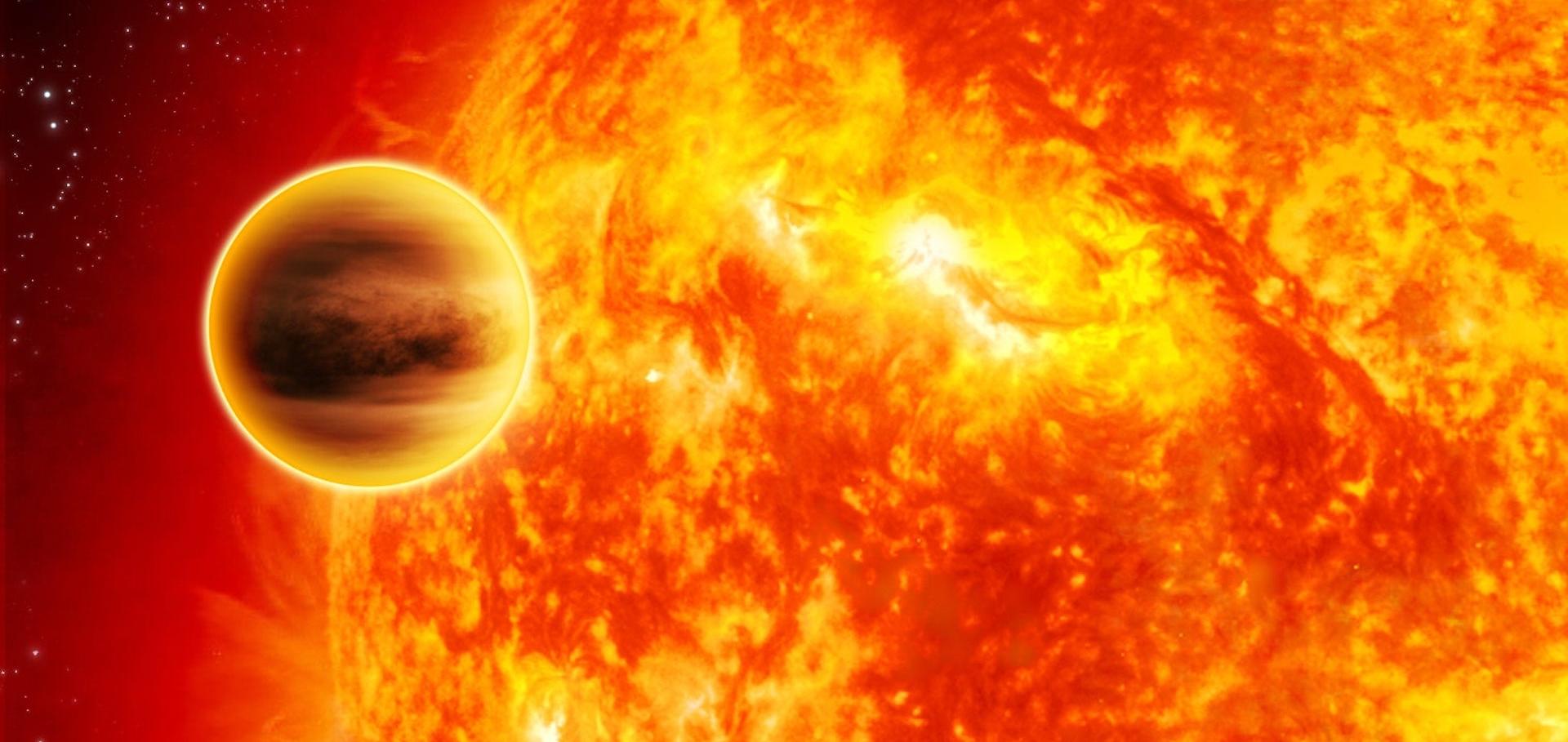
The chemical inventory of hot Jupiter (HJ) exoplanets atmospheres continue to be observed by various ground and space based instruments in increasing detail and precision. It is expected that some HJs will exhibit strong non-equilibrium chemistry characteristics in their atmospheres, which might be inferred from spectral observations. We aim to model the three dimensional thermochemical non-equilibrium chemistry in the atmospheres of the HJs WASP-39b and HD 189733b. We couple a lightweight, reduced chemical network `mini-chem' that utilises net reaction rate tables to the Exo-FMS General Circulation Model (GCM). We perform GCM models of the exoplanets WASP-39b and HD 189733b as case studies of the coupled mini-chem scheme. The GCM results are then post-processed using the 3D radiative-transfer model gCMCRT to produce transmission and emission spectra to assess the impact of non-equilibrium chemistry on their observable properties. Both simulations show significant departures from chemical equilibrium (CE) due to the dynamical motions of the atmosphere. The spacial distribution of species generally follows closely the dynamical features of the atmosphere rather than the temperature field. Each molecular species exhibits a different quench level in the simulations, also dependent on the latitude of the planet. Major differences are seen in the transmission and emission spectral features between the CE and kinetic models. Our simulations indicate that considering the 3D kinetic chemical structures of HJ atmospheres has an important impact on physical interpretation of observational data. Drawing bulk atmospheric parameters from fitting feature strengths may lead to inaccurate interpretation of chemical conditions in the atmosphere of HJs. Our open source mini-chem module is simple to couple with contemporary HJ GCM models without substantially increasing required computational resources.Comment: A&A Accepted 17 Feb 202The Runaway Greenhouse Effect on Hycean Worlds
(2023)