

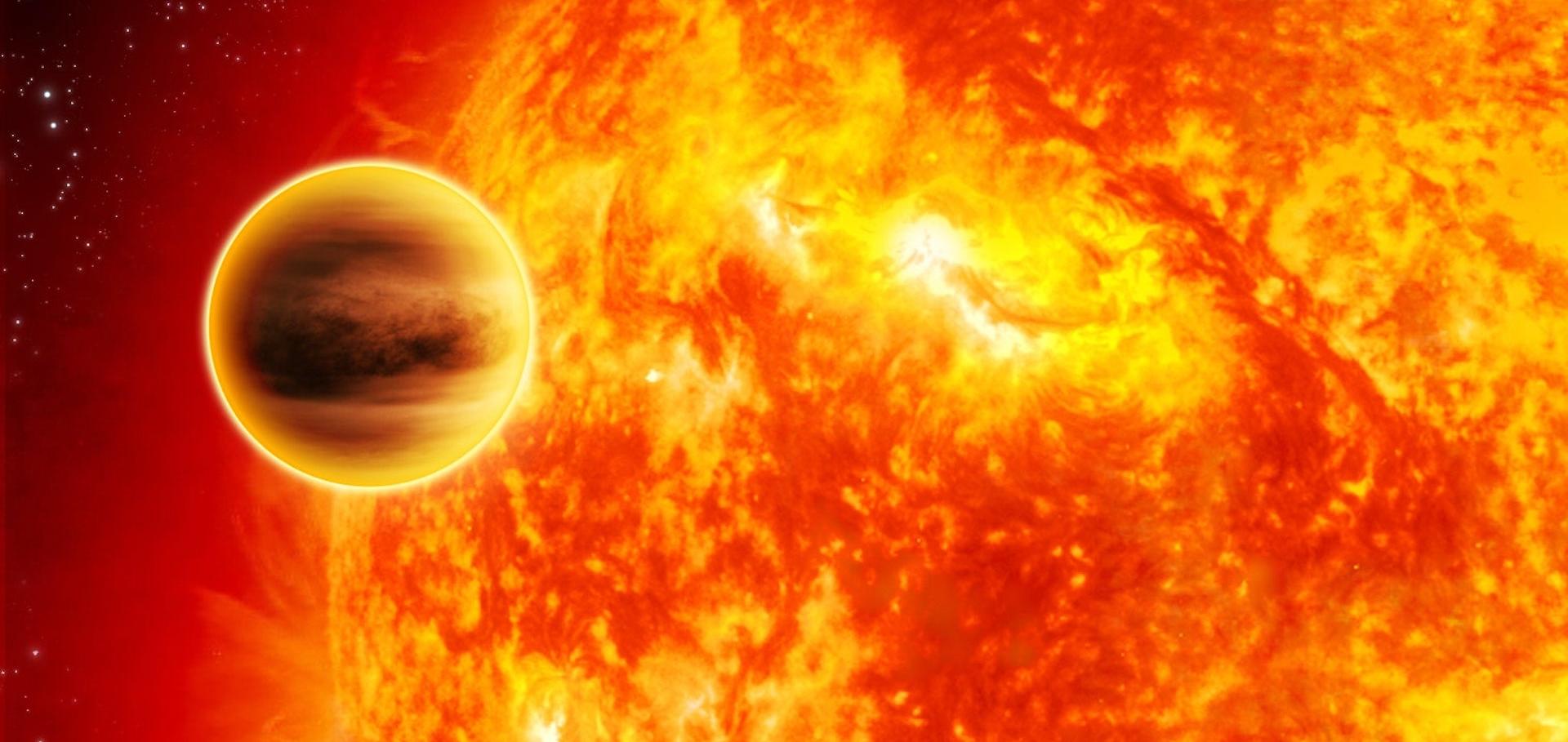
The climate and compositional variation of the highly eccentric planet HD 80606 b – the rise and fall of carbon monoxide and elemental sulfur
Monthly Notices of the Royal Astronomical Society Oxford University Press (OUP) (2023)
Abstract:
<jats:title>Abstract</jats:title> <jats:p>The gas giant HD 80606 b has a highly eccentric orbit (e ∼ 0.93). The variation due to the rapid shift of stellar irradiation provides a unique opportunity to probe the physical and chemical timescales and to study the interplay between climate dynamics and atmospheric chemistry. In this work, we present integrated models to study the atmospheric responses and the underlying physical and chemical mechanisms of HD 80606 b. We first run three-dimensional general circulation models (GCMs) to establish the atmospheric thermal and dynamical structures for different atmospheric metallicities and internal heat. Based on the GCM output, we then adopted a 1D time-dependent photochemical model to investigate the compositional variation along the eccentric orbit. The transition of the circulation patterns of HD 80606 b matched the dynamics regimes in previous works. Our photochemical models show that efficient vertical mixing leads to deep quench levels of the major carbon and nitrogen species and the quenching behavior does not change throughout the eccentric orbit. Instead, photolysis is the main driver of the time-dependent chemistry. While CH4 dominates over CO through most of the orbits, a transient state of [CO]/[CH4] &gt; 1 after periastron is confirmed for all metallicity and internal heat cases. The upcoming JWST Cycle 1 GO program will be able to track this real-time CH4–CO conversion and infer the chemical timescale. Furthermore, sulfur species initiated by sudden heating and photochemical forcing exhibit both short-term and long-term cycles, opening an interesting avenue for detecting sulfur on exoplanets.</jats:p>The climate and compositional variation of the highly eccentric planet HD 80606 b – the rise and fall of carbon monoxide and elemental sulfur
Monthly Notices of the Royal Astronomical Society Oxford University Press 520:3 (2023) 3867-3886
Abstract:
The gas giant HD 80606 b has a highly eccentric orbit (e ∼ 0.93). The variation due to the rapid shift of stellar irradiation provides a unique opportunity to probe the physical and chemical timescales and to study the interplay between climate dynamics and atmospheric chemistry. In this work, we present integrated models to study the atmospheric responses and the underlying physical and chemical mechanisms of HD 80606 b. We first run 3D general circulation models (GCMs) to establish the atmospheric thermal and dynamical structures for different atmospheric metallicities and internal heat. Based on the GCM output, we then adopted a 1D time-dependent photochemical model to investigate the compositional variation along the eccentric orbit. The transition of the circulation patterns of HD 80606 b matched the dynamics regimes in previous works. Our photochemical models show that efficient vertical mixing leads to deep quench levels of the major carbon and nitrogen species and the quenching behaviour does not change throughout the eccentric orbit. Instead, photolysis is the main driver of the time-dependent chemistry. While CH4 dominates over CO through most of the orbits, a transient state of [CO]/[CH4] > 1 after periastron is confirmed for all metallicity and internal heat cases. The upcoming JWST Cycle 1 GO program will be able to track this real-time CH4–CO conversion and infer the chemical timescale. Furthermore, sulfur species initiated by sudden heating and photochemical forcing exhibit both short-term and long-term cycles, opening an interesting avenue for detecting sulfur on exoplanets.Measuring the variability of directly imaged exoplanets using vector Apodizing Phase Plates combined with ground-based differential spectrophotometry
(2023)
Early Release Science of the exoplanet WASP-39b with JWST NIRSpec G395H
Nature Nature Research 614:7949 (2023) 664-669
Abstract:
Measuring the abundances of carbon and oxygen in exoplanet atmospheres is considered a crucial avenue for unlocking the formation and evolution of exoplanetary systems. Access to an exoplanet's chemical inventory requires high-precision observations, often inferred from individual molecular detections with low-resolution space-based and high-resolution ground-based facilities. Here we report the medium-resolution (R$\sim$600) transmission spectrum of an exoplanet atmosphere between 3-5 $\mu$m covering multiple absorption features for the Saturn-mass exoplanet WASP-39b, obtained with JWST NIRSpec G395H. Our observations achieve 1.46x photon precision, providing an average transit depth uncertainty of 221 ppm per spectroscopic bin, and present minimal impacts from systematic effects. We detect significant absorption from CO$_2$ (28.5$\sigma$) and H$_2$O (21.5$\sigma$), and identify SO$_2$ as the source of absorption at 4.1 $\mu$m (4.8$\sigma$). Best-fit atmospheric models range between 3 and 10x solar metallicity, with sub-solar to solar C/O ratios. These results, including the detection of SO$_2$, underscore the importance of characterising the chemistry in exoplanet atmospheres, and showcase NIRSpec G395H as an excellent mode for time series observations over this critical wavelength range.Comment: 44 pages, 11 figures, 3 tables. Resubmitted after revision to NaturDesign and challenges for the HARMONI Laser Guide Star Sensors
7th Adaptive Optics for Extremely Large Telescopes Conference, AO4ELT7 2023 (2023)