Home
Department Of Physics text logo
  • Research
    • Our research
    • Our research groups
    • Our research in action
    • Research funding support
    • Summer internships for undergraduates
  • Study
    • Undergraduates
    • Postgraduates
  • Engage
    • For alumni
    • For business
    • For schools
    • For the public
Menu
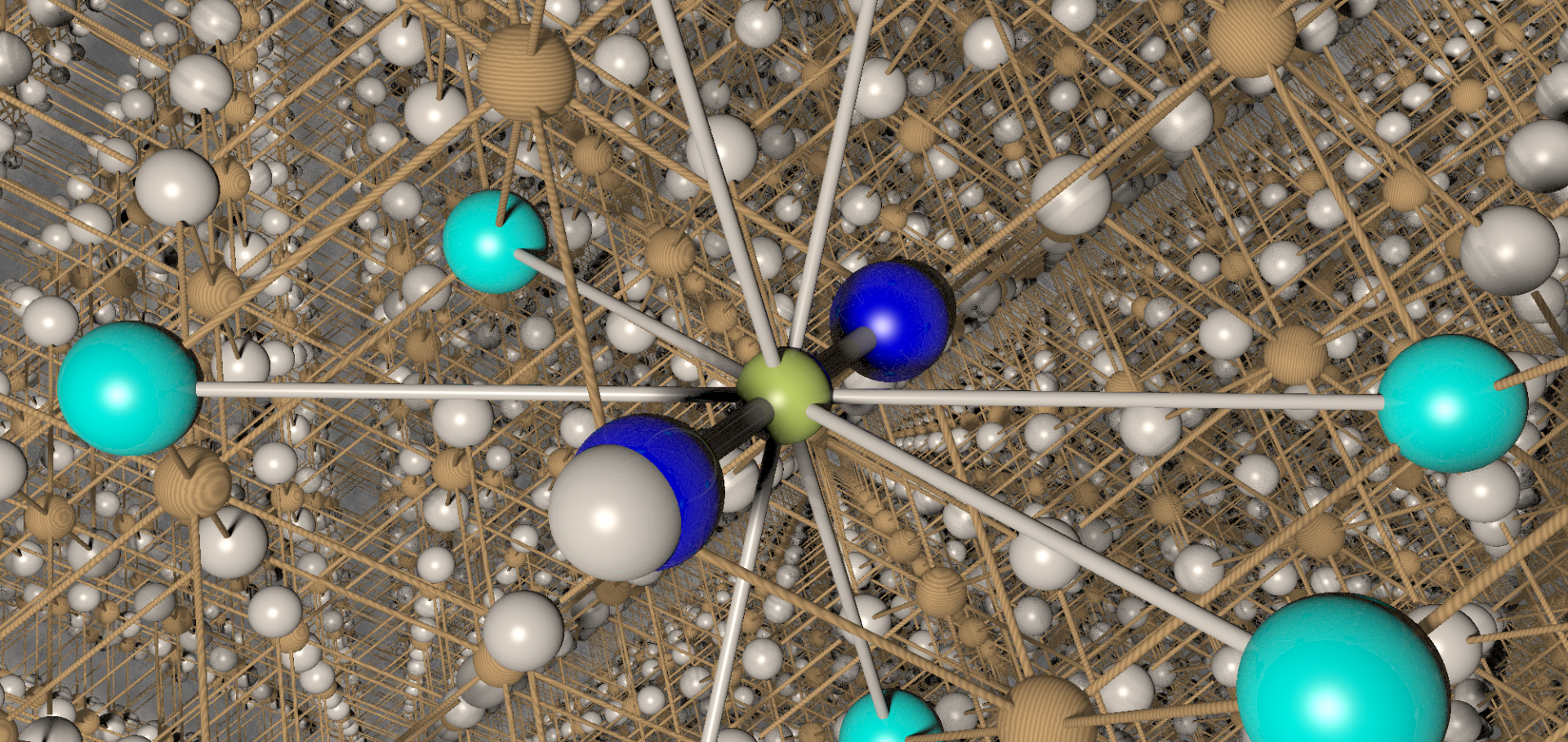
Crystal structure inside calcium fluoride with an implanted muon
Credit: SJB

Professor Stephen Blundell

Professor of Physics

Research theme

  • Quantum materials

Sub department

  • Condensed Matter Physics

Research groups

  • Muons and magnets
Stephen.Blundell@physics.ox.ac.uk
Telephone: 01865 (2)72347
Clarendon Laboratory, room 108
  • About
  • Books
  • Teaching
  • Research
  • Publications

Spiral spin liquid noise

Proceedings of the National Academy of Sciences National Academy of Sciences 122:12 (2025) e2422498122

Authors:

Hiroto Takahashi, Chun-Chih Hsu, Fabian Jerzembeck, Jack Murphy, Jonathan Ward, Jack D Enright, Jan Knapp, Pascal Puphal, Masahiko Isobe, Yosuke Matsumoto, Hidenori Takagi, JC Séamus Davis, Stephen J Blundell

Abstract:

An emerging concept for identification of different types of spin liquids [C. Broholm et al., Science 367, eaay0668 (2020)] is through the use of spontaneous spin noise [S. Chatterjee, J. F. Rodriguez-Nieva, E. Demler, Phys. Rev. B 99, 104425 (2019)]. Here, we develop spin noise spectroscopy for spin liquid studies by considering Ca10Cr7O28, a material hypothesized to be either a quantum or a spiral spin liquid (SSL). By enhancing techniques introduced for magnetic monopole noise studies [R. Dusad et al., Nature 571, 234–239 (2019)], we measure the time and temperature dependence of spontaneous flux Φ(t, T) and thus magnetization M(t, T) of Ca10Cr7O28 samples. The resulting power spectral density of magnetization noise SMω, T reveals intense spin fluctuations with SMω, T∝ω-α(T) and 0.84
More details from the publisher
Details from ORA
More details
More details

Muon Studies of Superconductors

Annual Review of Condensed Matter Physics Annual Reviews 16:1 (2025) 367-385
More details from the publisher

Field-orientation-dependent magnetic phases in GdRu2Si2 probed with muon-spin spectroscopy

Physical Review B American Physical Society (APS) 111:5 (2025) 54440

Authors:

Bm Huddart, A Hernández-Melián, Gda Wood, Da Mayoh, M Gomilšek, Z Guguchia, C Wang, Tj Hicken, Sj Blundell, G Balakrishnan, T Lancaster

Abstract:

<jats:p>Centrosymmetric <a:math xmlns:a="http://www.w3.org/1998/Math/MathML"><a:mrow><a:msub><a:mi>GdRu</a:mi><a:mn>2</a:mn></a:msub><a:msub><a:mi>Si</a:mi><a:mn>2</a:mn></a:msub></a:mrow></a:math> exhibits a variety of multi-<b:math xmlns:b="http://www.w3.org/1998/Math/MathML"><b:mrow><b:mi>Q</b:mi></b:mrow></b:math> magnetic states as a function of temperature and applied magnetic field, including a square skyrmion-lattice phase. The material's behavior is strongly dependent on the direction of the applied field, with different phase diagrams resulting for fields applied parallel or perpendicular to the crystallographic <c:math xmlns:c="http://www.w3.org/1998/Math/MathML"><c:mi>c</c:mi></c:math> axis. Here, we present the results of muon-spin relaxation (<d:math xmlns:d="http://www.w3.org/1998/Math/MathML"><d:mrow><d:msup><d:mi>μ</d:mi><d:mo>+</d:mo></d:msup><d:mi>SR</d:mi></d:mrow></d:math>) measurements on single crystals of <e:math xmlns:e="http://www.w3.org/1998/Math/MathML"><e:mrow><e:msub><e:mi>GdRu</e:mi><e:mn>2</e:mn></e:msub><e:msub><e:mi>Si</e:mi><e:mn>2</e:mn></e:msub></e:mrow></e:math>. Our analysis is based on the computation of muon stopping sites and consideration of quantum zero-point motion effects of muons, allowing direct comparison with the underlying spin textures in the material. The muon site is confirmed experimentally, using angle-dependent measurements of the muon Knight shift. Using transverse-field <f:math xmlns:f="http://www.w3.org/1998/Math/MathML"><f:msup><f:mi>μ</f:mi><f:mo>+</f:mo></f:msup><f:mi>SR</f:mi></f:math> with fields applied along either the [001] or [100] crystallographic directions, we distinguish between the magnetic phases in this system via their distinct muon response, providing additional evidence for the skyrmion and meron-lattice phases, while also suggesting the existence of RKKY-driven muon hyperfine coupling. Zero-field <g:math xmlns:g="http://www.w3.org/1998/Math/MathML"><g:mrow><g:msup><g:mi>μ</g:mi><g:mo>+</g:mo></g:msup><g:mi>SR</g:mi></g:mrow></g:math> provides clear evidence for a transition between two distinct magnetically ordered phases at 39 K.</jats:p> <jats:sec> <jats:title/> <jats:supplementary-material> <jats:permissions> <jats:copyright-statement>Published by the American Physical Society</jats:copyright-statement> <jats:copyright-year>2025</jats:copyright-year> </jats:permissions> </jats:supplementary-material> </jats:sec>
More details from the publisher
More details

Coexistence of Kondo coherence and localized magnetic moments in the normal state of molten salt-flux grown UTe2

Physical Review B American Physical Society (APS) 111:1 (2025) 014513

Authors:

N Azari, M Yakovlev, SR Dunsiger, OP Uzoh, E Mun, BM Huddart, SJ Blundell, MM Bordelon, SM Thomas, JD Thompson, PFS Rosa, JE Sonier
More details from the publisher
More details

Elastic softness of low-symmetry frustrated ATi2O5 (A=Co,Fe)

Physical Review B American Physical Society (APS) 111:2 (2025) 024426

Authors:

Tadataka Watanabe, Kazuya Takayanagi, Ray Nishimura, Yoshiaki Hara, Dharmalingam Prabhakaran, Roger D Johnson, Stephen J Blundell
More details from the publisher
More details

Pagination

  • First page First
  • Previous page Prev
  • Page 1
  • Page 2
  • Current page 3
  • Page 4
  • Page 5
  • Page 6
  • Page 7
  • Page 8
  • Page 9
  • …
  • Next page Next
  • Last page Last

Footer Menu

  • Contact us
  • Giving to the Dept of Physics
  • Work with us
  • Media

User account menu

  • Log in

Follow us

FIND US

Clarendon Laboratory,

Parks Road,

Oxford,

OX1 3PU

CONTACT US

Tel: +44(0)1865272200

University of Oxfrod logo Department Of Physics text logo
IOP Juno Champion logo Athena Swan Silver Award logo

© University of Oxford - Department of Physics

Cookies | Privacy policy | Accessibility statement

Built by: Versantus

  • Home
  • Research
  • Study
  • Engage
  • Our people
  • News & Comment
  • Events
  • Our facilities & services
  • About us
  • Giving to Physics
  • Current students
  • Staff intranet