Home
Department Of Physics text logo
  • Research
    • Our research
    • Our research groups
    • Our research in action
    • Research funding support
    • Summer internships for undergraduates
  • Study
    • Undergraduates
    • Postgraduates
  • Engage
    • For young people
    • For teachers
    • For the public
    • For alumni
    • For business
  • Support
Menu
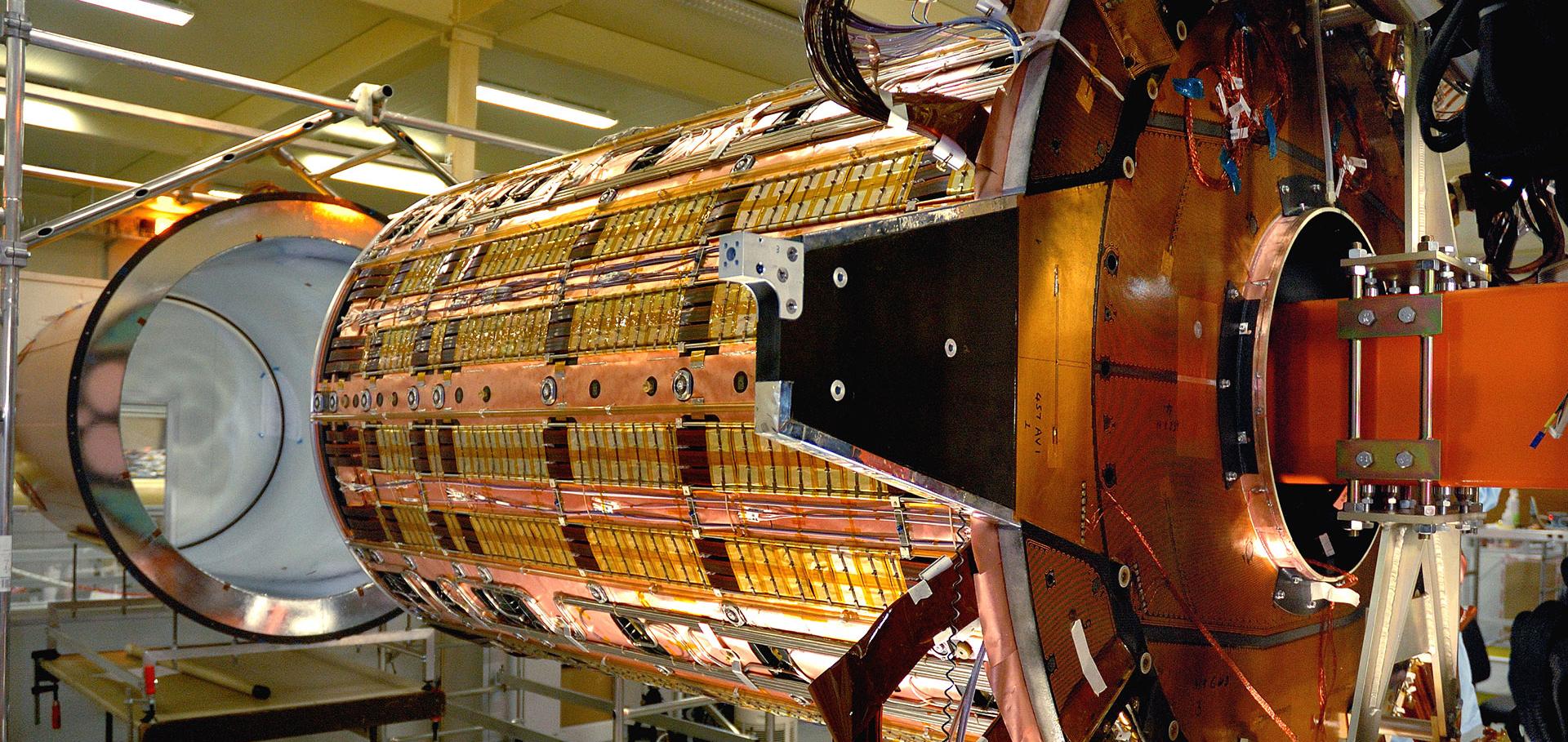
Insertion of STC into TRT at the Department of Physics, Oxford
Credit: CERN

Professor Daniela Bortoletto

Professor and Head of Particle Physics

Research theme

  • Instrumentation
  • Fundamental particles and interactions

Sub department

  • Particle Physics

Research groups

  • AION/Magis
  • ATLAS
  • Future Colliders
  • Mu3e
  • OPMD
daniela.bortoletto@physics.ox.ac.uk
Telephone: 01865 (2)73635
Denys Wilkinson Building, room 608c1
  • About
  • Students
  • Research
  • Teaching
  • Publications

Search for signatures of electroweakinos with photons, jets, and large missing transverse momentum in s = 13 TeV pp collisions with the ATLAS detector

Journal of High Energy Physics Springer 2026:4 (2026) 150

Authors:

G Aad, E Aakvaag, B Abbott, S Abdelhameed, K Abeling, NJ Abicht, SH Abidi, M Aboelela, A Aboulhorma, H Abramowicz, Y Abulaiti, BS Acharya, A Ackermann, C Adam Bourdarios, L Adamczyk, SV Addepalli, MJ Addison, J Adelman, A Adiguzel, T Adye, AA Affolder, Y Afik, MN Agaras, A Aggarwal, C Agheorghiesei

Abstract:

A search for final states characterised by at least one isolated high transverse-momentum photon, jets and large missing transverse momentum is presented. Such a final state might occur in gauge-mediated supersymmetric models where a pair of binos and higgsinos mix to form neutralinos, one of which decays into a photon plus a gravitino while the other decays into a Higgs boson, a Z boson or a photon, plus a gravitino. The search is performed using the full Run-2 data sample of 140 fb−1 of s=13 TeV proton-proton collisions collected by the ATLAS detector at the Large Hadron Collider. No significant excess of events is observed above the Standard Model prediction and model-dependent exclusion limits at the 95% confidence level are set. These limits are interpreted in terms of the masses of gauginos, which are excluded up to 1.2 TeV depending on their branching ratios, and on their branching ratios as a function of their mass.
More details from the publisher
Details from ORA
More details

Measurement of the top-quark mass using decays with a J/ψ meson at s = 13 TeV with the ATLAS detector

Journal of High Energy Physics Springer 2026:4 (2026) 99

Authors:

G Aad, E Aakvaag, B Abbott, S Abdelhameed, K Abeling, NJ Abicht, SH Abidi, M Aboelela, A Aboulhorma, H Abramowicz, Y Abulaiti, BS Acharya, A Ackermann, C Adam Bourdarios, L Adamczyk, SV Addepalli, MJ Addison, J Adelman, A Adiguzel, T Adye, AA Affolder, Y Afik, MN Agaras, A Aggarwal, C Agheorghiesei

Abstract:

The top-quark mass is measured using top-quark decays producing an isolated lepton and J/ψ meson reconstructed in its μ+μ− decay mode. The data sample was recorded with the ATLAS detector in proton-proton collisions at a centre-of-mass energy of s=13 TeV during Run 2 of the Large Hadron Collider, corresponding to an integrated luminosity of 140 fb−1. The measurement is based on the invariant mass m(ℓμ+μ−) of the system made of the isolated lepton ℓ from the W boson decay and the non-isolated μ+μ− pair from a J/ψ decay of a b-hadron, exploiting its sensitivity to the top-quark mass. An unbinned maximum-likelihood fit to the m(ℓμ+μ−) distribution is performed to extract the top-quark mass. The top-quark mass is measured to be mtop = 172.17 ± 0.80 (stat) ± 0.81 (syst) ± 1.07 (recoil) GeV, with a total uncertainty of 1.56 GeV. The third uncertainty arises from changing the dipole parton shower gluon-recoil scheme used in top-quark decays.
More details from the publisher
Details from ORA
More details

A Data-Driven Fast Simulation Approach for MAPS-based Detectors and their Optimization

ArXiv 2604.05893 (2026)

Authors:

Dumitru Vlad Berlea, Lucian Fasselt, Prafulla Behera, Daniela Bortoletto, Craig Buttar, Theertha Chembakan, Valerio Dao, Ganapati Dash, Sebastian Haberl, Tomohiro Inada, Fuat Kerem Isik, Cigdem Issever, Xuan Li, Long Li, Heinz Pernegger, Petra Riedler, Walter Snoeys, Carlos Solans Sánchez, Anna Swoboda, Ilkay Turk Cakir, Milou van Rijnbach, Anusree Vijay, Julian Weick, Steven Worm
Details from ArXiV

Measurement of charged-particle production in $\sqrt{s_\text{NN}}=9.62$ TeV proton-oxygen collisions as a probe of cosmic-ray air showers with the ATLAS detector

ArXiv 2604.05512 (2026)
Details from ArXiV

Charge collection parameterization of MALTA2, a depleted monolithic active pixel sensor

Journal of Instrumentation IOP Publishing 21:04 (2026) C04001

Authors:

L Fasselt, P Behera, DV Berlea, D Bortoletto, C Buttar, T Chembakan, V Dao, G Dash, S Haberl, T Inada, FK Isik, P Jana, X Li, L Li, H Pernegger, P Riedler, W Snoeys, CA Solans Sánchez, A Swoboda, I Turk Cakir, M van Rijnbach, M Vázquez Núñez, A Vijay, J Weick, S Worm

Abstract:

A fast simulation method is presented for a depleted monolithic active pixel sensor, which uses a data driven parameterization of the charge collection and propagation. This approach provides an efficient alternative to TCAD simulations, particularly for sensors whose proprietary process details — such as doping profiles or implant geometries — are unavailable. Data was obtained with a MALTA2 sensor fabricated in a 180 nm CMOS imaging technology on 30 µm epitaxial silicon using the MALTA beam telescope at CERN SPS. The model reproduces the measured in-pixel efficiency with high accuracy and enables a realistic yet computationally lightweight analog pixel simulation. This method will be further employed in optimizing the digital sensor design for applications in high-rate particle tracking and high-granularity calorimetry.
More details from the publisher
Details from ORA

Pagination

  • First page First
  • Previous page Prev
  • …
  • Page 15
  • Page 16
  • Page 17
  • Page 18
  • Current page 19
  • Page 20
  • Page 21
  • Page 22
  • Page 23
  • …
  • Next page Next
  • Last page Last

Footer Menu

  • Contact us
  • Giving to the Dept of Physics
  • Work with us
  • Media

User account menu

  • Log in

Follow us

FIND US

Clarendon Laboratory,

Parks Road,

Oxford,

OX1 3PU

CONTACT US

Tel: +44(0)1865272200

University of Oxfrod logo Department Of Physics text logo
IOP Juno Champion logo Athena Swan Silver Award logo

© University of Oxford - Department of Physics

Cookies | Privacy policy | Accessibility statement

Built by: Versantus

  • Home
  • Research
  • Study
  • Engage
  • Our people
  • News & Comment
  • Events
  • Our facilities & services
  • About us
  • Giving to Physics
  • Current students
  • Staff intranet