Home
Department Of Physics text logo
  • Research
    • Our research
    • Our research groups
    • Our research in action
    • Research funding support
    • Summer internships for undergraduates
  • Study
    • Undergraduates
    • Postgraduates
  • Engage
    • For alumni
    • For business
    • For schools
    • For the public
  • Support
Menu
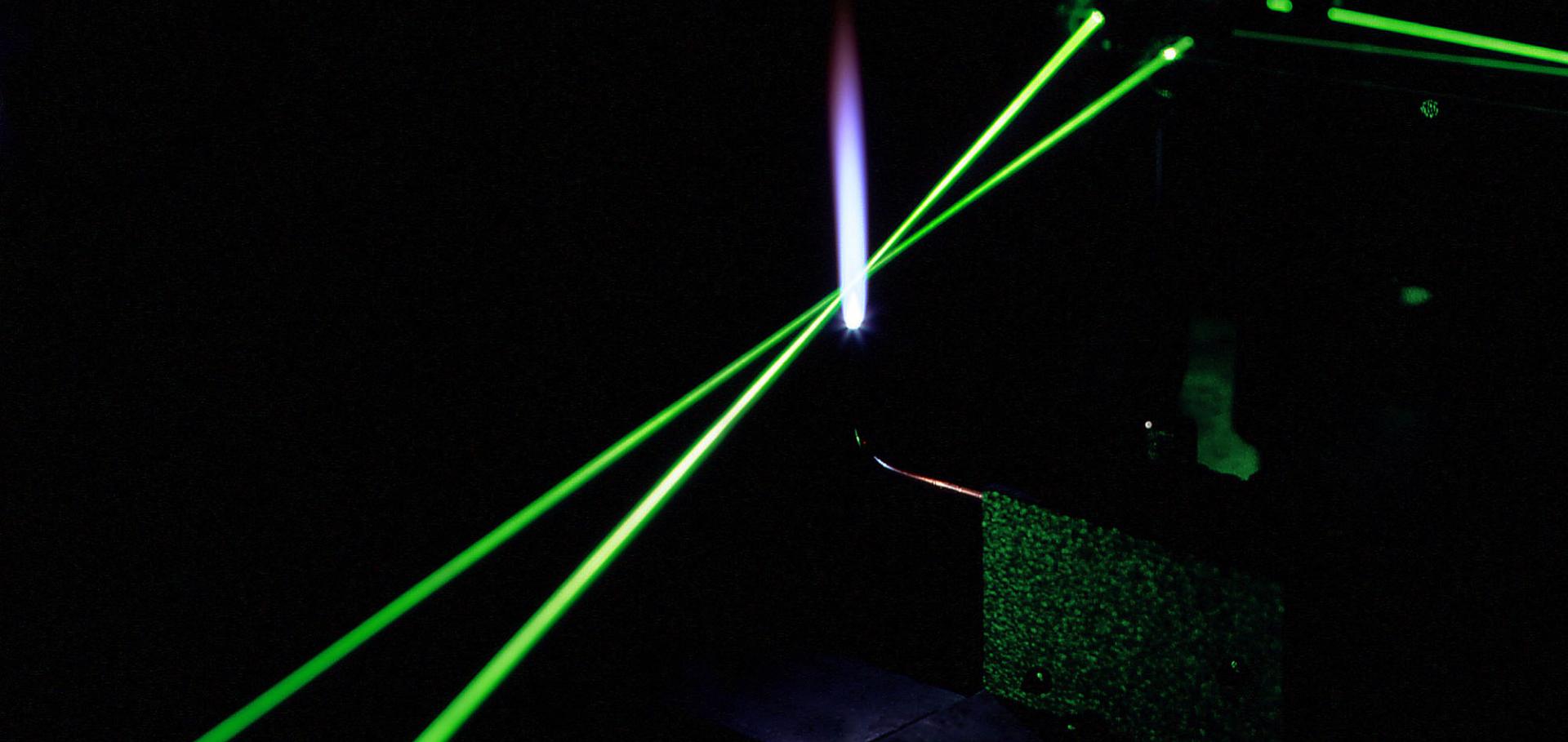
Lasers in flame

Probing temperature and radical species in a flame using 4-wave mixing spectroscopy.

Professor Paul Ewart

Academic Visitor

Sub department

  • Atomic and Laser Physics
paul.ewart@physics.ox.ac.uk
  • About
  • Publications

Time-resolved gas thermometry by Laser Induced Grating Spectroscopy with a high-repetition rate laser system

Experiments in Fluids Springer Verlag 58:7 (2017) 87

Authors:

Felix Förster, C Crua, Martin Davy, Paul Ewart

Abstract:

Thermometry using Laser Induced Grating Spectroscopy (LIGS) is reported using a high– repetition rate laser system, extending the technique to allow time–resolved measurements of gas dynamics. LIGS signals were generated using the second harmonic output at 532 nm of a commercially available high– repetition rate Nd:YAG laser with nitrogen dioxide as molecular seed. Measurements at rates up to 10 kHz were demonstrated under static cell conditions. Transient temperature changes of the same gas contained in a cell subjected to rapid compression by injection of gas were recorded at 1 kHz to derive the temperature evolution of the compressed gas showing temperature changes of 50 K on a time scale of 0.1 s with a measurement precision of 1.4 %. The data showed good agreement with an analytical thermodynamic model of the compression process.
More details from the publisher
Details from ORA
More details

High precision measurement of combustion parameters in flames and engines using Laser Induced Grating Scattering, LIGS

Optica Publishing Group (2017) eth2a.2

Authors:

A Luers, A-L Sahlberg, F Förster, C Willman, J Camm, R Stone, B Williams, P Ewart
More details from the publisher

Laser-based measurements of combustion engines – inside and outside

Optica Publishing Group (2017) ftu4e.3

Authors:

Paul Ewart, Benjamin AO Williams
More details from the publisher

Tomographic Infrared Multi-Mode Absorption Spectroscopy for spatially resolved multi-species detection

Optica Publishing Group (2017) em2b.3

Authors:

S O’Hagan, H Northern, J Dai, W Cai, P Ewart
More details from the publisher

Multi-mode absorption spectroscopy using a Quantum Cascade Laser for simultaneous detection of NO and H2O

Applied Physics B: Lasers and Optics Springer Verlag 122:8 (2016) 226

Authors:

Paul Ewart, S O'Hagan, T Pinto, GAD Ritchie

Abstract:

Detection of multiple transitions in NO and H2O using multi-mode absorption spectroscopy, MUMAS, with a quantum cascade laser, QCL, operating at 5.3 m at scan rates up to 10 kHz is reported. The linewidth of longitudinal modes of the QCL are derived from pressure-dependent fits to experimental MUMAS data. Variations in the spectral structure of the broadband, multi-mode, output of the commercially available QCL employed are analysed to provide accurate fits of modelled MUMAS signatures to the experimental data.
More details from the publisher
Details from ORA
More details
More details

Pagination

  • First page First
  • Previous page Prev
  • Page 1
  • Page 2
  • Page 3
  • Page 4
  • Current page 5
  • Page 6
  • Page 7
  • Page 8
  • Page 9
  • …
  • Next page Next
  • Last page Last

Footer Menu

  • Contact us
  • Giving to the Dept of Physics
  • Work with us
  • Media

User account menu

  • Log in

Follow us

FIND US

Clarendon Laboratory,

Parks Road,

Oxford,

OX1 3PU

CONTACT US

Tel: +44(0)1865272200

University of Oxfrod logo Department Of Physics text logo
IOP Juno Champion logo Athena Swan Silver Award logo

© University of Oxford - Department of Physics

Cookies | Privacy policy | Accessibility statement

Built by: Versantus

  • Home
  • Research
  • Study
  • Engage
  • Our people
  • News & Comment
  • Events
  • Our facilities & services
  • About us
  • Giving to Physics
  • Current students
  • Staff intranet