Home
Department Of Physics text logo
  • Research
    • Our research
    • Our research groups
    • Our research in action
    • Research funding support
    • Summer internships for undergraduates
  • Study
    • Undergraduates
    • Postgraduates
  • Engage
    • For alumni
    • For business
    • For schools
    • For the public
  • Support
Menu
Herz Group

Prof Laura Herz FRS

Professor of Physics

Sub department

  • Condensed Matter Physics

Research groups

  • Semiconductors group
  • Advanced Device Concepts for Next-Generation Photovoltaics
Laura.Herz@physics.ox.ac.uk
Google Scholar
Publons/WoS
  • About
  • Publications

Applicability of tin-iodide perovskites for hot-carrier PV devices – ultrafast pump-push-probe study of hot-carrier cooling dynamics

Fundacio Scito (2022)

Authors:

Aleksander Ulatowski, Michael Farrar, Henry Snaith, Michael Johnston, Laura Herz
More details from the publisher

Excellent Long-Range Charge-Carrier Mobility in 2D Perovskites

Fundacio Scito (2022)

Authors:

Manuel Kober-Czerny, Silvia G Motti, Philippe Holzhey, Bernard Wenger, Laura M Herz, Jongchul Lim, Henry Snaith
More details from the publisher

Silver‐Bismuth Based 2D Double Perovskites (4FPEA)4AgBiX8 (X = Cl, Br, I): Highly Oriented Thin Films with Large Domain Sizes and Ultrafast Charge‐Carrier Localization

Advanced Optical Materials Wiley 10:14 (2022)

Authors:

Rik Hooijer, Andreas Weis, Alexander Biewald, Maximilian T Sirtl, Julian Malburg, Rico Holfeuer, Simon Thamm, Amir Abbas Yousefi Amin, Marcello Righetto, Achim Hartschuh, Laura M Herz, Thomas Bein
More details from the publisher
More details

Excellent long-range charge-carrier mobility in 2D perovskites

Advanced Functional Materials Wiley 32:36 (2022) 2203064

Authors:

Manuel Kober-Czerny, Silvia Genaro Motti, Philippe Holzhey, Bernard Wenger, Jongchul Lim, Laura Maria Herz, Henry James Snaith

Abstract:

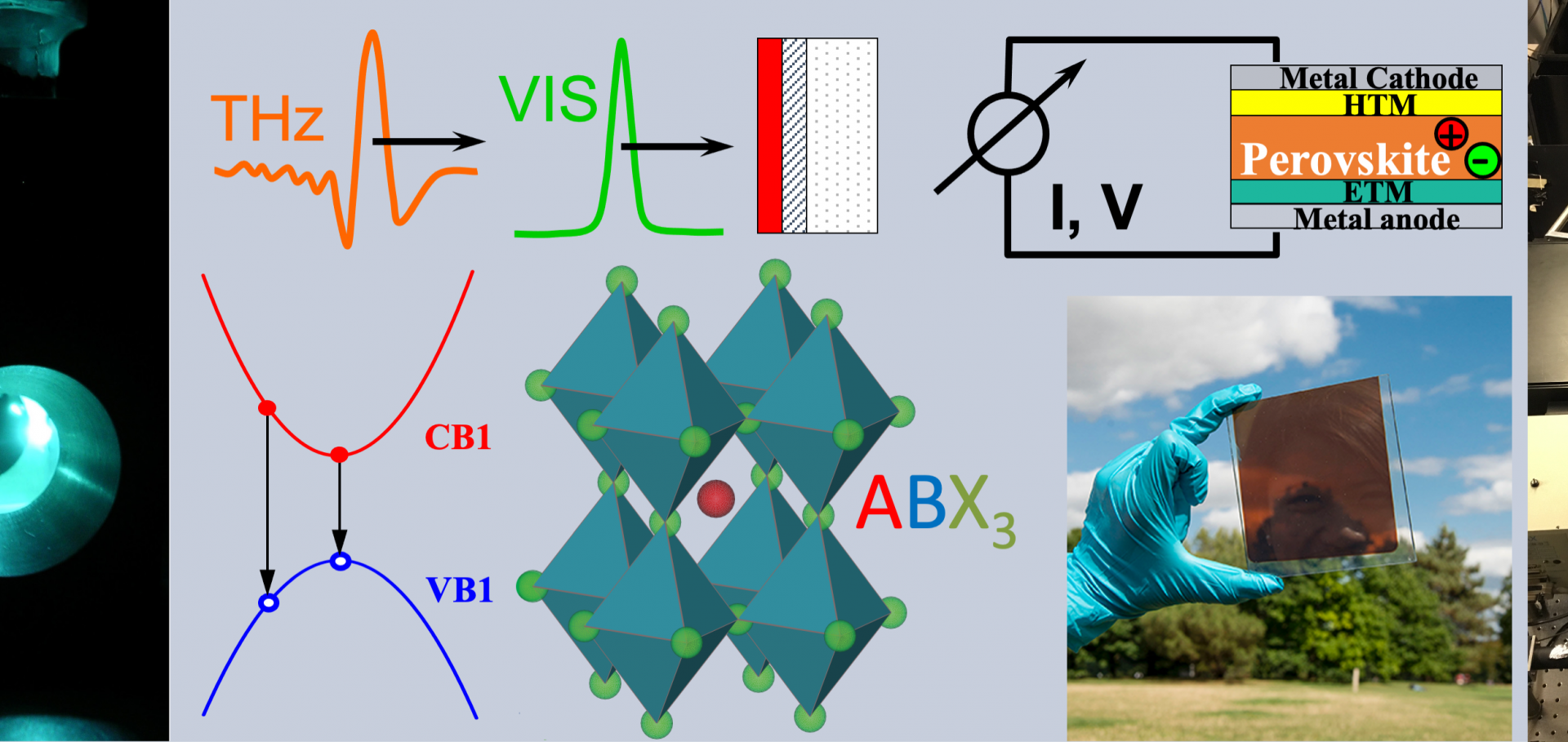
The use of layered, 2D perovskites can improve the stability of metal halide perovskite thin films and devices. However, the charge carrier transport properties in layered perovskites are still not fully understood. Here, the sum of the electron and hole mobilities (Σμ) in thin films of the 2D perovskite PEA2PbI4, through transient electronically contacted nanosecond-to-millisecond photoconductivity measurements, which are sensitive to long-time, long-range (micrometer length scale) transport processes is investigated. After careful analysis, accounting for both early-time recombination and the evolution of the exciton-to-free-carrier population, a long-range mobility of 8.0 +/− 0.6 cm2 (V s)–1, which is ten times greater than the long-range mobility of a comparable 3D material FA0.9Cs0.1PbI3 is determined. These values are compared to ultra-fast transient time-resolved THz photoconductivity measurements, which are sensitive to early-time, shorter-range (tens of nm length scale) mobilities. Mobilities of 8 and 45 cm2 (V s)–1 in the case of the PEA2PbI4 and FA0.9Cs0.1PbI3, respectively, are obtained. This previously unreported concurrence between the long-range and short-range mobility in a 2D material indicates that the polycrystalline thin films already have single-crystal-like qualities. Hence, their fundamental charge carrier transport properties should aid device performance.
More details from the publisher
Details from ORA
More details

Air-degradation mechanisms in mixed lead-tin halide perovskites for solar cells

Advanced Energy Materials Wiley 13:33 (2022) 2200847

Authors:

Michael Johnston, Laura Herz

Abstract:

Owing to the bandgap-bowing effect, mixed lead-tin halide perovskites provide ideal bandgaps for the bottom subcell of all-perovskite tandem photovoltaic devices that offer fundamentally elevated power-conversion efficiencies. However, these materials suffer from degradation in ambient air, which worsens their optoelectronic properties and hinders their usability for photovoltaic applications. Such degradation pathways are not yet fully understood, especially for the perovskites in the middle of the APbxSn1-xI3 solid solution line, which offer the narrowest bandgaps across the range. This study unravels the degradation mechanisms of APbxSn1-xI3 perovskites, reporting clear differences between mixed lead-tin (x = 0.5) and tin-only (x = 0) perovskites. The dynamic optoelectronic properties, electronic structure, crystal structure, and decomposition products of the perovskite thin films are examined in situ during air exposure. Both perovskite compositions suffer from the formation of defects over the timescale of hours, as indicated by a significant reduction in their charge-carrier diffusion lengths. For tin-only perovskite, degradation predominantly causes the formation of energetically shallow tin vacancies and hole doping. However, for mixed lead-tin perovskite, deep trap states are formed that significantly accelerate charge-carrier recombination, yet leave mobilities relatively unaffected. These findings highlight the need for passivation strategies tailored specifically to mixed lead-tin iodide perovskites.
More details from the publisher
Details from ORA
More details

Pagination

  • First page First
  • Previous page Prev
  • …
  • Page 12
  • Page 13
  • Page 14
  • Page 15
  • Current page 16
  • Page 17
  • Page 18
  • Page 19
  • Page 20
  • …
  • Next page Next
  • Last page Last

Footer Menu

  • Contact us
  • Giving to the Dept of Physics
  • Work with us
  • Media

User account menu

  • Log in

Follow us

FIND US

Clarendon Laboratory,

Parks Road,

Oxford,

OX1 3PU

CONTACT US

Tel: +44(0)1865272200

University of Oxfrod logo Department Of Physics text logo
IOP Juno Champion logo Athena Swan Silver Award logo

© University of Oxford - Department of Physics

Cookies | Privacy policy | Accessibility statement

Built by: Versantus

  • Home
  • Research
  • Study
  • Engage
  • Our people
  • News & Comment
  • Events
  • Our facilities & services
  • About us
  • Giving to Physics
  • Current students
  • Staff intranet