Home
Department Of Physics text logo
  • Research
    • Our research
    • Our research groups
    • Our research in action
    • Research funding support
    • Summer internships for undergraduates
  • Study
    • Undergraduates
    • Postgraduates
  • Engage
    • For alumni
    • For business
    • For schools
    • For the public
  • Support
Menu
Atomic and Laser Physics
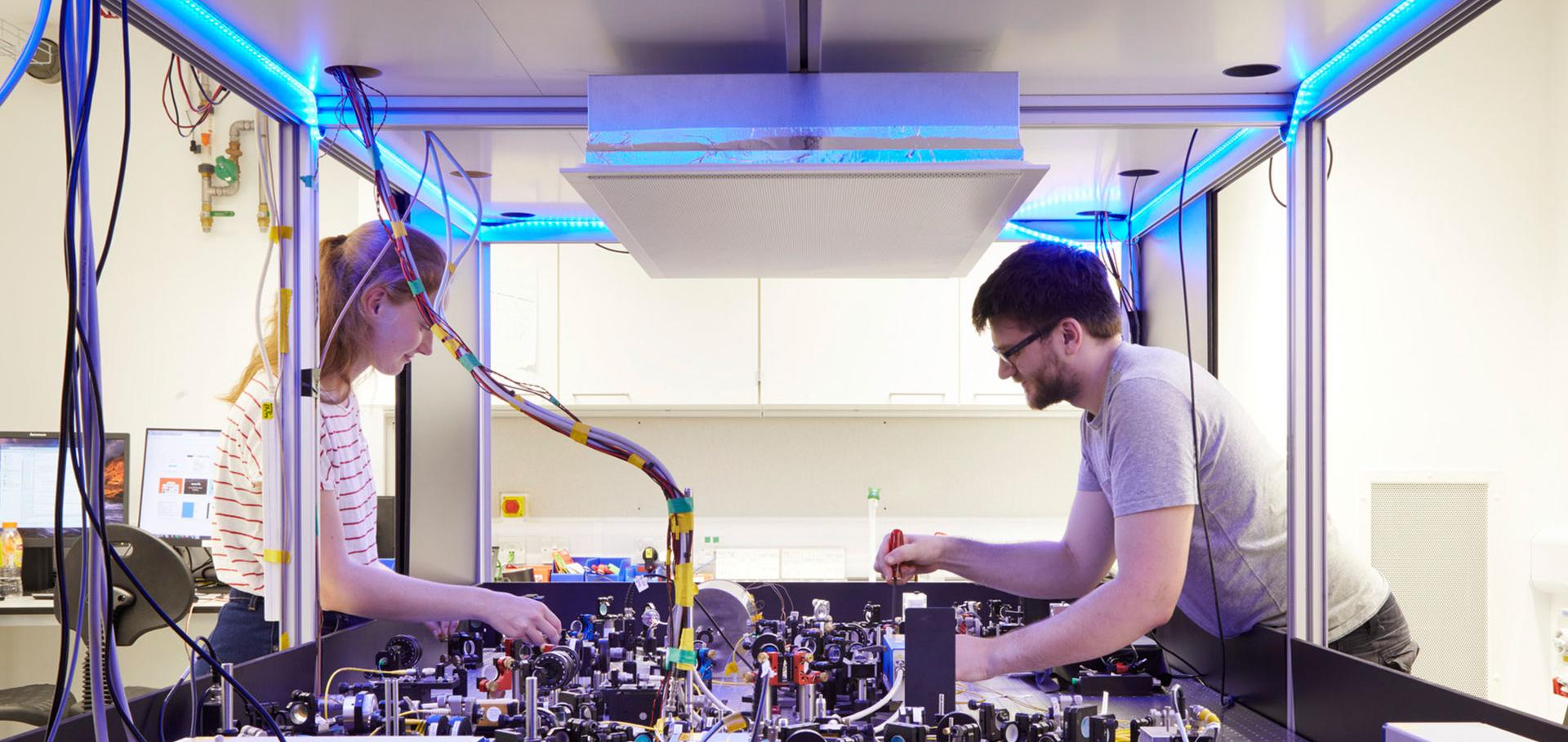
Credit: Jack Hobhouse

Prof Dieter Jaksch

Professor of Physics

Sub department

  • Atomic and Laser Physics

Research groups

  • Quantum systems engineering
Dieter.Jaksch@physics.ox.ac.uk
  • About
  • Publications

Decoherence of a quantum memory coupled to a collective spin bath

International Journal of Quantum Information 8:1-2 (2010) 271-294

Authors:

R Walters, SR Clark, D Jaksch

Abstract:

We study the quantum dynamics of a single qubit coupled to a bath of interacting spins as a model for decoherence in solid state quantum memories. The spin bath is described by the Lipkin-Meshkov-Glick model and the bath spins are subjected to a transverse magnetic field. We investigate the qubit interacting via either an Ising- or an XY-type coupling term to subsets of bath spins of differing size. The large degree of symmetry of the bath allows us to find parameter regimes where the initial qubit state is revived at well-defined times after the qubit preparation. These times may become independent of the bath size for large baths and thus enable faithful qubit storage even in the presence of strong coupling to a bath. We analyze a large range of parameters and identify those which are best suited for quantum memories. In general we find that a small number of links between qubit and bath spins leads to less decoherence and that systems with Ising coupling between qubit and bath spins are preferable. © 2010 World Scientific Publishing Company. © 2010 World Scientific Publishing Company.
More details from the publisher
Details from ORA
More details
Details from ArXiV

Bell inequality for pairs of particle-number-superselection-rule restricted states

PHYSICAL REVIEW A 82:4 (2010) ARTN 042116

Authors:

Libby Heaney, Seung-Woo Lee, Dieter Jaksch
More details from the publisher

Witnessing entanglement in phase space using inefficient detectors

PHYSICAL REVIEW A 81:1 (2010) ARTN 012302

Authors:

Seung-Woo Lee, Hyunseok Jeong, Dieter Jaksch
More details from the publisher

Entanglement percolation with bipartite mixed states

EPL 88:5 (2009)

Authors:

S Broadfoot, U Dorner, D Jaksch

Abstract:

We develop a concept of entanglement percolation for long-distance singlet generation in quantum networks with neighboring nodes connected by partially entangled bipartite mixed states. We give a necessary and sufficient condition on the class of mixed network states for the generation of singlets. States beyond this class are insufficient for entanglement percolation. We find that neighboring nodes are required to be connected by multiple partially entangled states and devise a rich variety of distillation protocols for the conversion of these states into singlets. These distillation protocols are suitable for a variety of network geometries and have a sufficiently high success probability even for significantly impure states. In addition to this, we discuss possible further improvements achievable by using quantum strategies including generalized forms of entanglement swapping. © Europhysics Letters Association.
More details from the publisher
More details

Exact matrix product solutions in the Heisenberg picture of an open quantum spin chain

ArXiv 0907.5582 (2009)

Authors:

SR Clark, J Prior, MJ Hartmann, D Jaksch, MB Plenio

Abstract:

In recent work Hartmann et al [Phys. Rev. Lett. 102, 057202 (2009)] demonstrated that the classical simulation of the dynamics of open 1D quantum systems with matrix product algorithms can often be dramatically improved by performing time evolution in the Heisenberg picture. For a closed system this was exemplified by an exact matrix product operator solution of the time-evolved creation operator of a quadratic fermi chain with a matrix dimension of just two. In this work we show that this exact solution can be significantly generalized to include the case of an open quadratic fermi chain subjected to master equation evolution with Lindblad operators that are linear in the fermionic operators. Remarkably even in this open system the time-evolution of operators continues to be described by matrix product operators with the same fixed dimension as that required by the solution of a coherent quadratic fermi chain for all times. Through the use of matrix product algorithms the dynamical behaviour of operators in this non-equilibrium open quantum system can be computed with a cost that is linear in the system size. We present some simple numerical examples which highlight how useful this might be for the more detailed study of open system dynamics. Given that Heisenberg picture simulations have been demonstrated to offer significant accuracy improvements for other open systems that are not exactly solvable our work also provides further insight into how and why this advantage arises.
Details from ArXiV
More details from the publisher
Details from ORA
More details

Pagination

  • First page First
  • Previous page Prev
  • …
  • Page 30
  • Page 31
  • Page 32
  • Page 33
  • Current page 34
  • Page 35
  • Page 36
  • Page 37
  • Page 38
  • …
  • Next page Next
  • Last page Last

Footer Menu

  • Contact us
  • Giving to the Dept of Physics
  • Work with us
  • Media

User account menu

  • Log in

Follow us

FIND US

Clarendon Laboratory,

Parks Road,

Oxford,

OX1 3PU

CONTACT US

Tel: +44(0)1865272200

University of Oxfrod logo Department Of Physics text logo
IOP Juno Champion logo Athena Swan Silver Award logo

© University of Oxford - Department of Physics

Cookies | Privacy policy | Accessibility statement

Built by: Versantus

  • Home
  • Research
  • Study
  • Engage
  • Our people
  • News & Comment
  • Events
  • Our facilities & services
  • About us
  • Giving to Physics
  • Current students
  • Staff intranet