Home
Department Of Physics text logo
  • Research
    • Our research
    • Our research groups
    • Our research in action
    • Research funding support
    • Summer internships for undergraduates
  • Study
    • Undergraduates
    • Postgraduates
  • Engage
    • For alumni
    • For business
    • For schools
    • For the public
  • Support
Menu
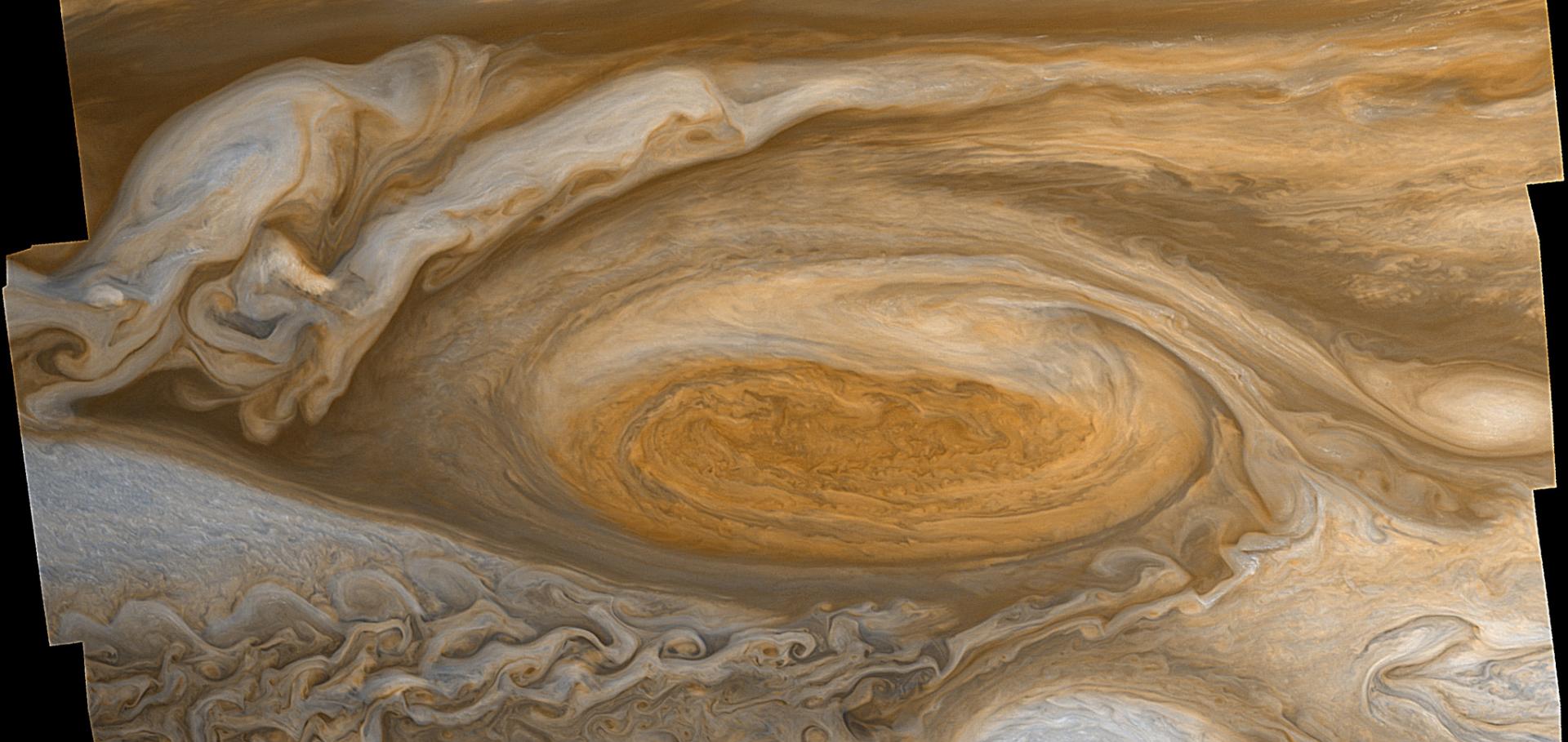
Image of Jupiter's Great Red Spot from Voyager 1

Image of Jupiter's Great Red Spot, obtained during the fly-by of Jupiter by NASA's Voyager 1 spacecraft in 1979.

Credit: NASA/JPL

Prof. Peter Read

Emeritus/researcher

Research theme

  • Climate physics
  • Exoplanets and planetary physics

Sub department

  • Atmospheric, Oceanic and Planetary Physics

Research groups

  • Geophysical and Astrophysical Fluid Dynamics
  • Planetary Climate Dynamics
Peter.Read@physics.ox.ac.uk
Telephone: 01865 (2)72082
Atmospheric Physics Clarendon Laboratory, room 210
  • About
  • Publications

Data assimilation in the laboratory using a rotating annulus experiment

Quarterly Journal of the Royal Meteorological Society (2012)

Authors:

RMB Young, PL Read

Abstract:

The thermally driven rotating annulus is a laboratory experiment important for the study of the dynamics of planetary atmospheres under controllable and reproducible conditions. We use the analysis correction method to assimilate laboratory data into an annulus model. We analyze the 2S and 3AV regular flow regimes between rotation rates of 0.75 and 0.875 rad s and the 3SV chaotic flow regime between rotation rates of 2.2 and 3.1 rad s. Our assimilated observations are irregularly distributed, which is more meteorologically realistic than gridded observations as used in recent applications of data assimilation to laboratory measurements. We demonstrate that data assimilation can be used successfully and accurately in this context. We examine a number of specific assimilation scenarios: a wave-number transition between two regimes, information propagation from data-rich to data-poor regions, the response of the assimilation to a strong disturbance to the flow, and a vortex-shedding instability phenomenon at high rotation rate. At the highest rotation rates we calculated the barotropic E-vectors using unobserved variables such as temperature and the vertical structure of the velocity field that are only available via the assimilation. These showed that the mean flow is weakened by the action of eddies, going some way towards explaining why vortices are shed at the very highest rotation rates but not at lower rotation. Rossby-wave stability theory suggests that the underlying instability leading to vortex shedding may be baroclinic in character. © 2012 Royal Meteorological Society.
More details from the publisher
More details

Phase synchronization between stratospheric and tropospheric quasi-biennial and semi-annual oscillations

Quarterly Journal of the Royal Meteorological Society (2012)

Authors:

PL Read, AA Castrejón-Pita
More details from the publisher

Erratum: Flow transitions resembling bifurcations of the logistic map in simulations of the baroclinic rotating annulus (Physica D (2008) 237 (2251-2262))

Physica D: Nonlinear Phenomena 240:23 (2011) 1903-1904

Authors:

RMB Young, PL Read
More details from the publisher

Storm-clouds brooding on towering heights

Nature Springer Nature 475:7354 (2011) 44-45
More details from the publisher
More details

Thermal structure and dynamics of Saturn's northern springtime disturbance.

Science 332:6036 (2011) 1413-1417

Authors:

Leigh N Fletcher, Brigette E Hesman, Patrick GJ Irwin, Kevin H Baines, Thomas W Momary, Agustin Sanchez-Lavega, F Michael Flasar, Peter L Read, Glenn S Orton, Amy Simon-Miller, Ricardo Hueso, Gordon L Bjoraker, Andrei Mamoutkine, Teresa del Rio-Gaztelurrutia, Jose M Gomez, Bonnie Buratti, Roger N Clark, Philip D Nicholson, Christophe Sotin

Abstract:

Saturn's slow seasonal evolution was disrupted in 2010-2011 by the eruption of a bright storm in its northern spring hemisphere. Thermal infrared spectroscopy showed that within a month, the resulting planetary-scale disturbance had generated intense perturbations of atmospheric temperatures, winds, and composition between 20° and 50°N over an entire hemisphere (140,000 kilometers). The tropospheric storm cell produced effects that penetrated hundreds of kilometers into Saturn's stratosphere (to the 1-millibar region). Stratospheric subsidence at the edges of the disturbance produced "beacons" of infrared emission and longitudinal temperature contrasts of 16 kelvin. The disturbance substantially altered atmospheric circulation, transporting material vertically over great distances, modifying stratospheric zonal jets, exciting wave activity and turbulence, and generating a new cold anticyclonic oval in the center of the disturbance at 41°N.
More details from the publisher
More details

Pagination

  • First page First
  • Previous page Prev
  • …
  • Page 23
  • Page 24
  • Page 25
  • Page 26
  • Current page 27
  • Page 28
  • Page 29
  • Page 30
  • Page 31
  • …
  • Next page Next
  • Last page Last

Footer Menu

  • Contact us
  • Giving to the Dept of Physics
  • Work with us
  • Media

User account menu

  • Log in

Follow us

FIND US

Clarendon Laboratory,

Parks Road,

Oxford,

OX1 3PU

CONTACT US

Tel: +44(0)1865272200

University of Oxfrod logo Department Of Physics text logo
IOP Juno Champion logo Athena Swan Silver Award logo

© University of Oxford - Department of Physics

Cookies | Privacy policy | Accessibility statement

Built by: Versantus

  • Home
  • Research
  • Study
  • Engage
  • Our people
  • News & Comment
  • Events
  • Our facilities & services
  • About us
  • Giving to Physics
  • Current students
  • Staff intranet