Home
Department Of Physics text logo
  • Research
    • Our research
    • Our research groups
    • Our research in action
    • Research funding support
    • Summer internships for undergraduates
  • Study
    • Undergraduates
    • Postgraduates
  • Engage
    • For alumni
    • For business
    • For schools
    • For the public
Menu
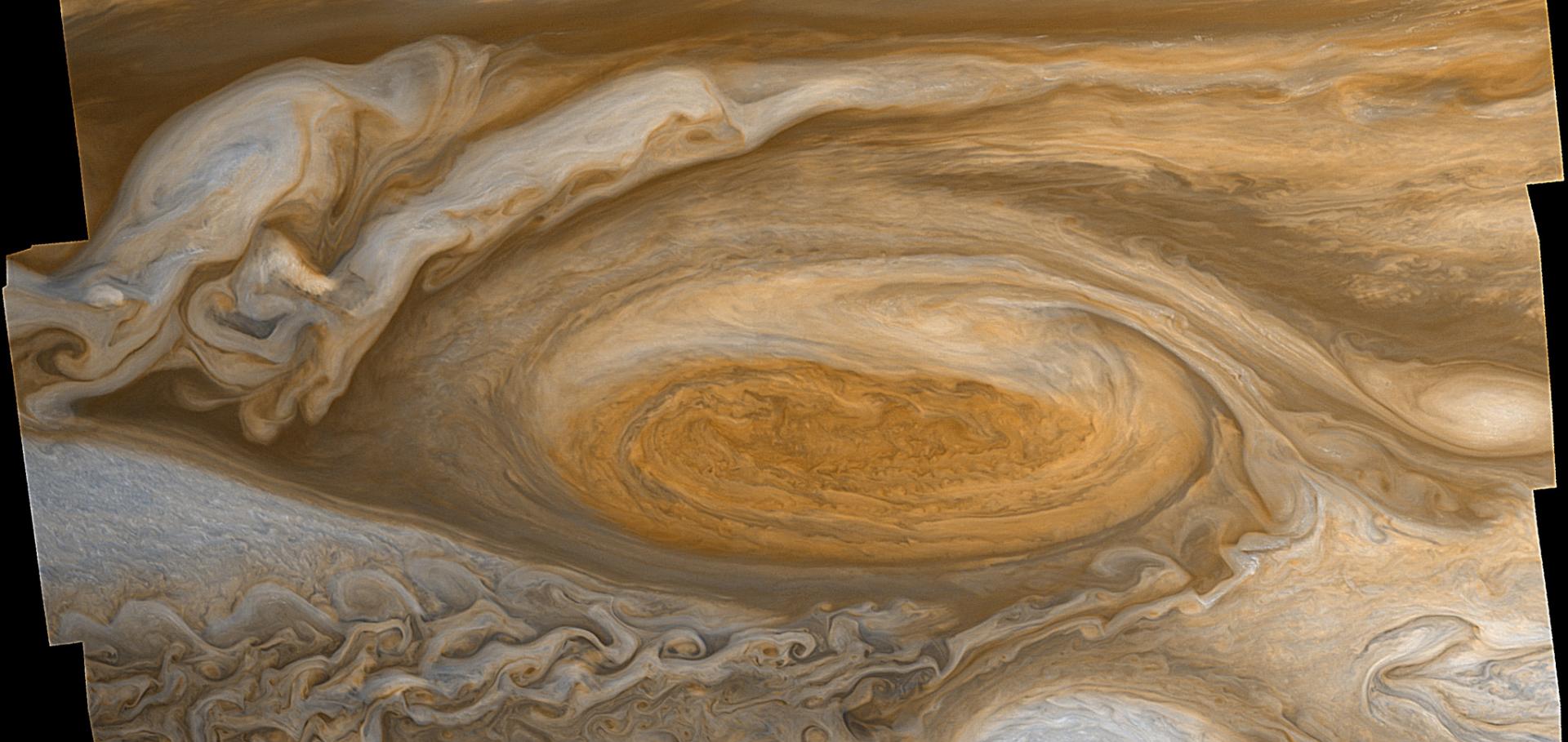
Image of Jupiter's Great Red Spot from Voyager 1

Image of Jupiter's Great Red Spot, obtained during the fly-by of Jupiter by NASA's Voyager 1 spacecraft in 1979.

Credit: NASA/JPL

Prof. Peter Read

Emeritus/researcher

Research theme

  • Climate physics
  • Exoplanets and planetary physics

Sub department

  • Atmospheric, Oceanic and Planetary Physics

Research groups

  • Geophysical and Astrophysical Fluid Dynamics
  • Planetary Climate Dynamics
Peter.Read@physics.ox.ac.uk
Telephone: 01865 (2)72082
Atmospheric Physics Clarendon Laboratory, room 210
  • About
  • Publications

Noise induced effects in the axisymmetric spherical Couette flow

Philosophical Transactions of the Royal Society A Mathematical Physical and Engineering Sciences The Royal Society 381:2246 (2023) 20220124

Authors:

O Krivonosova, M Gritsevich, D Zhilenko, P Read
More details from the publisher
More details

Parameterization of Water-ammonia Hail in Jupiter’s Atmosphere

Copernicus Publications (2022)

Authors:

Xinmiao Hu, Peter Read, Vivien Parmentier, Greg Colyer

Abstract:

Recent Juno microwave observations revealed some puzzling features of the ammonia distribution. In particular, an ammonia-poor layer extends down to levels of tens of bars in Jupiter outside the equatorial region to at least ±40° [Li et al. 2017]. Such a depletion has not yet emerged in general circulation models (GCMs). Guillot et al. [2020] showed that ammonia vapour can dissolve in water ice within violent storms, forming ammonia-rich hail, or "mushballs", that leads to an efficient transport of ammonia to the deeper atmosphere and hence its observed depletion. However, this mechanism has not been tested in numerical simulations in which convective events are self-consistently determined. 

We present a simple parameterization scheme for the mushball process. Our scheme determines the mushball concentration using the water-ammonia equilibrium phase diagram, and considers the transport of water and ammonia due to its associated downdraft. We implemented this scheme to a GCM based on the MITgcm [Young et al. 2019] that includes the following key parameterizations: a water moist convection scheme, a simple cloud microphysics model for water and ammonia, a dry convection scheme, and a two-stream radiative transfer scheme. We present our preliminary results using water and ammonia abundance according to Juno observations. Further, we discuss the ability of the "mushball" scheme to reproduce the Juno observations and explore which parameters are the most important to understand the ammonia distribution in the deep layers of Jupiter.

More details from the publisher

The Mars Climate Database (Version 6.1)

Copernicus Publications (2022)

Authors:

Ehouarn Millour, Francois Forget, Aymeric Spiga, Thomas Pierron, Antoine Bierjon, Luca Montabone, Margaux Vals, Franck Lefèvre, Jean-Yves Chaufray, Miguel Lopez-Valverde, Francisco Gonzalez-Galindo, Stephen Lewis, Peter Read, Marie-Christine Desjean, Fabrice Cipriani

Abstract:

Introduction:

The Mars Climate Database (MCD) is a database of meteorological fields derived from General Circulation Model (GCM) numerical simulations of the Martian atmosphere and validated using available observational data. The MCD includes complementary post-processing schemes such as high spatial resolution interpolation of environmental data and means of reconstructing the variability thereof.

The GCM that is used to create the MCD data, now known as the Mars Planetary Climate Model (Mars PCM) is developed at Laboratoire de Météorologie Dynamique du CNRS (Paris, France) [1] in collaboration with LATMOS (Paris, France), the Open University (UK), the Oxford University (UK) and the Instituto de Astrofisica de Andalucia (Spain) with support from the European Space Agency (ESA) and the Centre National d'Etudes Spatiales (CNES).

The latest version of the MCD, version 5.3 [2], was released in July 2017, and at the time of writing of this abstract we are working on MCDv6.1 [3], which we will release in June 2022. This new version will benefit from all the recent developments and improvements in the Mars PCM’s physics package.

The MCD is freely distributed and intended to be useful and used in the framework of engineering applications as well as in the context of scientific studies which require accurate knowledge of the state of the Martian atmosphere. Over the years, various versions of the MCD have been released and handed to more than 400 teams around the world.

Current applications include entry descent and landing (EDL) studies for future missions, investigations of some specific Martian issues (via coupling of the MCD with homemade codes), analysis of observations (Earth-based as well as with various instruments onboard Mars Express, Mars Reconnaissance Orbiter, Maven, Trace Gas Orbiter, Hope),...

The MCD is freely available upon request via an online form on the dedicated website: http://www-mars.lmd.jussieu.fr which moreover includes a convenient web interface for quick looks.

Figure 1: Illustrative example of the online Mars Climate Database web interface and its plotting capabilities.

Overview of MCD contents:

The MCD provides mean values and statistics of the main meteorological variables (atmospheric temperature, density, pressure and winds) as well as atmospheric composition (including dust and water vapor and ice content), as the GCM from which the datasets are obtained includes water cycle, chemistry, and ionosphere models. The database extends up to and including the thermosphere (~350km). Since the influence of Extreme Ultra Violet (EUV) input from the sun is significant in the latter, 3 EUV scenarios (solar minimum, average and maximum inputs) account for the impact of the various states of the solar cycle.

As the main driver of the Martian climate is the dust loading of the atmosphere, the MCD provides climatologies over a series of synthetic dust scenarios: standard year (a.k.a. climatology), cold (i.e: low dust), warm (i.e: dusty atmosphere) and dust storm, These are derived from home-made, instrument-derived (TES, THEMIS, MCS, MERs), dust climatology of the last 12 Martian years. In addition, we also provide additional “add-on” scenarios which focus on individual Martian Years (from MY 24 to MY 35) for users more interested in more specific climatologies than the MCD baseline scenarios.

In practice the MCD provides users with:

  • Mean values and statistics of main meteorological variables (atmospheric temperature, density, pressure and winds), as well as surface pressure and temperature, CO2 ice cover, thermal and solar radiative fluxes, dust column opacity and mixing ratio, [H20] vapor and ice concentrations, along with concentrations of many species: [CO], [O2], [O], [N2], [Ar], [H2], [O3], [H] ..., as well as electrons mixing ratios. Column densities of these species are also given.

  • Physical processes in the Planetary Boundary Layer (PBL), such as PBL height, minimum and maximum vertical convective winds in the PBL, surface wind stress and sensible heat flux.
  • The possibility to reconstruct realistic conditions by combining the provided climatology with additional large scale (derived from Empirical Orthogonal Functions extracted from the GCM runs) and small scale perturbations (gravity waves).

  • Dust mass mixing ratio, along with estimated dust effective radius and dust deposition rate on the surface are provided.

  • A high resolution mode which combines high resolution (32 pixel/degree) MOLA topography records and Insight pressure records with raw lower resolution GCM results to yield, within the restriction of the procedure, high resolution values of atmospheric variables (pressure, but also temperature and winds via dedicated schemes).


Validation of MCDv6.1:

At EPSC2022 we will present validation campaigns between the MCDv6.1 and multiple measurements such as:

  • Surface temperatures, atmospheric temperatures and water vapor from TES/MGS.

  • Atmospheric temperatures, water ice and airborne dust from MCS/MRO.

  • Atmospheric temperatures from MGS and MEx radio occultations

  • Atmospheric temperatures from TIRVIM/ACS/TGO

  • Surface pressures recorded by Viking Landers, Phoenix, Curiosity and Insight

  • And hopefully much more...


References:

[1] Forget et al. (2022), “Challenges in Mars Climate Modelling with the LMD Mars Global Climate Model, Now Called the Mars « Planetary Climate Model »(PCM) “, The 7th International Workshop on the Mars Atmosphere : Modelling and Observations, 14-17 June 2022, Paris, France.

[2] Millour et al. (2018), “The Mars Climate Database (version 5.3) “, From Mars Express to ExoMars Scienfic Workshop, 22-28 February 2018, ESAC Madrid, Spain.

[3] Millour et al. (2022), “The Mars Climate Database, Version 6.1 “, The 7th International Workshop on the Mars Atmosphere : Modelling and Observations, 14-17 June 2022, Paris, France.

More details from the publisher

Energy Exchanges in Saturn's Polar Regions From Cassini Observations: Eddy‐Zonal Flow Interactions

Journal of Geophysical Research: Planets American Geophysical Union (AGU) 127:5 (2022) e2021JE006973

Authors:

Peter L Read, Arrate Antuñano, Simon Cabanes, Greg Colyer, Teresa del Río Gaztelurrutia, Agustin Sanchez‐Lavega

Abstract:

AbstractSaturn's polar regions (polewards of ∼63° planetocentric latitude) are strongly dynamically active with zonal jets, polar cyclones and the intriguing north polar hexagon (NPH) wave. Here we analyze measurements of horizontal winds, previously obtained from Cassini images by Antuñano et al. (2015), https://doi.org/10.1002/2014je004709, to determine the spatial and spectral exchanges of kinetic energy (KE) between zonal mean zonal jets and nonaxisymmetric eddies in Saturn's polar regions. Eddies of most resolved scales generally feed KE into the eastward and westward zonal mean jets at rates between 4.3 × 10−5 and 1.4 × 10−4 W kg−1. In particular, the north polar jet (at 76°N) was being energized at a rate of ∼10−4 W kg−1, dominated by the contribution due to the zonal wavenumber m = 6 NPH wave itself. This implies that the hexagon was not being driven at this time through a barotropic instability of the north polar jet, but may suggest a significant role for baroclinic instabilities, convection or other internal energy sources for this feature. The south polar zonal mean jet KE was also being sustained by eddies in that latitude band across a wide range of m. In contrast, results indicate that the north polar vortex may have been weakly barotropically unstable at this time with eddies of low m gaining KE at the expense of the axisymmetric cyclone. However, the southern axisymmetric polar cyclone was gaining KE from non‐axisymmetric components at this time, including m = 2 and its harmonics, as the elliptical distortion of the vortex may have been decaying.
More details from the publisher

Pen portraits of presidents - Professor Raymond Hide, CBE, ScD, FRS

Weather Wiley 77:3 (2021) 103-107

Authors:

Chris K Folland, Peter L Read

Abstract:

We describe the life and scientific accomplishments of Professor Raymond Hide. He was a past President of the Royal Meteorological Society and a supreme example of a geophysicist much honoured in his lifetime. He covered a wide area of geophysics from geomagnetism, meteorology, geodesy, oceanography and related aspects of planetary physics. Raymond Hide was particularly known in meteorology as a founding father of geophysical fluid dynamics, especially for his experiments using a rotating cylindrical annulus to study atmospheric dynamics.
More details from the publisher
Details from ORA
More details

Pagination

  • First page First
  • Previous page Prev
  • Page 1
  • Page 2
  • Page 3
  • Page 4
  • Current page 5
  • Page 6
  • Page 7
  • Page 8
  • Page 9
  • …
  • Next page Next
  • Last page Last

Footer Menu

  • Contact us
  • Giving to the Dept of Physics
  • Work with us
  • Media

User account menu

  • Log in

Follow us

FIND US

Clarendon Laboratory,

Parks Road,

Oxford,

OX1 3PU

CONTACT US

Tel: +44(0)1865272200

University of Oxfrod logo Department Of Physics text logo
IOP Juno Champion logo Athena Swan Silver Award logo

© University of Oxford - Department of Physics

Cookies | Privacy policy | Accessibility statement

Built by: Versantus

  • Home
  • Research
  • Study
  • Engage
  • Our people
  • News & Comment
  • Events
  • Our facilities & services
  • About us
  • Giving to Physics
  • Current students
  • Staff intranet