Home
Department Of Physics text logo
  • Research
    • Our research
    • Our research groups
    • Our research in action
    • Research funding support
    • Summer internships for undergraduates
  • Study
    • Undergraduates
    • Postgraduates
  • Engage
    • For alumni
    • For business
    • For schools
    • For the public
  • Support
Menu
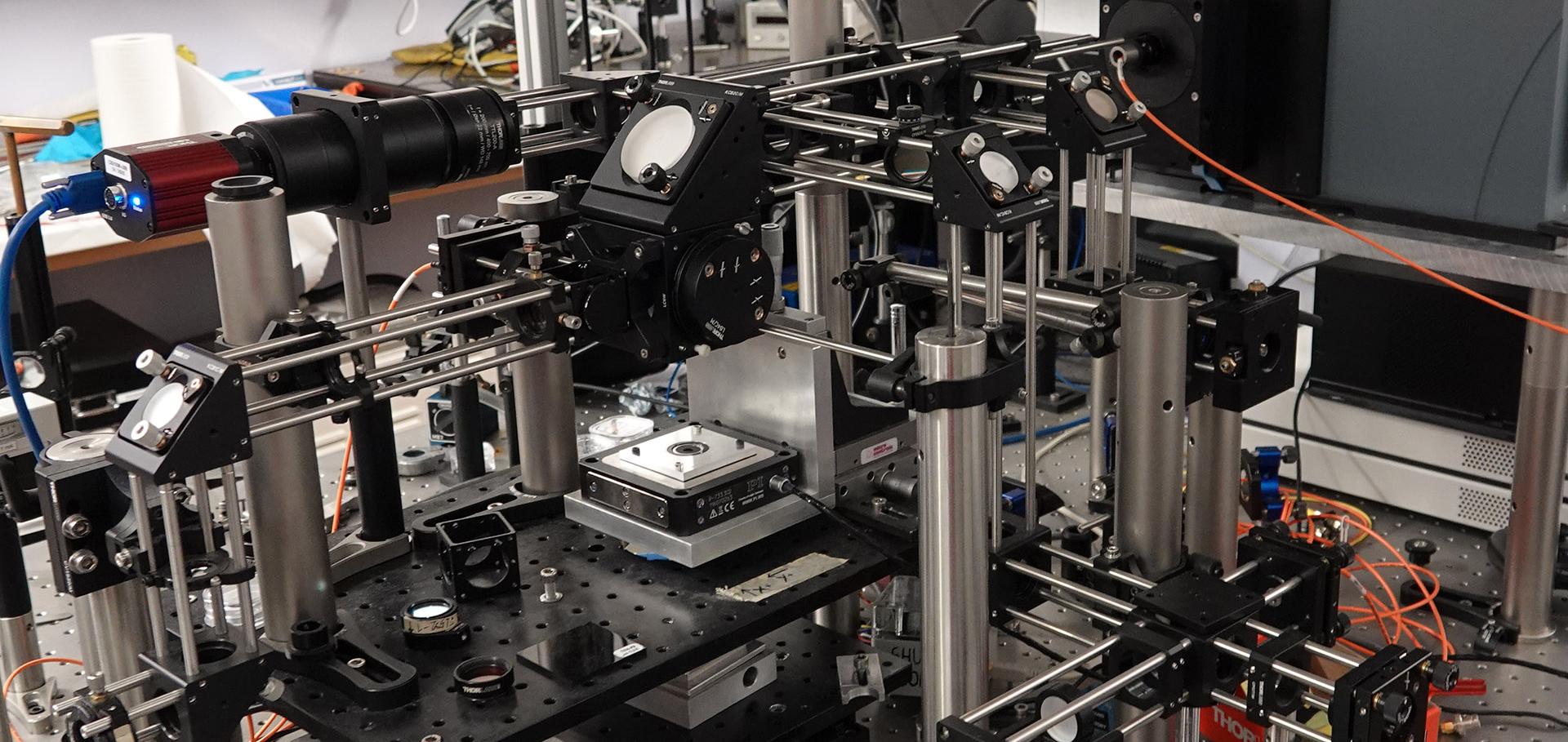
MicroPL optical setup

Professor Robert Taylor

Emeritus Professor of Condensed Matter Physics

Research theme

  • Photovoltaics and nanoscience

Sub department

  • Condensed Matter Physics

Research groups

  • Quantum Optoelectronics
Robert.Taylor@physics.ox.ac.uk
Telephone: 01865 (2)72230
Clarendon Laboratory, room 164
orcid.org/0000-0003-2578-9645
  • About
  • Teaching
  • Positions available
  • Publications

Lasing in perovskite nanocrystals

Image of transverse modes from lasing nanocrystals
Nano Research, 14, 108, 2021

Q-factor measurements on planar nitride cavities

Physica Status Solidi (C) Current Topics in Solid State Physics 7:7-8 (2010) 1866-1868

Authors:

DP Collins, MJ Holmes, RA Taylor, RA Oliver, MJ Kappers, CJ Humphreys

Abstract:

To enable the study of cavity quantum electro-dynamical effects in nitride systems, it is essential to be able to fabricate high quality cavity structures that exhibit large Q-values of the order of several thousands. A promising candidate for such a realisation is based around the micro-pillar distributed Bragg reflector (DBR) cavity. The growth of nitride stacks is problematic due to such material issues as lattice mismatch and dislocation propagation which seem to be more pronounced when compared to similar arsenide structures. In this paper we report on our efforts to characterize the homogeneity of our first generation planar DBR structures through both reflectivity measurements using the broadband output of a photonic crystal fiber (PCF) and cryogenic photoluminescence under ultraviolet (UV) excitation. © 2010 Wiley-VCH Verlag GmbH & Co. KGaA.
More details from the publisher
More details

Cavity modes of tapered ZnO nanowires

New Journal of Physics 12 (2010)

Authors:

X Xu, FSF Brossard, DA Williams, DP Collins, MJ Holmes, RA Taylor, X Zhang

Abstract:

We report on a cavity mode mapping of ZnO tapered nanowires using micro-photoluminescence spectroscopy at room temperature. Both the Fabry-Perot (FP) and the whispering gallery (WG) modes are identified in a single wire. The emission spectra from single nanowires comprise regular Lorentzian peaks, which arise from the FP interference between the ends of the nanowire. The overall intensity along the tapered wire varies periodically. This variation is ascribed to WG mode resonances across the nanowire. The results agree well with the theoretical calculations using the finite-difference time-domain method. © IOP Publishing Ltd and Deutsche Physikalische Gesellschaft.
More details from the publisher

Optical properties of bulk‐like GaN nanorods grown on Si(111) substrates by rf‐plasma assisted molecular beam epitaxy

physica status solidi (c) Wiley 7:7‐8 (2010) 2211-2213

Authors:

Young S Park, TW Kang, Hyunsik Im, Mark J Holmes, Robert A Taylor
More details from the publisher
More details

Strongly coupled single quantum dot in a photonic crystal waveguide cavity

(2010)

Authors:

FSF Brossard, XL Xu, DA Williams, M Hadjipanayi, M Hopkinson, X Wang, RA Taylor
More details from the publisher

Quantum confined Stark effect of InGaN/GaN multi-quantum disks grown on top of GaN nanorods.

Nanotechnology 21:11 (2010) 115401

Authors:

Young S Park, Mark J Holmes, Tae W Kang, Robert A Taylor

Abstract:

We have investigated, using micro-photoluminescence, the quantum confined Stark effect in an In(x)Ga(1-x)N/GaN multi-quantum disk structure at the tip of a single GaN nanorod. A strong and sharp emission line from the In(x)Ga(1-x)N/GaN quantum disks near 3.26 eV was observed. The peak energy of the emission line was observed to blue-shift with increasing excitation power, indicating a quantum confined Stark effect. Furthermore, both the blue-shift and the intensity of the emission saturate with increasing excitation power. The temperature-dependence of the 3.26 eV emission line has also been investigated.
More details from the publisher
More details

Pagination

  • First page First
  • Previous page Prev
  • …
  • Page 43
  • Page 44
  • Page 45
  • Page 46
  • Current page 47
  • Page 48
  • Page 49
  • Page 50
  • Page 51
  • …
  • Next page Next
  • Last page Last

Footer Menu

  • Contact us
  • Giving to the Dept of Physics
  • Work with us
  • Media

User account menu

  • Log in

Follow us

FIND US

Clarendon Laboratory,

Parks Road,

Oxford,

OX1 3PU

CONTACT US

Tel: +44(0)1865272200

University of Oxfrod logo Department Of Physics text logo
IOP Juno Champion logo Athena Swan Silver Award logo

© University of Oxford - Department of Physics

Cookies | Privacy policy | Accessibility statement

Built by: Versantus

  • Home
  • Research
  • Study
  • Engage
  • Our people
  • News & Comment
  • Events
  • Our facilities & services
  • About us
  • Giving to Physics
  • Current students
  • Staff intranet