Home
Department Of Physics text logo
  • Research
    • Our research
    • Our research groups
    • Our research in action
    • Research funding support
    • Summer internships for undergraduates
  • Study
    • Undergraduates
    • Postgraduates
  • Engage
    • For alumni
    • For business
    • For schools
    • For the public
  • Support
Menu
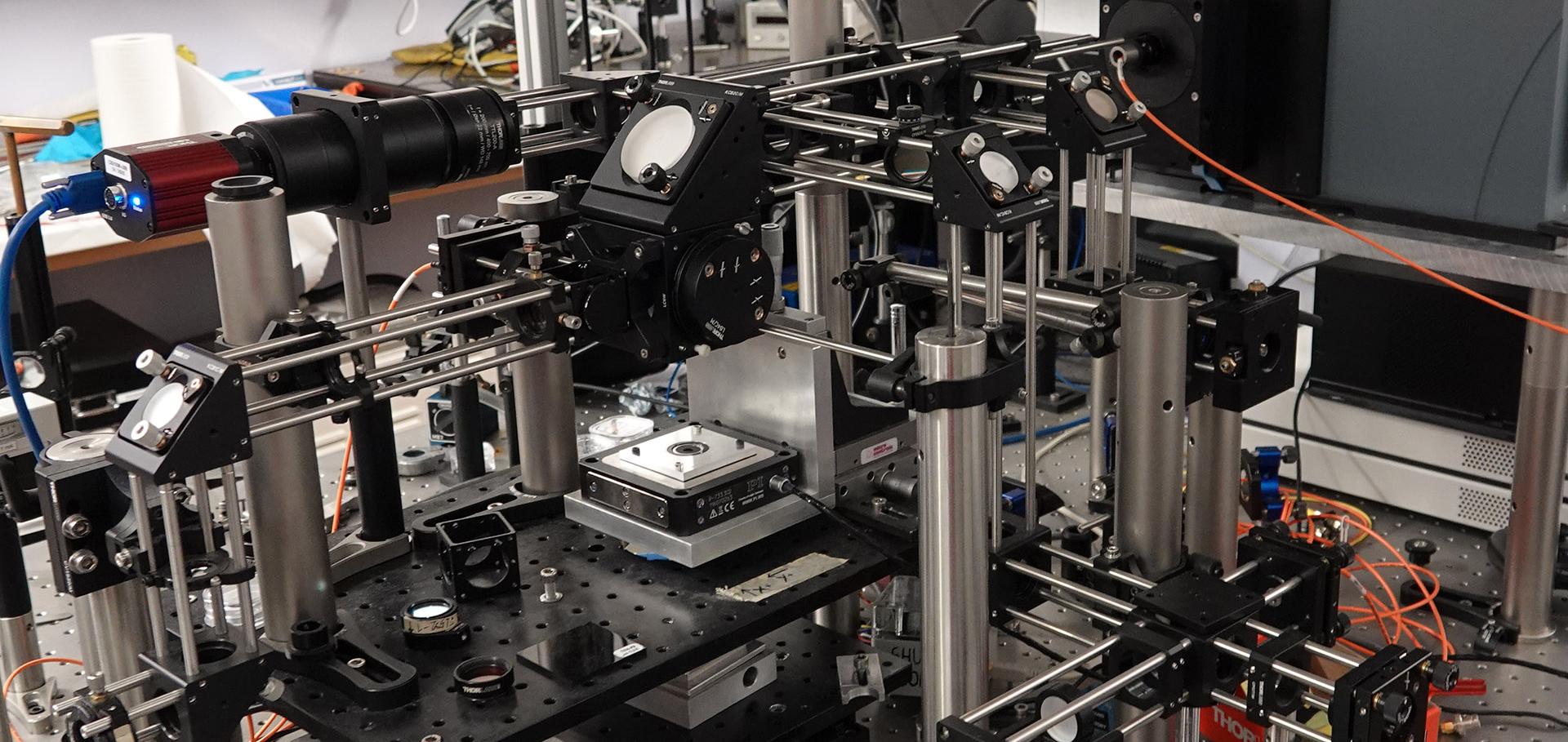
MicroPL optical setup

Professor Robert Taylor

Emeritus Professor of Condensed Matter Physics

Research theme

  • Photovoltaics and nanoscience

Sub department

  • Condensed Matter Physics

Research groups

  • Quantum Optoelectronics
Robert.Taylor@physics.ox.ac.uk
Telephone: 01865 (2)72230
Clarendon Laboratory, room 164
orcid.org/0000-0003-2578-9645
  • About
  • Teaching
  • Positions available
  • Publications

Lasing in perovskite nanocrystals

Image of transverse modes from lasing nanocrystals
Nano Research, 14, 108, 2021

Non-linear excitation and correlation studies of single InGaN quantum dots

Physica Status Solidi (C) Current Topics in Solid State Physics 6:4 (2009) 864-867

Authors:

DP Collins, AF Jarjour, RA Taylor, M Hadjipanayi, RA Oliver, MJ Kappers, CJ Humphreys, A Tahraoui

Abstract:

The exact mechanism for non-linear sub-bandgap excitation of single InGaN quantum dots (QDs) has been investigated using interferometric autocorrelation techniques based around a near-infrared (NIR) excitation laser. We identify unambiguously the heavily favoured two-photon absorption (TPA) as being crucial in the observed background reduction for such Nitride structures and compare systematically the relative merits of both the linear (blue) and non-linear (NIR) excitation regimes on several apertures of a masked sample. © 2009 WILEY-VCH Verlag GmbH & Co. KGaA, Weinheim.
More details from the publisher

Design of leaky modes of two-dimensional photonic crystal slabs to enhance the luminescence from Er3N@C80 fullerenes

Optics Communications 282:17 (2009) 3637-3640

Authors:

Y Qi, AF Jarjour, X Wang, RA Taylor, G Zhang

Abstract:

We develop an effective way to engineer a two-dimensional GaAs photonic crystal slab with its leaky eigenmodes at desired wavelengths by investigating its spectral dispersion, particularly in terms of transmission efficiency spectra at different launch angles of the light beam. Structural parameters for the photonic crystal slab with leaky eigenmode wavelengths at both 1492 nm and 1519 nm are obtained. This may lead to the enhanced luminescence from erbium-doped trinitride-template fullerenes (Er3N@C80) on the surface of the photonic crystal slabs. © 2009 Elsevier B.V.
More details from the publisher

Acuminated fluorescence of Er3 + centres in endohedral fullerenes through the incarceration of a carbide cluster

Chemical Physics Letters 476:1-3 (2009) 41-45

Authors:

SR Plant, G Dantelle, Y Ito, TC Ng, A Ardavan, H Shinohara, RA Taylor, GAD Briggs, K Porfyrakis

Abstract:

Photoluminescence spectroscopic measurements have allowed the acquisition of high resolution spectra at low temperature for the endohedral metallofullerenes, Er2 @ C82 (isomer I) and Er2 C2 @ C82 (isomer I). The characteristic emission in the 1.5-1.6 μm region corresponds to the 4 I13 / 2 (m) → 4 I15 / 2 (n) transitions of the Er3 + ion for both molecules. The emission arising from Er2 C2 @ C82 (I) appears acuminated (narrow lines that taper to a point) when compared with that of Er2 @ C82 (I). The Er2 C2 @ C82 (I) emission linewidths are comparable to those found in crystals, making this molecule of interest for applications where accessible, well-defined quantum states are required. © 2009 Elsevier B.V. All rights reserved.
More details from the publisher

Mapping cavity modes of ZnO nanobelts

Applied Physics Letters 94:23 (2009)

Authors:

X Xu, FSF Brossard, DA Williams, DP Collins, MJ Holmes, RA Taylor, X Zhang

Abstract:

ZnO nanostructures attract current interest because they have the potential to implement cavity quantum electrodynamics at room temperature. We report a photoluminescence mapping of ZnO nanobelts both at room temperature and 4.2 K. The multicavity modes were observed all over the belt surface, which were induced by Fabry-Ṕrot interference. The emission from the belt surface is enhanced at both the ends and the sides of the belt, and is highly linearly polarized in the direction perpendicular to the long axis of the belt. The results are explained using finite-difference time-domain simulations. © 2009 American Institute of Physics.
More details from the publisher

Two-photon autocorrelation measurements on a single InGaN/GaN quantum dot

Nanotechnology IOP Publishing 20:24 (2009) 245702

Authors:

Daniel Collins, Anas Jarjour, Maria Hadjipanayi, Robert Taylor, Rachel Oliver, Menno Kappers, Colin Humphreys, Abbes Tahraoui
More details from the publisher
More details
More details

Pagination

  • First page First
  • Previous page Prev
  • …
  • Page 45
  • Page 46
  • Page 47
  • Page 48
  • Current page 49
  • Page 50
  • Page 51
  • Page 52
  • Page 53
  • …
  • Next page Next
  • Last page Last

Footer Menu

  • Contact us
  • Giving to the Dept of Physics
  • Work with us
  • Media

User account menu

  • Log in

Follow us

FIND US

Clarendon Laboratory,

Parks Road,

Oxford,

OX1 3PU

CONTACT US

Tel: +44(0)1865272200

University of Oxfrod logo Department Of Physics text logo
IOP Juno Champion logo Athena Swan Silver Award logo

© University of Oxford - Department of Physics

Cookies | Privacy policy | Accessibility statement

Built by: Versantus

  • Home
  • Research
  • Study
  • Engage
  • Our people
  • News & Comment
  • Events
  • Our facilities & services
  • About us
  • Giving to Physics
  • Current students
  • Staff intranet