Home
Department Of Physics text logo
  • Research
    • Our research
    • Our research groups
    • Our research in action
    • Research funding support
    • Summer internships for undergraduates
  • Study
    • Undergraduates
    • Postgraduates
  • Engage
    • For alumni
    • For business
    • For schools
    • For the public
Menu
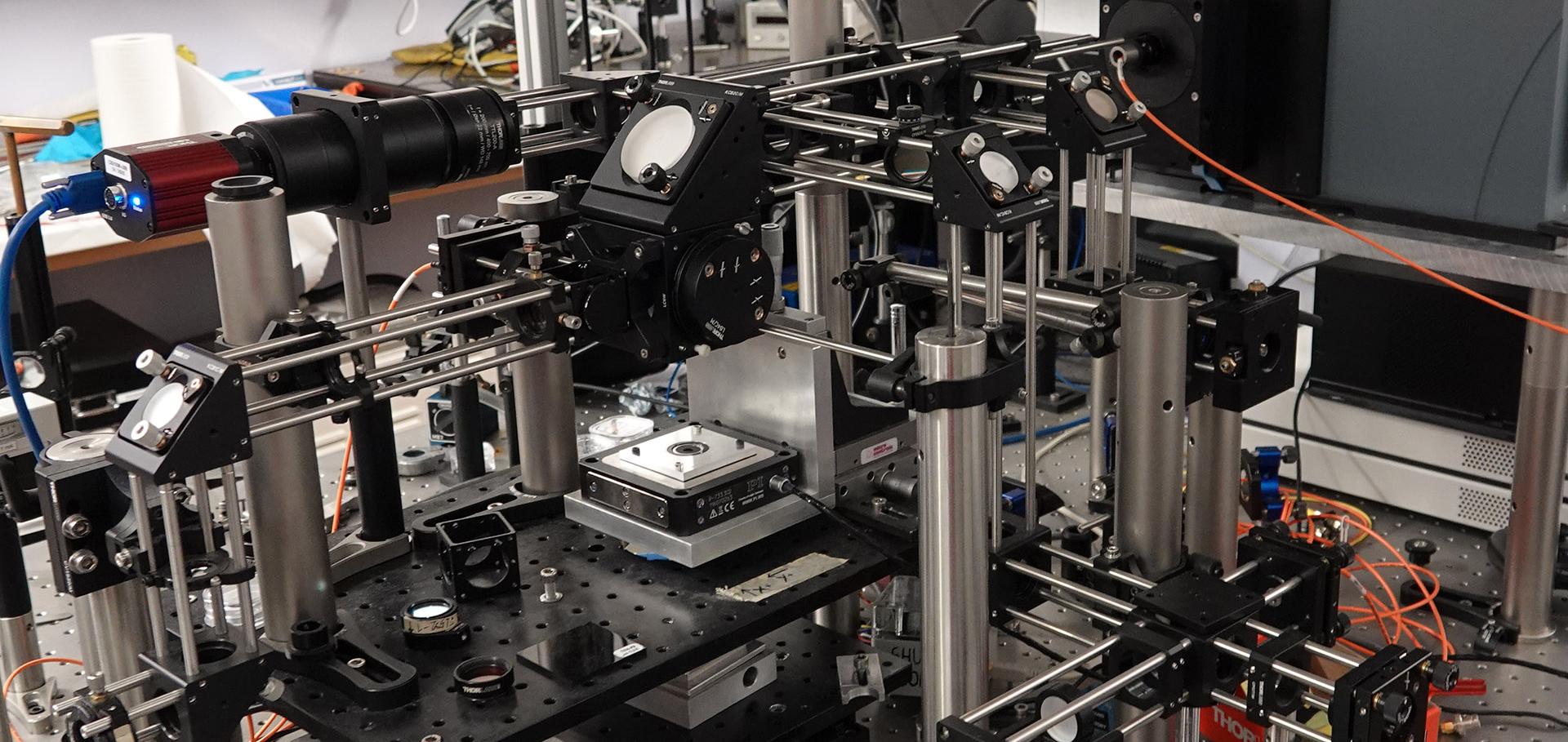
MicroPL optical setup

Professor Robert Taylor

Emeritus Professor of Condensed Matter Physics

Research theme

  • Photovoltaics and nanoscience

Sub department

  • Condensed Matter Physics

Research groups

  • Quantum Optoelectronics
Robert.Taylor@physics.ox.ac.uk
Telephone: 01865 (2)72230
Clarendon Laboratory, room 164
orcid.org/0000-0003-2578-9645
  • About
  • Teaching
  • Positions available
  • Publications

Lasing in perovskite nanocrystals

Image of transverse modes from lasing nanocrystals
Nano Research, 14, 108, 2021

Fabrication of ultrathin single-crystal diamond membranes

Advanced Materials 20:24 (2008) 4793-4798

Authors:

BA Fairchild, P Olivero, S Rubanov, AD Greentree, F Waldermann, RA Taylor, I Walmsley, JM Smith, S Huntington, BC Gibson, DN Jamieson, S Prawer

Abstract:

A method for preparing ultrathin single-crystal diamond membranes suitable for post-processing and liftout, is reported. The proposed method used single-crystal diamond substrates and two-energy ion implant process for the fabrication of thin diamond membranes. Two ion-implant process was used in this method to prepare two different damage layers within diamond sample. This method can be used for preparing integrated quantum-photonic structure based on color center in diamond. This method can also be used for fabricating various structures including Bragg gratings and whispering gallery mode resonators. A significant application of the diamond nanostructures is to fabricate the micro- and nanoscale cantilevers. It was also observed that the fabricated single-crystal diamond are suitable for another FIB processing.
More details from the publisher

Abnormal photoluminescence properties of GaN nanorods grown on Si(111) by molecular-beam epitaxy

Nanotechnology 19:47 (2008)

Authors:

YS Park, TW Kang, RA Taylor

Abstract:

We have studied the photoluminescence properties of GaN nanorods grown on Si(111) substrates by radio-frequency plasma-assisted molecular-beam epitaxy. The hexagonal shaped nanorods with lateral average diameters from 30 to 150 nm are obtained by controlling the Ga flux with a fixed amount of nitrogen. As the diameters decrease, the main emission lines assigned as donor bound excitons are blueshifted, causing a spectral overlap of this emission line with that of the free exciton at 10 K due to the quantum size effect in the GaN nanorods. The temperature-dependent photoluminescence spectra show an abnormal behaviour with an 'S-like' shape for higher diameter nanorods. The activation energy of the free exciton for GaN nanorods with different diameters was also evaluated. © 2008 IOP Publishing Ltd.
More details from the publisher

Towards registered single quantum dot photonic devices.

Nanotechnology 19:45 (2008) 455307

Authors:

KH Lee, FSF Brossard, M Hadjipanayi, X Xu, F Waldermann, AM Green, DN Sharp, AJ Turberfield, DA Williams, RA Taylor

Abstract:

We have registered the position and wavelength of a single InGaAs quantum dot using an innovative cryogenic laser lithography technique. This approach provides accurate marking of the location of self-organized dots and is particularly important for realizing any solid-state cavity quantum electrodynamics scheme where the overlap of the spectral and spatial characteristics of an emitter and a cavity is essential. We demonstrate progress in two key areas towards efficient single quantum dot photonic device implementation. Firstly, we show the registration and reacquisition of a single quantum dot with 50 and 150 nm accuracy, respectively. Secondly, we present data on the successful fabrication of a photonic crystal L3 cavity following the registration process.
More details from the publisher
More details

Experimental and theoretical study of the quantum-confined Stark effect in a single InGaN/GaN quantum dot under applied vertical electric field

Superlattices and Microstructures 43:5-6 (2008) 431-435

Authors:

AF Jarjour, RA Oliver, A Tahraoui, MJ Kappers, RA Taylor, CJ Humphreys

Abstract:

We present a study of the effect of externally applied vertical electric field on the optical properties of single InGaN/GaN quantum dots via microphotoluminescence spectroscopy. This is achieved by incorporating the quantum dot layer in the intrinsic region of a p-i-n diode structure. We observe a large blue energy shift of ∼60 meV, which is explained by the partial compensation of the internal piezoelectric field. The energy shift dependence on the applied field allows the determination of the vertical component of the permanent dipole and the polarizability. We also present theoretical modelling of our results based on atomistic semi-empirical tight-binding simulations. A good quantitative agreement between the experiment and the theory is found. © 2007 Elsevier Ltd. All rights reserved.
More details from the publisher

Experimental and theoretical study of the quantum-confined Stark effect in a single InGaN/GaN quantum dot under applied vertical electric field

SUPERLATTICE MICROST 43:5-6 (2008) 431-435

Authors:

AF Jarjour, RA Oliver, A Tahraoui, MJ Kappers, RA Taylor, CJ Humphreys

Abstract:

We present a study of the effect of externally applied vertical electric field on the optical properties of single InGaN/GaN quantum dots via microphotoluminescence spectroscopy. This is achieved by incorporating the quantum dot layer in the intrinsic region of a p-i-n diode structure. We observe a large blue energy shift of similar to 60 meV, which is explained by the partial compensation of the internal piezoelectric field. The energy shift dependence on the applied field allows the determination of the vertical component of the permanent dipole and the polarizability. We also present theoretical modelling of our results based on atomistic semi-empirical tight-binding simulations. A good quantitative agreement between the experiment and the theory is found. (C) 2007 Elsevier Ltd. All rights reserved.
More details from the publisher

Pagination

  • First page First
  • Previous page Prev
  • …
  • Page 47
  • Page 48
  • Page 49
  • Page 50
  • Current page 51
  • Page 52
  • Page 53
  • Page 54
  • Page 55
  • …
  • Next page Next
  • Last page Last

Footer Menu

  • Contact us
  • Giving to the Dept of Physics
  • Work with us
  • Media

User account menu

  • Log in

Follow us

FIND US

Clarendon Laboratory,

Parks Road,

Oxford,

OX1 3PU

CONTACT US

Tel: +44(0)1865272200

University of Oxfrod logo Department Of Physics text logo
IOP Juno Champion logo Athena Swan Silver Award logo

© University of Oxford - Department of Physics

Cookies | Privacy policy | Accessibility statement

Built by: Versantus

  • Home
  • Research
  • Study
  • Engage
  • Our people
  • News & Comment
  • Events
  • Our facilities & services
  • About us
  • Giving to Physics
  • Current students
  • Staff intranet