Home
Department Of Physics text logo
  • Research
    • Our research
    • Our research groups
    • Our research in action
    • Research funding support
    • Summer internships for undergraduates
  • Study
    • Undergraduates
    • Postgraduates
  • Engage
    • For alumni
    • For business
    • For schools
    • For the public
  • Support
Menu
Atomic and Laser Physics
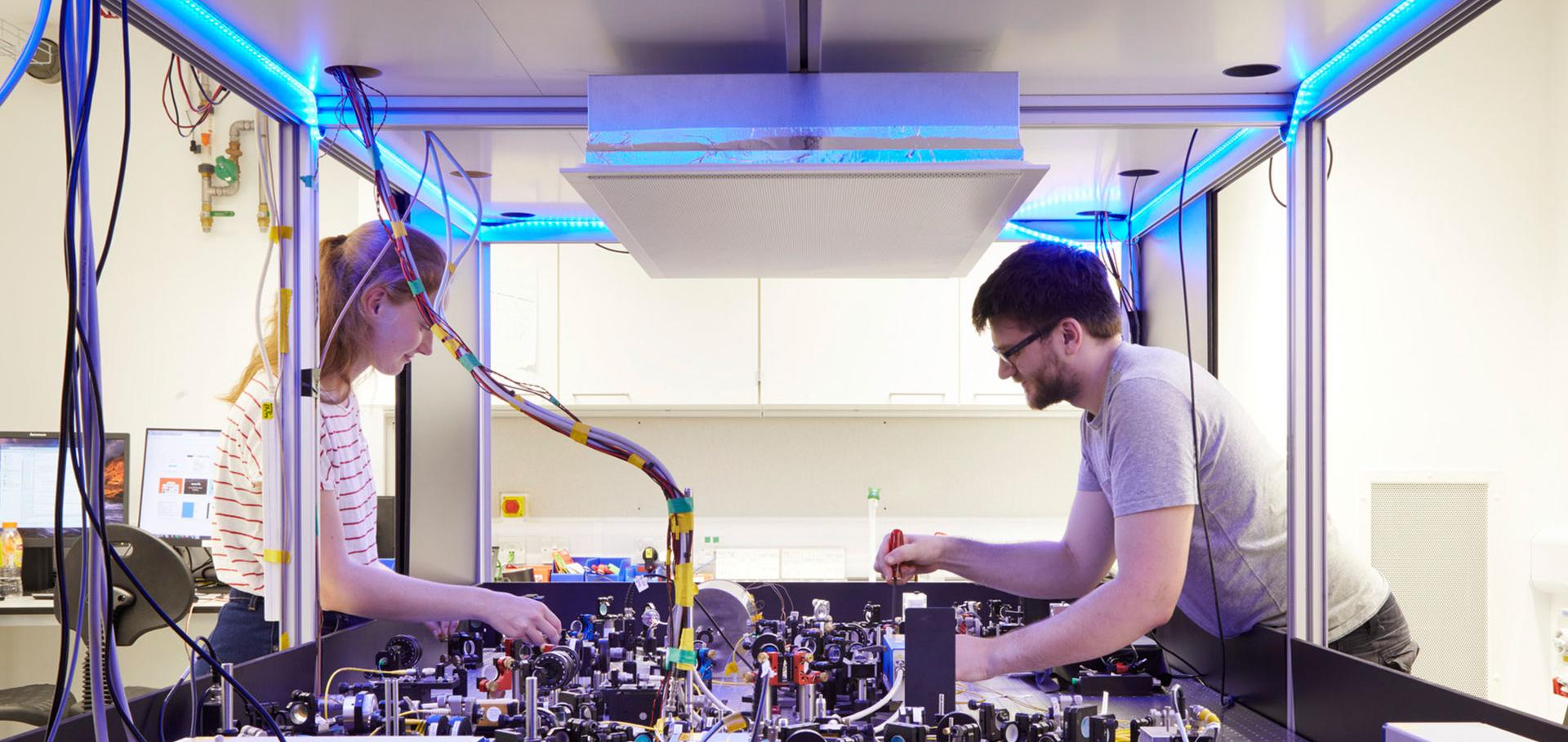
Credit: Jack Hobhouse

Prof Vlatko Vedral FInstP

Professor of Quantum Information Science

Sub department

  • Atomic and Laser Physics

Research groups

  • Frontiers of quantum physics
vlatko.vedral@physics.ox.ac.uk
Telephone: 01865 (2)72389
Clarendon Laboratory, room 241.8
  • About
  • Publications

Topological network analysis using a programmable photonic quantum processor

(2025)

Authors:

Shang Yu, Jinzhao Sun, Zhenghao Li, Ewan Mer, Yazeed K Alwehaibi, Oscar Scholin, Gerard J Machado, Kuan-Cheng Chen, Aonan Zhang, Raj B Patel, Ying Dong, Ian A Walmsley, Vlatko Vedral, Ginestra Bianconi
More details from the publisher

Bose-Marletto-Vedral experiment without observable spacetime superpositions

(2025)

Authors:

Nicetu Tibau Vidal, Chiara Marletto, Vlatko Vedral, Giulio Chiribella
More details from the publisher

Universal Quantum Computational Spectroscopy on a Quantum Chip

(2025)

Authors:

Chonghao Zhai, Jinzhao Sun, Jieshan Huang, Jun Mao, Hongchang Bao, Siyuan Zhang, Qihuang Gong, Vlatko Vedral, Xiao Yuan, Jianwei Wang
More details from the publisher

Temporal Entanglement and Witnesses of Non-Classicality

(2025)

Authors:

Giuseppe Di Pietra, Gaurav Bhole, James Eaton, Andrew J Baldwin, Jonathan A Jones, Vlatko Vedral, Chiara Marletto

Quantum mutual information in time

New Journal of Physics IOP Publishing 27:6 (2025) 064504

Authors:

Zhen Wu, Arthur J Parzygnat, Vlatko Vedral, James Fullwood

Abstract:

While the quantum mutual information is a fundamental measure of quantum information, it is only defined for spacelike separated quantum systems. Such a limitation is not present in the theory of classical information, where the mutual information between two random variables is well-defined irrespective of whether or not the variables are separated in space or separated in time. Motivated by this disparity between the classical and quantum mutual information, we employ the pseudo-density matrix formalism to define a simple extension of quantum mutual information into the time domain. As in the spatial case, we show that such a notion of quantum mutual information in time serves as a natural measure of correlation between timelike separated systems, while also highlighting ways in which quantum correlations distinguish between space and time. We also show how such quantum mutual information is time-symmetric with respect to quantum Bayesian inversion, and then we conclude by showing how quantum mutual information in time yields a Holevo bound for the amount of classical information that may be extracted from sequential measurements on an ensemble of quantum states.
More details from the publisher
Details from ORA

Pagination

  • First page First
  • Previous page Prev
  • Page 1
  • Page 2
  • Page 3
  • Current page 4
  • Page 5
  • Page 6
  • Page 7
  • Page 8
  • Page 9
  • …
  • Next page Next
  • Last page Last

Footer Menu

  • Contact us
  • Giving to the Dept of Physics
  • Work with us
  • Media

User account menu

  • Log in

Follow us

FIND US

Clarendon Laboratory,

Parks Road,

Oxford,

OX1 3PU

CONTACT US

Tel: +44(0)1865272200

University of Oxfrod logo Department Of Physics text logo
IOP Juno Champion logo Athena Swan Silver Award logo

© University of Oxford - Department of Physics

Cookies | Privacy policy | Accessibility statement

Built by: Versantus

  • Home
  • Research
  • Study
  • Engage
  • Our people
  • News & Comment
  • Events
  • Our facilities & services
  • About us
  • Giving to Physics
  • Current students
  • Staff intranet