

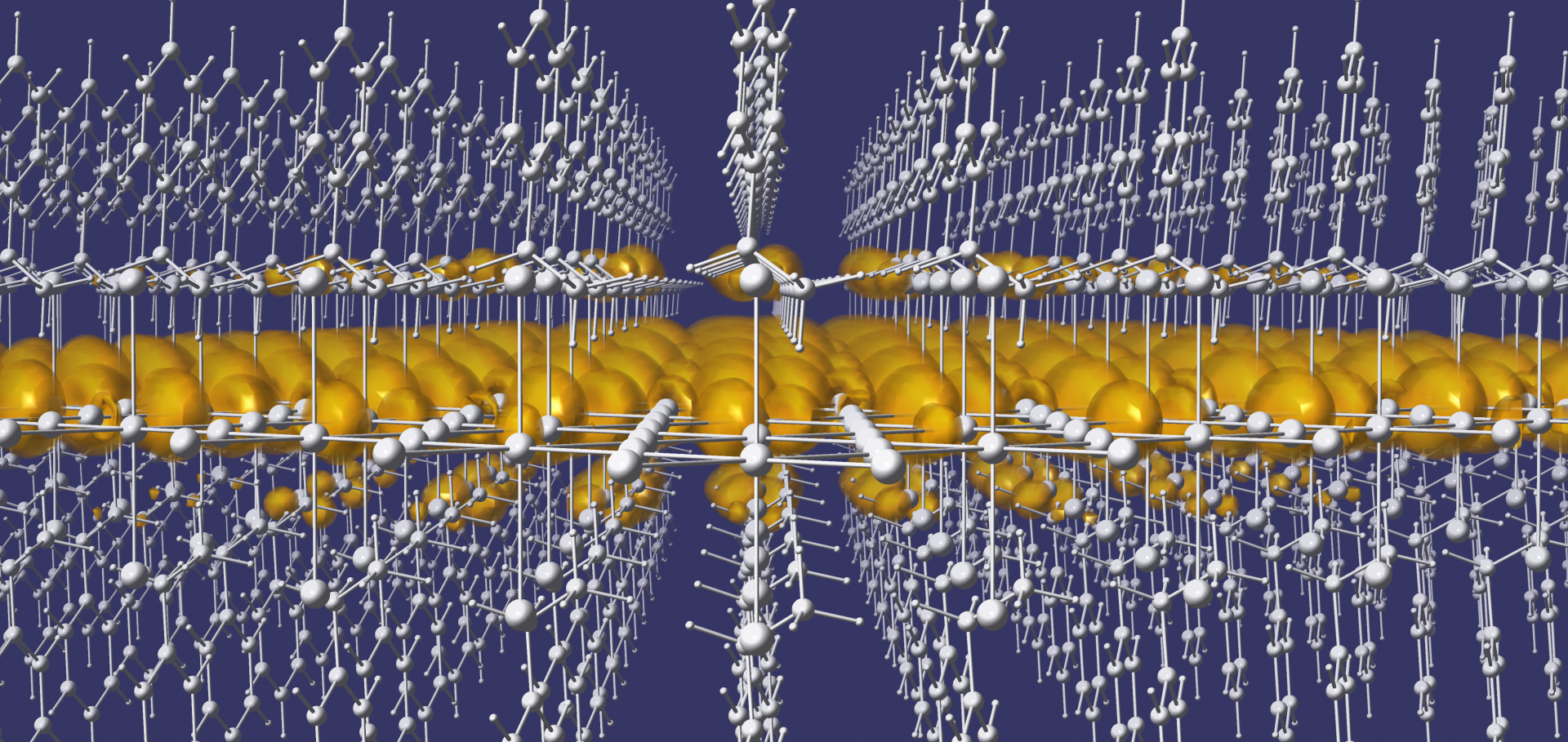
Fused borophenes: A new family of superhard light-weight materials
Physical Review Materials American Physical Society (APS) 5:8 (2021) L080601
Phonon Screening of Excitons in Semiconductors: Halide Perovskites and Beyond.
Physical review letters American Physical Society (APS) 127:6 (2021) 67401
Abstract:
The ab initio Bethe-Salpeter equation (BSE) approach, an established method for the study of excitons in materials, is typically solved in a limit where only static screening from electrons is captured. Here, we generalize this framework to include dynamical screening from phonons at lowest order in the electron-phonon interaction. We apply this generalized BSE approach to a series of inorganic lead halide perovskites, CsPbX_{3}, with X=Cl, Br, and I. We find that inclusion of screening from phonons significantly reduces the computed exciton binding energies of these systems. By deriving a simple expression for phonon screening effects, we reveal general trends for their importance in semiconductors and insulators, based on a hydrogenic exciton model. We demonstrate that the magnitude of the phonon screening correction in isotropic materials can be reliably predicted using four material specific parameters: the reduced effective mass, static and optical dielectric constants, and frequency of the most strongly coupled longitudinal-optical phonon mode. This framework helps to elucidate the importance of phonon screening and its relation to excitonic properties in a broad class of semiconductors.Band gaps of crystalline solids from Wannier-localization-based optimal tuning of a screened range-separated hybrid functional.
Proceedings of the National Academy of Sciences of the United States of America 118:34 (2021) ARTN e2104556118
Abstract:
Accurate prediction of fundamental band gaps of crystalline solid-state systems entirely within density functional theory is a long-standing challenge. Here, we present a simple and inexpensive method that achieves this by means of nonempirical optimal tuning of the parameters of a screened range-separated hybrid functional. The tuning involves the enforcement of an ansatz that generalizes the ionization potential theorem to the removal of an electron from an occupied state described by a localized Wannier function in a modestly sized supercell calculation. The method is benchmarked against experiment for a set of systems ranging from narrow band-gap semiconductors to large band-gap insulators, spanning a range of fundamental band gaps from 0.2 to 14.2 electronvolts (eV), and is found to yield quantitative accuracy across the board, with a mean absolute error of ∼0.1 eV and a maximal error of ∼0.2 eV.Hot electron cooling in InSb probed by ultrafast time-resolved terahertz cyclotron resonance
Physical Review B American Physical Society 103 (2021) 245205
Abstract:
Measuring terahertz (THz) conductivity on an ultrafast time scale is an excellent way to observe charge-carrier dynamics in semiconductors as a function of time after photoexcitation. However, a conductivity measurement alone cannot separate the effects of charge-carrier recombination from effective mass changes as charges cool and experience different regions of the electronic band structure. Here we present a form of time-resolved magneto-THz spectroscopy which allows us to measure cyclotron effective mass on a picosecond time scale. We demonstrate this technique by observing electron cooling in the technologically-significant narrow-bandgap semiconductor indium antimonide (InSb). A significant reduction of electron effective mass from 0.032 me to 0.017 me is observed in the first 200 ps after injecting hot electrons. Measurement of electron effective mass in InSb as a function of photo-injected electron density agrees well with conduction band non-parabolicity predictions from ab initio calculations of the quasiparticle band structure.Phonon Screening of Excitons in Semiconductors: Halide Perovskites and Beyond
(2021)