

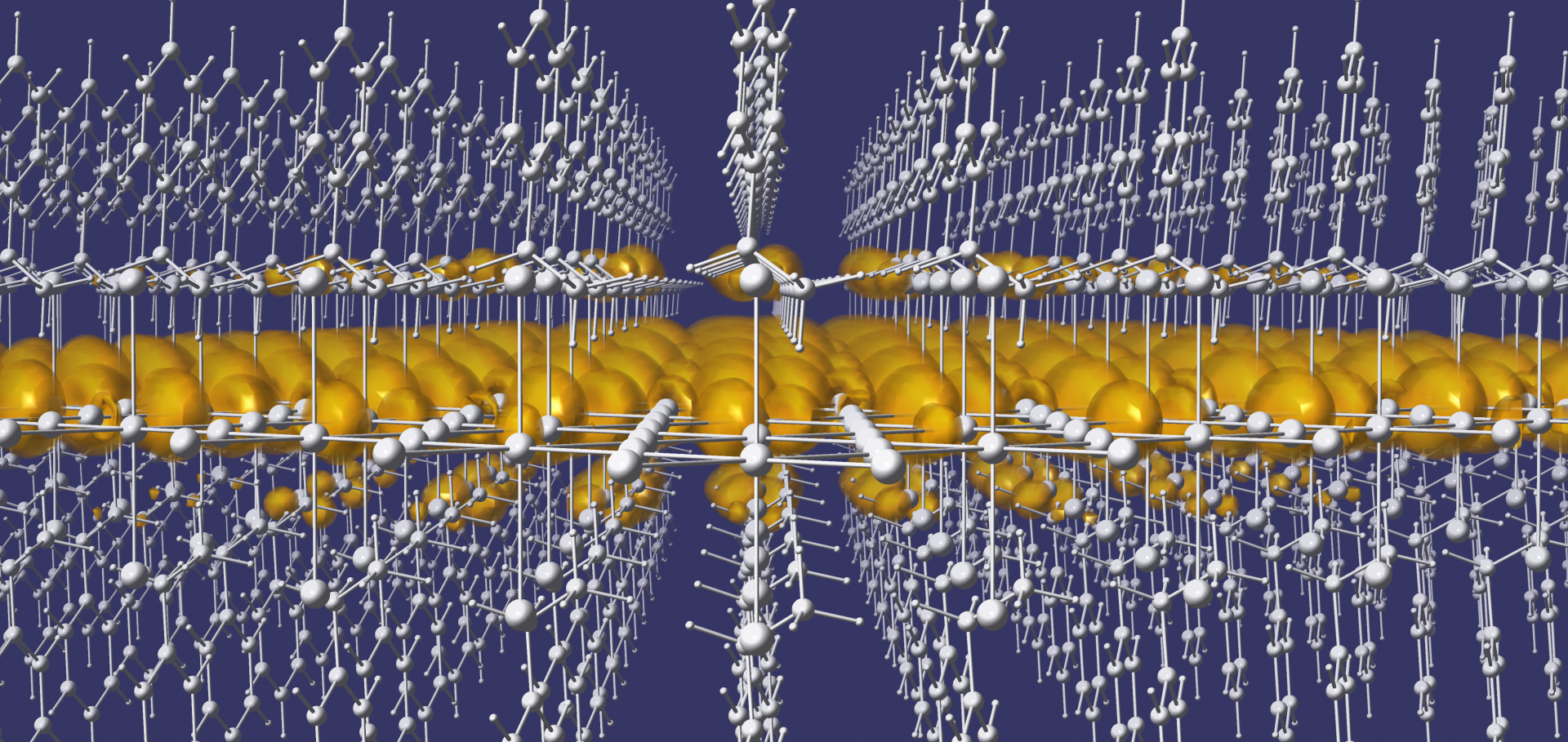
Localized Soft Vibrational Modes and Coherent Structural Phase Transformations in Rutile TiO2 Nanoparticles under Negative Pressure.
Abstract:
We study the effect of size on the vibrational modes and frequencies of nanoparticles, by applying a newly developed, robust, and efficient first-principles-based method that we present in outline. We focus on rutile TiO2, a technologically important material whose bulk exhibits a softening of a transverse acoustic mode close to q=(12,12,14), which becomes unstable with the application of negative pressure. We demonstrate that, under these conditions, nanoparticles above a critical size exhibit unstable localized modes and we calculate their characteristic localization length and decomposition with respect to bulk phonons. We propose that such localized soft modes could initiate coherent structural phase transformations in small nanoparticles above a critical size.Screening of Excitons by Organic Cations in Quasi-Two-Dimensional Organic-Inorganic Lead-Halide Perovskites.
Abstract:
Interlayer organic cations in quasi-two-dimensional halide perovskites are a versatile tuning vehicle for the optoelectronic properties of these complex systems, but chemical intuition for this design route is yet to be established. Here, we use density functional theory, the GW approximation, and the Bethe-Salpeter equation approach to understand the contribution of the organic cation to the quasiparticle band gap and exciton binding energy of layered perovskites. We show that organic cations in quasi-two-dimensional perovskites contribute significantly to the dielectric screening in these systems, countering quantum confinement effects on the quasiparticle band gap and the exciton binding energy. Using a simple electrostatics model inspired by parallel-plate capacitors, we decouple the organic cation and inorganic layer contributions to the effective dielectric constants and show that dielectric properties of layered perovskites are broadly tunable via the interlayer cation, providing a direct means of tuning photophysical properties for a variety of applications.Pressure-induced electronic transitions in samarium monochalcogenides
Abstract:
The pressure-induced isostructural insulator-to-metal transition for SmS is characterized by the presence of an intermediate valence state at higher pressure which cannot be captured by density functional theory. As a direct outcome of including the charge and spin fluctuations incorporated in dynamical mean-field theory, we see the emergence of insulating and metallic phases with increasing pressure as a function of changing valence. This is accompanied by significantly improved predictions of the equilibrium lattice constants and bulk moduli for all Sm monochalcogenides verifying experiments. Nudged elastic band analysis reveals the insulating states to have a finite quasiparticle weight, decreasing as the gap closes rendering the transition to be not Mott-like, and classifies these materials as correlated band insulators. The difference between the discontinuous and continuous natures of these transitions can be attributed to the closeness of the sharply resonant Sm-4f peaks to the Fermi level in the predicted metallic states in SmS compared with SmSe and SmTe.Optimally tuned starting point for single-shot GW calculations of solids
Abstract:
The dependence of ab initio many-body perturbation theory within the GW approximation on the eigensystem used in calculating quasiparticle corrections limits this method's predictive power. Here, we investigate the accuracy of the recently developed Wannier-localized optimally tuned screened range-separated hybrid (WOT-SRSH) functional as a generalized Kohn-Sham starting point for single-shot GW (G0W0) calculations for a range of semiconductors and insulators. Comparison to calculations based on well-established functionals, namely, PBE, PBE0, and HSE, as well as to self-consistent GW schemes and to experiment, shows that band gaps computed via G0W0@WOT-SRSH have a level of precision and accuracy that is comparable to that of more advanced methods such as quasiparticle self-consistent GW and eigenvalue self-consistent GW. We also find that G0W0@WOT-SRSH improves the description of states deeper in the valence band manifold. Finally, we show that G0W0@WOT-SRSH significantly reduces the sensitivity of computed band gaps to ambiguities in the underlying WOT-SRSH tuning procedure.