

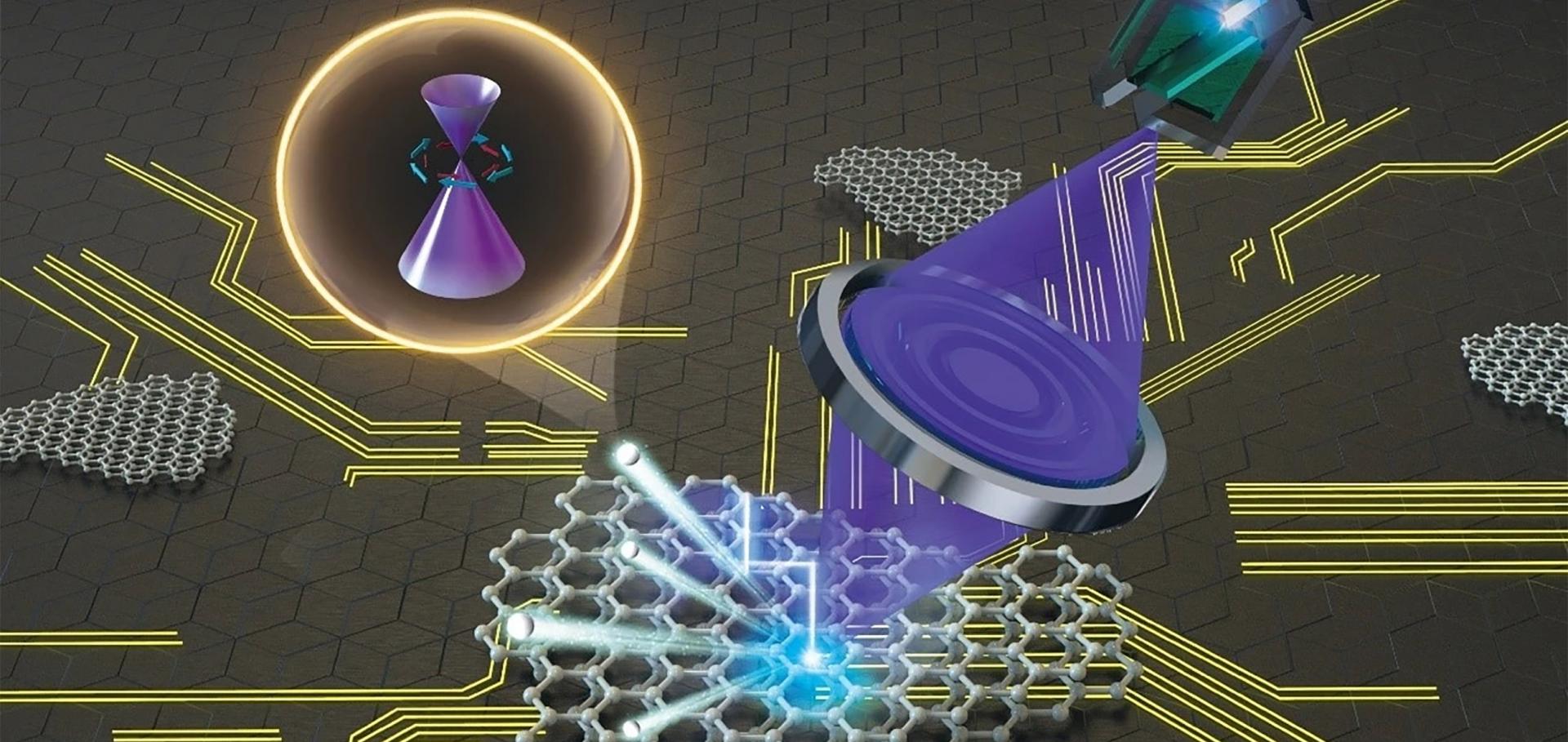
Photonic topological insulator with broken time-reversal symmetry
Proceedings of the National Academy of Sciences of the United States of America Proceedings of the National Academy of Sciences 113:18 (2016) 4924-4928
Electronic Structure, Surface Doping, and Optical Response in Epitaxial WSe2 Thin Films
Nano Letters American Chemical Society (ACS) 16:4 (2016) 2485-2491
Selectively enhanced photocurrent generation in twisted bilayer graphene with van Hove singularity
Nature Communications Springer Nature 7:1 (2016) 10699
Evolution of the Fermi surface of Weyl semimetals in the transition metal pnictide family.
Nature materials Nature Publishing Groupt 15:1 (2016) 27-31
Abstract:
Topological Weyl semimetals (TWSs) represent a novel state of topological quantum matter which not only possesses Weyl fermions (massless chiral particles that can be viewed as magnetic monopoles in momentum space) in the bulk and unique Fermi arcs generated by topological surface states, but also exhibits appealing physical properties such as extremely large magnetoresistance and ultra-high carrier mobility. Here, by performing angle-resolved photoemission spectroscopy (ARPES) on NbP and TaP, we directly observed their band structures with characteristic Fermi arcs of TWSs. Furthermore, by systematically investigating NbP, TaP and TaAs from the same transition metal monopnictide family, we discovered their Fermiology evolution with spin-orbit coupling (SOC) strength. Our experimental findings not only reveal the mechanism to realize and fine-tune the electronic structures of TWSs, but also provide a rich material base for exploring many exotic physical phenomena (for example, chiral magnetic effects, negative magnetoresistance, and the quantum anomalous Hall effect) and novel future applications.Experimental observation of incoherent-coherent crossover and orbital-dependent band renormalization in iron chalcogenide superconductors
Physical Review B American Physical Society (APS) 92:23 (2015) 235138