

Temperature, Composition, and Cloud structure in Atmosphere of Uranus from MIRI-MRS and NIRSpec-IFU Spectra
(2025)
Abstract:
The Rise and Fall of a Mid-West Tilt: Seasonal Evolution of Titan’s Stratospheric Tilt Axis
(2025)
Abstract:
The bolometric Bond albedo and energy balance of Uranus
(2025)
Abstract:
The impact of cloud microphysics on the atmospheric dynamics of hot Jupiters
Copernicus Publications (2025)
Abstract:
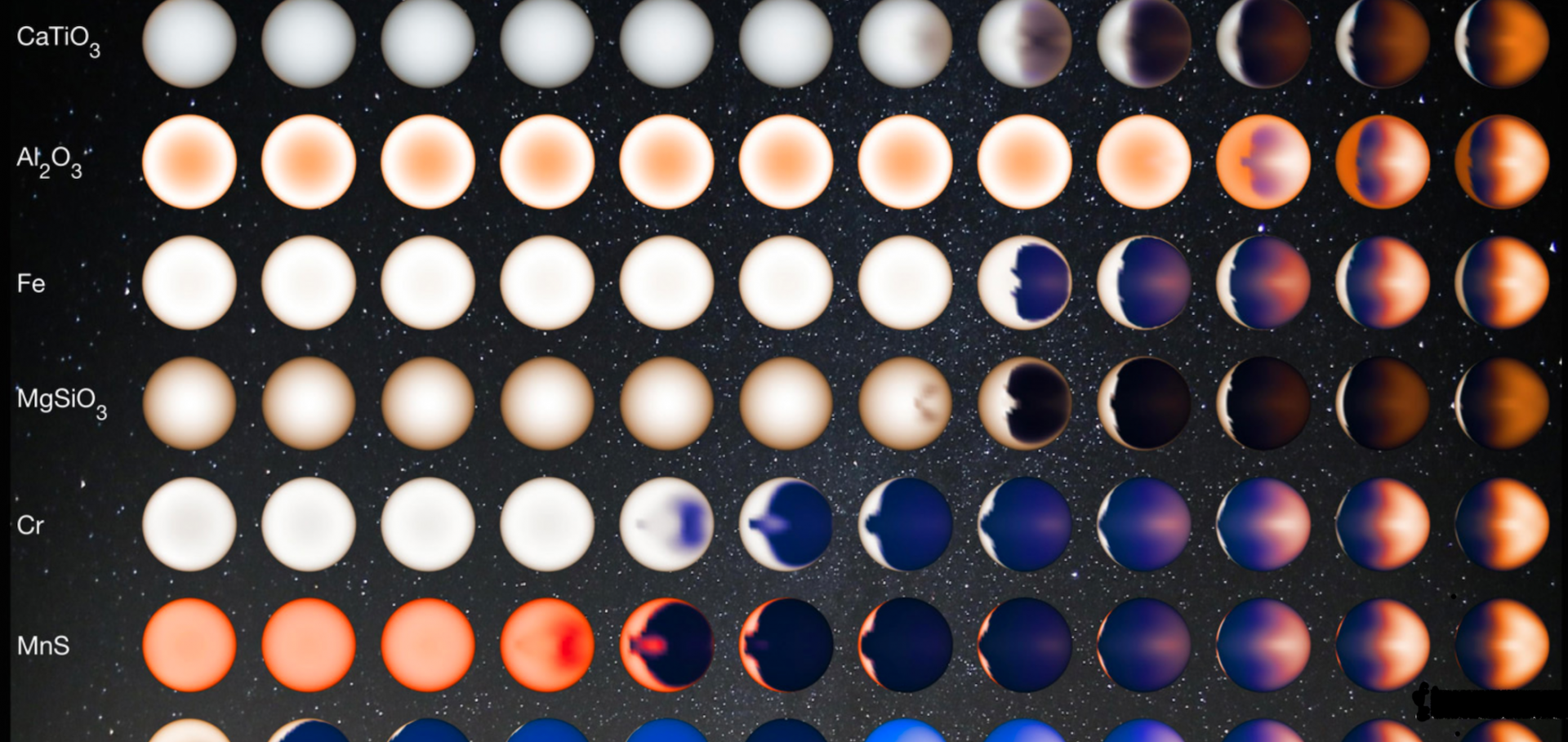
Recent JWST transmission and emission spectroscopic observation of hot Jupiters have demonstrated that mineral clouds are likely common in hot Jupiter atmospheres. These mineral clouds have long been predicted to form and persist on the nightside and western dayside of hot Jupiters by cloud microphysical models and 3D General Circulation Models. Given the capability of JWST and recent advancements in modeling techniques, the time is right to determine the prevalence and distribution of mineral clouds across the parameter regime of hot Jupiters in order to provide a detailed test of our theoretical understanding of cloud nucleation, transport and growth processes, and the radiative feedback of clouds on the atmospheric circulation and climate of hot Jupiters. In this work, we develop an indirectly coupled cloud microphysics and atmospheric dynamics framework in order to present theoretical expectations for the 3D distribution of mineral clouds across hot Jupiter planetary parameter space. To do so, we develop a fundamental understanding of the cloud speciation alongside particle size and spatial distribution by feeding the results of 3D cloud-free GCMs into 1D CARMA cloud microphysics simulations. We then use these results to drive 3D MITgcm simulations of hot Jupiters with cloud-radiative feedback. We use a grid of GCM simulations to assess the radiative impact on clouds of the climates of hot and ultra-hot Jupiters. Notably, we find that mineral cloud particle size distributions are not ubiquitously unimodal and log-normal, leading to potentially stark differences between the 3D cloud distributions in our work compared to previous work that assumed a single log-normal cloud particle size distribution. Finally, we will discuss paths forward toward coupling the cloud microphysics and atmospheric dynamics of hot Jupiters using a modeling hierarchy encompassing multi-dimensional cloud microphysics and atmospheric dynamics.Using SOFIA’s EXES to improve the upper limits for C6H2 and C4N2 in Titan’s atmosphere
(2025)