

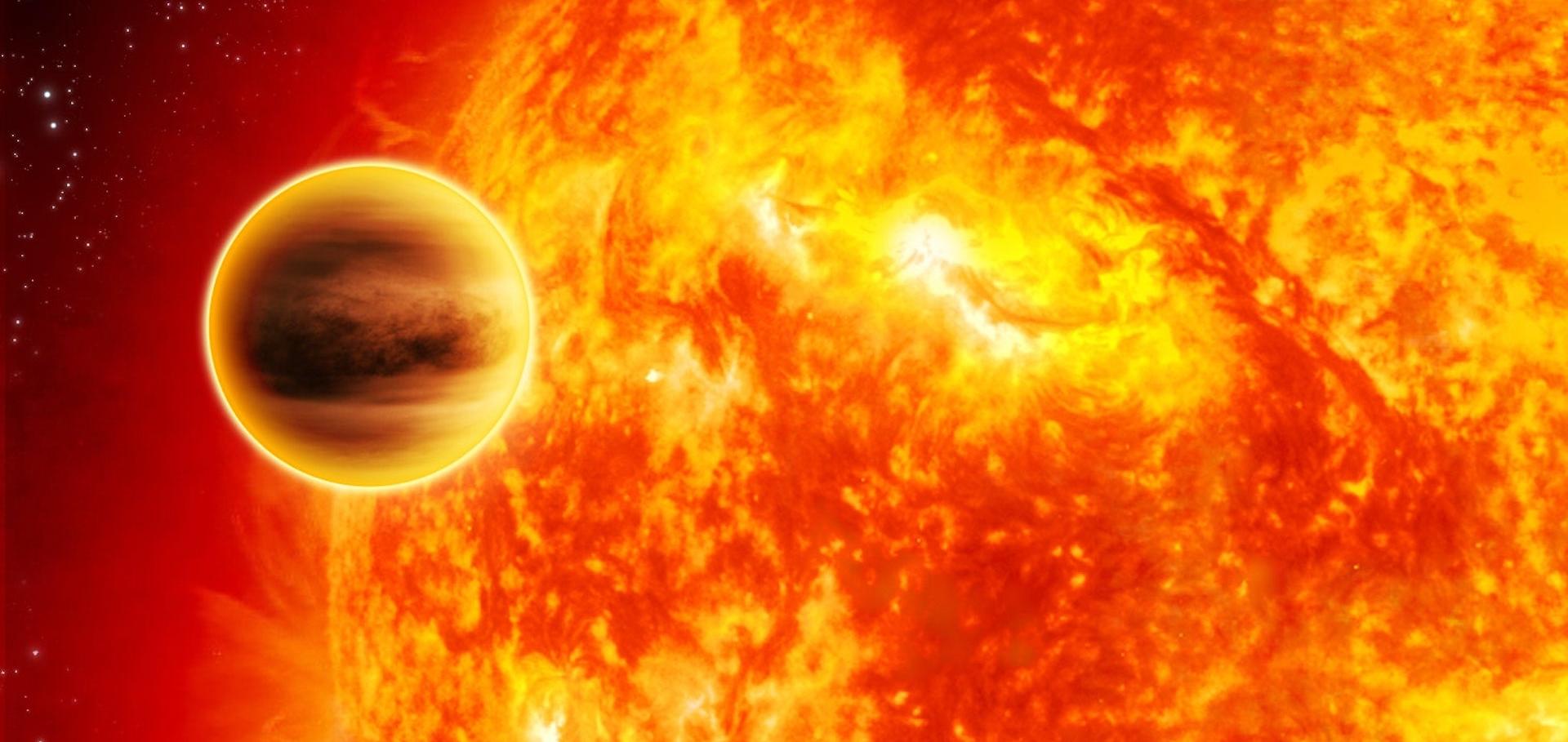
Gravity-darkening Analysis of the Misaligned Hot Jupiter MASCARA-4 b
Astrophysical Journal 888:2 (2020)
Abstract:
MASCARA-4 b is a hot Jupiter in a highly misaligned orbit around a rapidly rotating A3V star that was observed for 54 days by the Transiting Exoplanet Survey Satellite (TESS). We perform two analyses of MASCARA-4 b using a stellar gravity-darkened model. First, we measure MASCARA-4 b's misaligned orbital configuration by modeling its TESS photometric light curve. We take advantage of the asymmetry in MASCARA-4 b's transit due to its host star's gravity-darkened surface to measure MASCARA-4 b's true spin-orbit angle to be 104°. We also detect a ∼4σ secondary eclipse at 0.491 � 0.007 orbital phase, proving that the orbit is slightly eccentric. Second, we model MASCARA-4 b's insolation including gravity darkening and find that the planet's received X-ray and ultraviolet flux varies by 4% throughout its orbit. MASCARA-4 b's short-period, polar orbit suggests that the planet likely underwent dramatic orbital evolution to end up in its present-day configuration and that it receives a varying stellar irradiance that perpetually forces the planet out of thermal equilibrium. These findings make MASCARA-4 b an excellent target for follow-up characterization to better understand the orbital evolution and present-day environment of planets around high-mass stars.Evidence for H2 dissociation and recombination heat transport in the atmosphere of KELT-9b
Astrophysical Journal Letters American Astronomical Society 888:2 (2020) L15
A robust, template-free approach to precise radial velocity extraction
Monthly Notices of the Royal Astronomical Society Oxford University Press 492:3 (2020) 3960-3983
Abstract:
Doppler spectroscopy is a powerful tool for discovering and characterizing exoplanets. For decades, the standard approach to extracting radial velocities (RVs) has been to cross-correlate observed spectra with a weighted template mask. While still widely used, this approach is known to suffer numerous drawbacks, and so in recent years increasing attention has been paid to developing new and improved ways of extracting RVs. In this proof-of-concept paper, we present a simple yet powerful approach to RV extraction. We use Gaussian processes to model and align all pairs of spectra with each other; we combine the pairwise RVs thus obtained to produce accurate differential stellar RVs, without constructing any template. Doing this on a highly localized basis enables a data-driven approach to identifying and mitigating spectral contamination, even without the input of any prior astrophysical knowledge. We show that a crude implementation of this method applied to an inactive standard star yields RVs with comparable precision to and significantly lower rms variation than RVs from industry-standard pipelines. Though amenable to numerous improvements, even in its basic form presented here our method could facilitate the study of smaller planets around a wider variety of stars than has previously been possible.Erratum: “An 11 Earth-mass, Long-period Sub-Neptune Orbiting a Sun-like Star” (2019, AJ, 158, 165)
The Astronomical Journal American Astronomical Society 159:1 (2020) 34-34
Detection of Ionized Calcium in the Atmosphere of the Ultra-hot Jupiter KELT-9b
The Astrophysical Journal Letters American Astronomical Society 888:1 (2020) l13