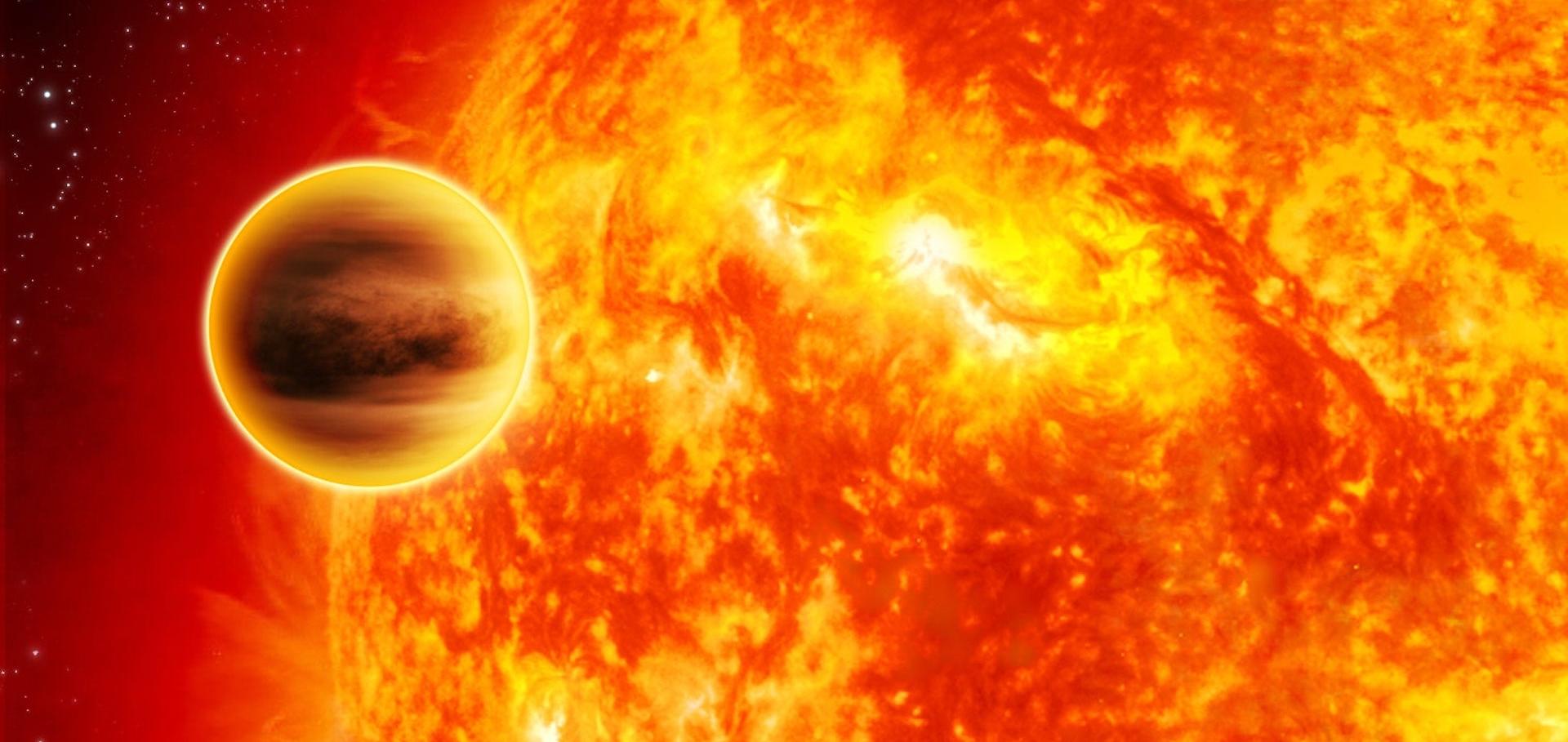
A HARPS-N mass for the elusive Kepler-37d: a case study in disentangling stellar activity and planetary signals

(2021)

Authors:

VM Rajpaul, LA Buchhave, G Lacedelli, K Rice, A Mortier, L Malavolta, S Aigrain, L Borsato, AW Mayo, D Charbonneau, M Damasso, X Dumusque, A Ghedina, DW Latham, M López-Morales, A Magazzù, G Micela, E Molinari, F Pepe, G Piotto, E Poretti, S Rowther, A Sozzetti, S Udry, CA Watson

High-contrast observations of brown dwarf companion HR 2562 B with the vector Apodizing Phase Plate coronagraph

Monthly Notices of the Royal Astronomical Society Oxford University Press (OUP) 506:3 (2021) 3224-3238

Authors:

Ben J Sutlieff, Alexander J Bohn, Jayne L Birkby, Matthew A Kenworthy, Katie M Morzinski, David S Doelman, Jared R Males, Frans Snik, Laird M Close, Philip M Hinz, David Charbonneau

Geophysical constraints on the properties of a subglacial lake in northwest Greenland

Cryosphere 15:7 (2021) 3279-3291

Authors:

R Maguire, N Schmerr, E Pettit, K Riverman, C Gardner, DN Dellagiustina, B Avenson, N Wagner, AG Marusiak, N Habib, JI Broadbeck, VJ Bray, SH Bailey

Abstract:

In this study, we report the results of an active-source seismology and ground-penetrating radar survey performed in northwestern Greenland at a site where the presence of a subglacial lake beneath the accumulation area has previously been proposed. Both seismic and radar results show a flat reflector approximately 830-845ĝ€¯m below the surface, with a seismic reflection coefficient of -0.43ĝ€¯±ĝ€¯0.17, which is consistent with the acoustic impedance contrast between a layer of water and glacial ice. Additionally, in the seismic data we observe an intermittent lake bottom reflection arriving between 14-20ĝ€¯ms after the lake top reflection, corresponding to a lake depth of approximately 10-15ĝ€¯m. A strong coda following the lake top and lake bottom reflections is consistent with a package of lake bottom sediments although its thickness and material properties are uncertain. Finally, we use these results to conduct a first-order assessment of the lake origins using a one-dimensional thermal model and hydropotential modeling based on published surface and bed topography. Using these analyses, we narrow the lake origin hypotheses to either anomalously high geothermal flux or hypersalinity due to local ancient evaporite. Because the origins are still unclear, this site provides an intriguing opportunity for the first in situ sampling of a subglacial lake in Greenland, which could better constrain mechanisms of subglacial lake formation, evolution, and relative importance to glacial hydrology.

Decomposing the iron cross-correlation signal of the ultra-hot Jupiter WASP-76b in transmission using 3D Monte Carlo radiative transfer

Monthly Notices of the Royal Astronomical Society Oxford University Press (OUP) 506:1 (2021) 1258-1283

Authors:

Joost P Wardenier, Vivien Parmentier, Elspeth KH Lee, Michael R Line, Ehsan Gharib-Nezhad

Simulating gas giant exoplanet atmospheres with Exo-FMS: comparing semigrey, picket fence, and correlated-k radiative-transfer schemes

Monthly Notices of the Royal Astronomical Society Royal Astronomical Society 506:2 (2021) 2695-2711

Authors:

Elspeth KH Lee, Vivien Parmentier, Mark Hammond, Simon L Grimm, Daniel Kitzmann, Xianyu Tan, Shang-Min Tsai, Raymond T Pierrehumbert

Abstract:

Radiative-transfer (RT) is a fundamental part of modelling exoplanet atmospheres with general circulation models (GCMs). An accurate RT scheme is required for estimates of the atmospheric energy transport and for gaining physical insight from model spectra. We implement three RT schemes for Exo-FMS: semigrey, non-grey ‘picket fence’, and real gas with correlated-k. We benchmark the Exo-FMS GCM, using these RT schemes to hot Jupiter simulation results from the literature. We perform a HD 209458b-like simulation with the three schemes and compare their results. These simulations are then post-processed to compare their observable differences. The semigrey scheme results show qualitative agreement with previous studies in line with variations seen between GCM models. The real gas model reproduces well the temperature and dynamical structures from other studies. After post-processing our non-grey picket fence scheme compares very favourably with the real gas model, producing similar transmission spectra, emission spectra, and phase curve behaviours. Exo-FMS is able to reliably reproduce the essential features of contemporary GCM models in the hot gas giant regime. Our results suggest the picket fence approach offers a simple way to improve upon RT realism beyond semigrey schemes.