

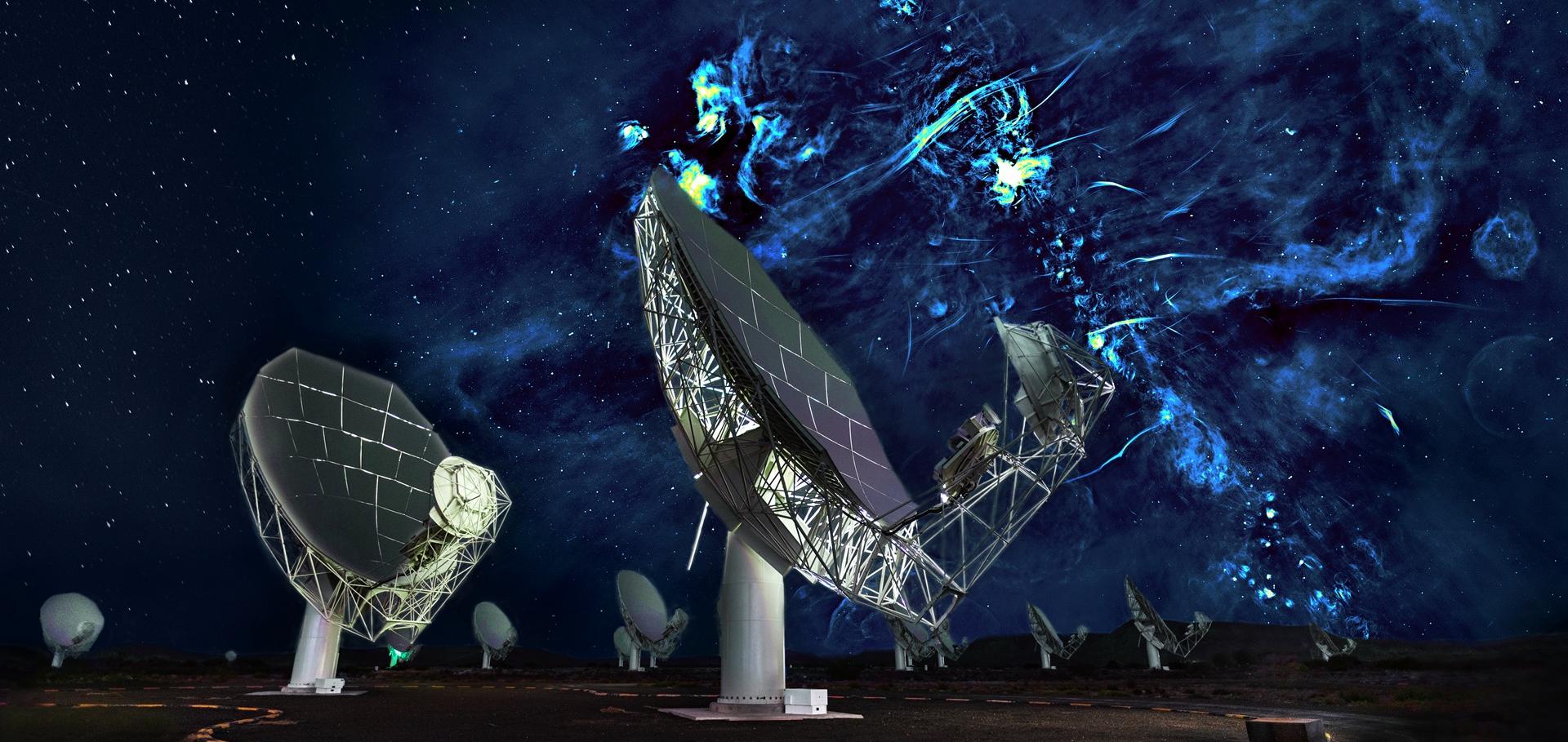
Large-scale radio bubbles around the black hole transient V4641 Sgr
(2026)
Evidence of mutually exclusive outflow forms from a black hole X-ray binary
Nature Astronomy (2026) 1-9
Abstract:
Accretion onto black holes often leads to the launch of outflows that substantially influence their surrounding environments. The two primary forms of these outflows are X-ray disk winds—hot, ionized gases ejected from the accretion disk—and relativistic jets, which are collimated streams of particles often expelled along the rotational axis of the black hole. While previous studies have revealed a general association between spectral states and different types of outflow, the physical mechanisms governing wind and jet formation remain debated. Here, using coordinated NICER and MeerKAT observations of the recurrent black hole X-ray binary 4U 1630–472, we identify a clear anti-correlation between X-ray disk winds and jets: during three recent outbursts, only one type of outflow is detected at a time. Notably, this apparent exclusivity occurs even as the overall accretion luminosity remains within the range expected for a standard thin disk, characteristic of the canonical soft state. These results suggest a competition between outflow channels that may depend on how the accretion energy is partitioned between the disk and the corona. Our findings provide observational constraints on jet and wind formation in X-ray binaries and offer a fresh perspective on the interplay between different modes of accretion-driven feedback.The Radio Afterglow of the Ultralong GRB 220627A
The Astrophysical Journal American Astronomical Society 996:1 (2026) 22
Abstract:
We present the discovery of the radio afterglow of the most distant ultralong gamma-ray burst (GRB) detected to date, GRB 220627A at redshift z = 3.084. Its prompt gamma-ray light curve shows a double-pulse profile, with the pulses separated by a period of quiescence lasting ∼15 minutes, leading to early speculation it could be a strongly gravitationally lensed GRB. However, our analysis of the Fermi Gamma-ray Burst Monitor spectra taken during the time intervals of both pulses show clear differences in their spectral energy distributions, disfavouring the lensing scenario. We observed the radio afterglow from 7 to 456 days postburst: an initial, steep decay (Fν ∝ t−2) is followed by a shallower decline (Fν ∝ t−1/2) after ∼20 days. There are three scenarios that could explain these radio properties: (i) energy injection from an additional, slower ejecta component catching up to the external shock; (ii) a stratified density profile going as n ∝ r−8/3; or alternatively, (iii) the presence of a slow, wide ejecta component in addition to a fast, narrow ejecta component. We also conducted an independent test of the lensing hypothesis via very long baseline interferometry (VLBI) observations at ∼12 days postburst by searching, for the first time, for multiple images of the candidate lensed GRB afterglow. Our experiment highlighted the growing need for developments in real-time correlation capabilities for time-critical VLBI experiments, particularly as we advance towards the SKA and ngVLA era of radio astronomy.WHITE DWARF + M DWARF DETACHED BINARIES IN LONG PERIOD RADIO TRANSIENTS: OBSERVED BINARY PARAMETERS, EVOLUTION, AND POPULATION CONSTRAINTS
Open Journal of Astrophysics 9 (2026)
Abstract:
Long period radio transients (LPTs) are the slowest radio-pulsing sources ever found, with the current population spanning periods of seven minutes to over six hours. Two of the fourteen published LPTs, ILT J1101+5521 and GLEAM-X J0704–37, have been associated with an M dwarf closely orbiting a white dwarf (WD) through optical spectroscopy. Here, we present new Keck I/LRIS optical spectroscopy of ILT J1101+5521, which reveals Hα emission from the M dwarf and confirms an orbital period nearly matching the radio period (2.092 hr). Radio pulses in both systems arrive just after maximum M dwarf redshift, assuming the radio period matches the orbital period. Based on Gaia proper motions and systemic velocities, we find that these systems are likely members of the Galactic thick disk. Both systems harbor unusually massive and cool WDs, with MUVOIR Spectrum, X-Ray Emission, and Proper Motion of the Isolated Neutron Star RX J2143.0+0654 * * Based on observations made with the NASA/ESA Hubble Space Telescope, obtained at the Space Telescope Science Institute, which is operated by the Association of Universities for Research in Astronomy, Inc., under NASA contract NAS 5-26555. These observations are associated with program #17476
The Astrophysical Journal American Astronomical Society 996:1 (2025) 79