

Far-Field Electrostatic Signatures of Macromolecular 3D Conformation
Nano Letters American Chemical Society (ACS) (2022)
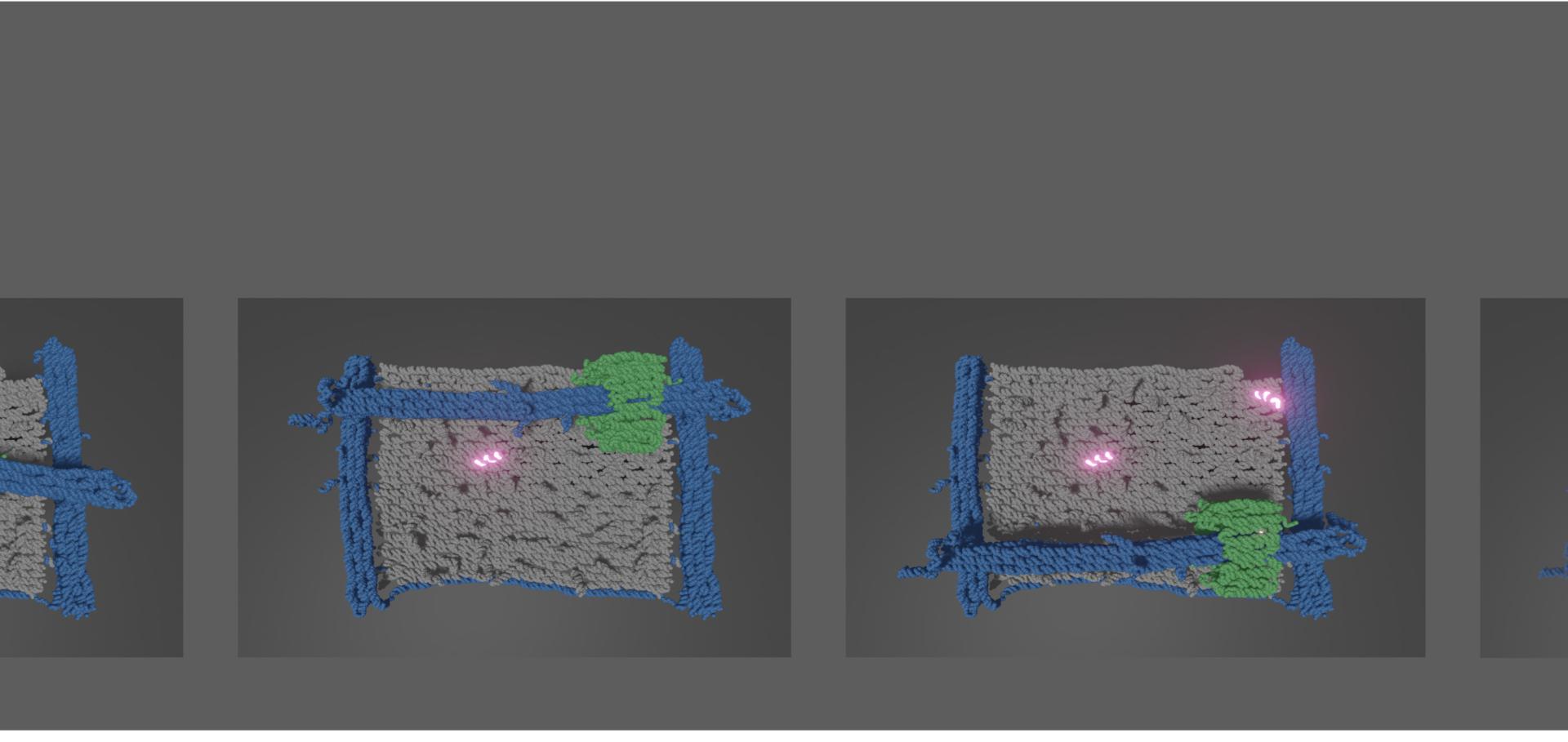
A DNA molecular printer capable of programmable positioning and patterning in two dimensions
Science Robotics American Association for the Advancement of Science 7:65 (2022) eabn5459
Abstract:
Nanoscale manipulation and patterning usually require costly and sensitive top-down techniques such as those used in scanning probe microscopies or in semiconductor lithography. DNA nanotechnology enables exploration of bottom-up fabrication and has previously been used to design self-assembling components capable of linear and rotary motion. In this work, we combine three independently controllable DNA origami linear actuators to create a nanoscale robotic printer. The two-axis positioning mechanism comprises a moveable gantry, running on parallel rails, threading a mobile sleeve. We show that the device is capable of reversibly positioning a write head over a canvas through the addition of signaling oligonucleotides. We demonstrate “write” functionality by using the head to catalyze a local DNA strand–exchange reaction, selectively modifying pixels on a canvas. This work demonstrates the power of DNA nanotechnology for creating nanoscale robotic components and could find application in surface manufacturing, biophysical studies, and templated chemistry.Template-directed conjugation of heterogeneous oligonucleotides to a homobifunctional molecule for programmable supramolecular assembly
Nanoscale Royal Society of Chemistry 14:12 (2022) 4463-4468
Abstract:
Nanoscience aspires to mimic nature's control over functional molecular assemblies. Here we present a templating technique for the efficient attachment of two different oligonucleotides to a homobifunctional molecule, enabling its controlled and programmable placement within a DNA nanostructure. We demonstrate its application to a range of organic molecules with different conjugation chemistries and water solubilities. We show that the two oligonucleotide adapters can be used to integrate a bifunctional cyanine dye into a self-assembled 3D-DNA origami nanostructure, giving control of both position and orientation. We also demonstrate the use of both adapters to exert dynamic control over the environment of the target molecule by means of a series of strand-displacement reactions.DNA-PAINT microscope data of a DNA nanostructure printer
University of Oxford (2022)
Abstract:
This dataset consist of reconstructed DNA-PAINT images of DNA origami based molecular devices. This is the data from the paper "A DNA molecular printer capable of programmable positioning and patterning in two dimensions". The data is structures after the figure of the paper. It is reconstructed and can be opened using the DNA-PAINT software Picasso. The data is described by what DNA paint probe was used to image it, corresponding to multiple image channels. 'P1' is the DNA-PAINT docking handle used on the frame and the canvas, 'R1' is the DNA-PAINT docking handle used on the sleeve, and 'R3' is the DNA-PAINT docking handle used on the ink patterned on the canvas.Strategies for constructing and operating DNA origami linear actuators
Small Wiley 17:20 (2021) 2007704