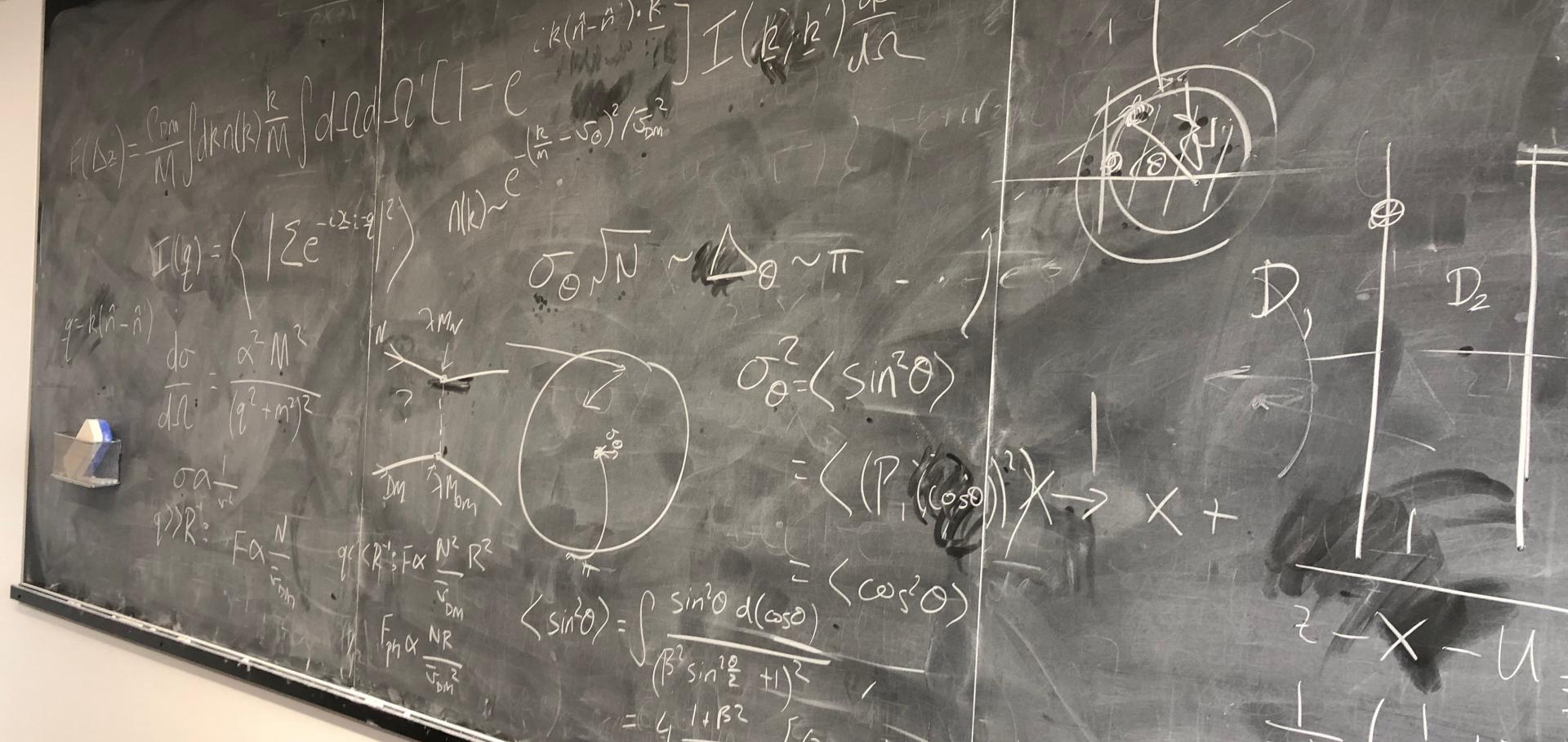
Asymmetric Dark Matter via Spontaneous Co-Genesis

ArXiv 1106.4319 (2011)

Authors:

John March-Russell, Matthew McCullough

Abstract:

We investigate, in the context of asymmetric dark matter (DM), a new mechanism of spontaneous co-genesis of linked DM and baryon asymmetries, explaining the observed relation between the baryon and DM densities, Omega_DM/Omega_B ~ 5. The co-genesis mechanism requires a light scalar field, phi, with mass below 5 eV which couples derivatively to DM, much like a `dark axion'. The field phi can itself provide a final state into which the residual symmetric DM component can annihilate away.

Asymmetric Dark Matter via Spontaneous Co-Genesis

(2011)

Authors:

John March-Russell, Matthew McCullough

The high energy neutrino cross-section in the Standard Model and its uncertainty

(2011)

Authors:

Amanda Cooper-Sarkar, Philipp Mertsch, Subir Sarkar

The high energy neutrino cross-section in the Standard Model and its uncertainty

ArXiv 1106.3723 (2011)

Authors:

Amanda Cooper-Sarkar, Philipp Mertsch, Subir Sarkar

Abstract:

Updated predictions are presented for high energy neutrino and antineutrino charged and neutral current cross-sections within the conventional DGLAP formalism of NLO QCD using modern PDF fits. PDF uncertainties from model assumptions and parametrization bias are considered in addition to the experimental uncertainties. Particular attention is paid to assumptions and biases which could signal the need for extension of the conventional formalism to include effects such as ln(1/x) resummation or non-linear effects of high gluon density.

Neutrino analysis of the September 2010 Crab Nebula flare and time-integrated constraints on neutrino emission from the Crab using IceCube

ArXiv 1106.3484 (2011)

Authors:

IceCube Collaboration, R Abbasi, Y Abdou, T Abu-Zayyad, J Adams, JA Aguilar, M Ahlers, D Altmann, K Andeen, J Auffenberg, X Bai, M Baker, SW Barwick, R Bay, JL Bazo Alba, K Beattie, JJ Beatty, S Bechet, JK Becker, K-H Becker, ML Benabderrahmane, S BenZvi, J Berdermann, P Berghaus, D Berley, E Bernardini, D Bertrand, DZ Besson, D Bindig, M Bissok, E Blaufuss, J Blumenthal, DJ Boersma, C Bohm, D Bose, S Böser, O Botner, AM Brown, S Buitink, KS Caballero-Mora, M Carson, D Chirkin, B Christy, J Clem, F Clevermann, S Cohen, C Colnard, DF Cowen, MV D'Agostino, M Danninger, J Daughhetee, JC Davis, C De Clercq, L Demirörs, T Denger, O Depaepe, F Descamps, P Desiati, G de Vries-Uiterweerd, T DeYoung, JC Díaz-Vélez, M Dierckxsens, J Dreyer, JP Dumm, R Ehrlich, J Eisch, RW Ellsworth, O Engdegård, S Euler, PA Evenson, O Fadiran, AR Fazely, A Fedynitch, J Feintzeig, T Feusels, K Filimonov, C Finley, T Fischer-Wasels, MM Foerster, BD Fox, A Franckowiak, R Franke, TK Gaisser, J Gallagher, L Gerhardt, L Gladstone, T Glüsenkamp, A Goldschmidt, JA Goodman, D Gora, D Grant, T Griesel, A Groß, S Grullon, M Gurtner, C Ha, A Hajismail, A Hallgren, F Halzen, K Han, K Hanson, D Heinen, K Helbing, P Herquet, S Hickford, GC Hill, KD Hoffman, A Homeier, K Hoshina, D Hubert, W Huelsnitz, J-P Hülß, PO Hulth, K Hultqvist, S Hussain, A Ishihara, J Jacobsen, GS Japaridze, H Johansson, JM Joseph, K-H Kampert, A Kappes, T Karg, A Karle, P Kenny, J Kiryluk, F Kislat, SR Klein, J-H Köhne, G Kohnen, H Kolanoski, L Köpke, S Kopper, DJ Koskinen, M Kowalski, T Kowarik, M Krasberg, T Krings, G Kroll, N Kurahashi, T Kuwabara, M Labare, S Lafebre, K Laihem, H Landsman, MJ Larson, R Lauer, J Lünemann, B Madajczyk, J Madsen, P Majumdar, A Marotta, R Maruyama, K Mase, HS Matis, K Meagher, M Merck, P Mészáros, T Meures, E Middell, N Milke, J Miller, T Montaruli, R Morse, SM Movit, R Nahnhauer, JW Nam, U Naumann, P Nießen, DR Nygren, S Odrowski, A Olivas, M Olivo, A O'Murchadha, M Ono, S Panknin, L Paul, C Pérez de los Heros, J Petrovic, A Piegsa, D Pieloth, R Porrata, J Posselt, CC Price, PB Price, GT Przybylski, K Rawlins, P Redl, E Resconi, W Rhode, M Ribordy, A Rizzo, JP Rodrigues, P Roth, F Rothmaier, C Rott, T Ruhe, D Rutledge, B Ruzybayev, D Ryckbosch, H-G Sander, M Santander, S Sarkar, K Schatto, T Schmidt, A Schönwald, A Schukraft, A Schultes, O Schulz, M Schunck, D Seckel, B Semburg, SH Seo, Y Sestayo, S Seunarine, A Silvestri, A Slipak, GM Spiczak, C Spiering, M Stamatikos, T Stanev, G Stephens, T Stezelberger, RG Stokstad, A Stössl, S Stoyanov, EA Strahler, T Straszheim, M Stür, GW Sullivan, Q Swillens, H Taavola, I Taboada, A Tamburro, A Tepe, S Ter-Antonyan, S Tilav, PA Toale, S Toscano, D Tosi, D Turčan, N van Eijndhoven, J Vandenbroucke, A Van Overloop, J van Santen, M Vehring, M Voge, C Walck, T Waldenmaier, M Wallraff, M Walter, Ch Weaver, C Wendt, S Westerhoff, N Whitehorn, K Wiebe, CH Wiebusch, DR Williams, R Wischnewski, H Wissing, M Wolf, TR Wood, K Woschnagg, C Xu, XW Xu, G Yodh, S Yoshida, P Zarzhitsky, M Zoll

Abstract:

We present the results for a search of high-energy muon neutrinos with the IceCube detector in coincidence with the Crab nebula flare reported on September 2010 by various experiments. Due to the unusual flaring state of the otherwise steady source we performed a prompt analysis of the 79-string configuration data to search for neutrinos that might be emitted along with the observed gamma-rays. We performed two different and complementary data selections of neutrino events in the time window of 10 days around the flare. One event selection is optimized for discovery of E^-2 neutrino spectrum typical of 1st order Fermi acceleration. A similar event selection has also been applied to the 40-string data to derive the time-integrated limits to the neutrino emission from the Crab. The other event selection was optimized for discovery of neutrino spectra with softer spectral index and TeV energy cut-offs as observed for various galactic sources in gamma-rays. The 90% CL best upper limits on the Crab flux during the 10 day flare are 4.73 x 10^-11 cm-2 s-1 TeV-1 for an E^-2 neutrino spectrum and 2.50 x 10^-10 cm-2 s-1 TeV-1 for a softer neutrino spectra of E-2.7, as indicated by Fermi measurements during the flare. IceCube has also set a time-integrated limit on the neutrino emission of the Crab using 375.5 days of livetime of the 40-string configuration data. This limit is compared to existing models of neutrino production from the Crab and its impact on astrophysical parameters is discussed. The most optimistic predictions of some models are already rejected by the IceCube neutrino telescope with more than 90% CL.