Thermal properties of Rhea's poles: Evidence for a meter-deep unconsolidated subsurface layer

Icarus Elsevier 272 (2016) 140-148

Authors:

Cja Howett, Jr Spencer, T Hurford, A Verbiscer, M Segura

Abstract:

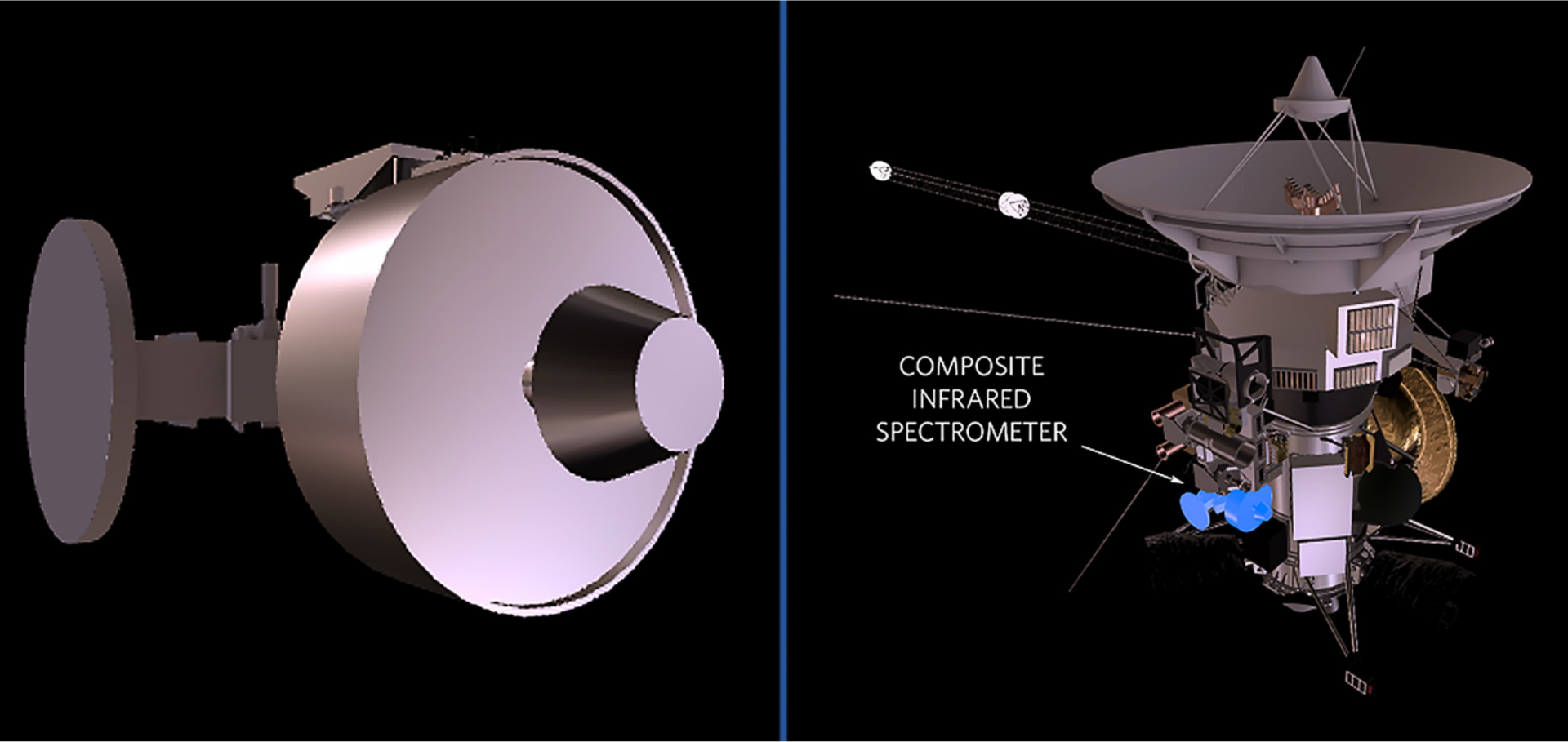
Cassini's Composite Infrared Spectrometer (CIRS) observed both of Rhea's polar regions during a close (2000 km) flyby on 9th March 2013 during orbit 183. Rhea's southern pole was again observed during a more distant (51,000 km) flyby on 10th February 2015 during orbit 212. The results show Rhea's southern winter pole is one of the coldest places directly observed in our Solar System: surface temperatures of 25.4 ± 7.4 K and 24.7 ± 6.8 K are inferred from orbit 183 and 212 data, respectively. The surface temperature of the northern summer pole inferred from orbit 183 data is warmer: 66.6 ± 0.6 K. Assuming the surface thermophysical properties of the two polar regions are comparable then these temperatures can be considered a summer and winter seasonal temperature constraint for the polar region. Orbit 183 will provide solar longitude (LS) coverage at 133° and 313° for the summer and winter poles respectively, while orbit 212 provides an additional winter temperature constraint at LS 337°. Seasonal models with bolometric albedo values between 0.70 and 0.74 and thermal inertia values between 1 and 46 J m−2 K−1 s−1/2 (otherwise known as MKS units) can provide adequate fits to these temperature constraints (assuming the winter temperature is an upper limit). Both these albedo and thermal inertia values agree within the uncertainties with those previously observed on both Rhea's leading and trailing hemispheres. Investigating the seasonal temperature change of Rhea's surface is particularly important, as the seasonal wave is sensitive to deeper surface temperatures (∼tens of centimeters to meter depths) than the more commonly reported diurnal wave (typically less than a centimeter), the exact depth difference dependent upon the assumed surface properties. For example, if a surface porosity of 0.5 and thermal inertia of 25 MKS is assumed then the depth of the seasonal thermal wave is 76 cm, which is much deeper than the ∼0.5 cm probed by diurnal studies of Rhea (Howett et al., 2010). The low thermal inertia derived here implies that Rhea's polar surfaces are highly porous even at great depths. Analysis of a CIRS focal plane 1 (10–600 cm−1) stare observation, taken during the orbit 183 encounter between 16:22:33 and 16:23:26 UT centered on 71.7°W, 58.7°S provides the first analysis of a thermal emissivity spectrum on Rhea. The results show a flat emissivity spectrum with negligible emissivity features. A few possible explanations exist for this flat emissivity spectrum, but the most likely for Rhea is that the surface is both highly porous and composed of small particles (<∼50 µm).

Thermal properties of Rhea's Poles: Evidence for a Meter-Deep Unconsolidated Subsurface Layer

(2016)

Authors:

Carly Howett, John Spencer, Terry Hurford, Anne Verbiscer, Marcia Segura

Simulated stellar kinematics studies of high-redshift galaxies with the HARMONI Integral Field Spectrograph

(2016)

Authors:

S Kendrew, S Zieleniewski, RCW Houghton, N Thatte, J Devriendt, M Tecza, F Clarke, K O'Brien, B Häussler

A deep space inventory tour of the main asteroid belt

Proceedings of the International Astronautical Congress, IAC 0 (2016)

Authors:

A Gibbings, N Bowles, C Snodgrass, JP Sanchez, H Henning, A Braukhane

Abstract:

A consortium of international scientists and industry partners are proposing the Main Belt Inventory Mission as a candidate in the next forthcoming ESA medium class mission call. The inventory mission will characterise a broad range of statistically significant asteroid samples throughout the Main Asteroid Belt (MAB). A 0.5 m aperture space-based telescope will conduct a detailed spectroscopic survey, observing thousands of objects from a range of 0.1-0.5 AU, and perform basic flybys of pre-selected targets. Each flyby will target an asteroid of a different size, taxonomic (sub)classes and orbital families, where spatially resolved spectral mapping and spectroscopy will be performed. Smaller and fainter passing targets will also be discovered, through opportunistic science, with dedicated star tracker-like cameras. Examining the compositional diversity across the asteroid population will provide a key tracer to understanding the dynamic evolution of the solar system, offer an insight into its early history and the origins of life forming material. Furthermore, by combing visible, near-infrared and thermal spectroscopy, the mission will unlock information on the major rock forming minerals, hydrated minerals, organics and primitive material found throughout the asteroid belt. Coarse UV mapping capability will search for weak OH emission bands, providing evidence of buried volatile (water) reservoirs. This will provide an additional link to fully understanding the meteorite record on Earth, and more importantly, place the returned samples from the up-and-coming Hayabusa-2 (JAXA) and OSIRIS-REx (NASA) missions in a wider geological context. The mission will provide an accurate description of the present day MAB population, and further refinements of the origins and evolution models of Near Earth Asteroids. This paper will report on the scientific justification and focus on the (sub-)system spacecraft design to perform a detailed inventory mission of the MAB. It includes an evaluation of the different system options and architecture designs. The baseline design is then presented, and further broken down for each subsystem. The science and mission objectives have been developed within the scope of the expected boundary conditions of the forthcoming ESA medium class mission call. It therefore necessitates a high TRL spacecraft, ready for launch within the 2028/32 timeframe on either a Vega-C (or Ariane 6) launch vehicle. The mission and system design is currently being developed through an ongoing mission study. Analysis is performed by a consortium of OHB System AG, Cranfield University and an association of scientists from different institutes and organisations. Concurrent engineering techniques are used throughout.

Asteroid belt multiple fly-by options for m-class missions

Proceedings of the International Astronautical Congress, IAC 0 (2016)

Authors:

JPS Cuartielles, A Gibbings, C Snodgrass, S Green, N Bowles

Abstract:

The exploration of the asteroid main belt is of the utmost importance to address many of the fundamental questions in modern planetary science (e.g., Solar System formation and evolution theories). This paper investigates potential opportunities for medium-class asteroid belt survey missions in the timeframe of 2029+. The launch as assumed here corresponds to that of the forthcoming ESA call for medium class mission proposals. The study has been developed in support of the CASTAway Asteroid Spectroscopic Survey mission proposal, which is to be submitted to the aforementioned call. CASTAway envisages the launch of a small telescope with relatively straightforward (i.e. high TRL) remote sensing instrumentation to detect asteroids at a range of 0.1-0.5 AU. The spacecraft would then head towards the main belt with the following objectives: The mission should test Solar System evolution theories by; 1) performing a statistical survey of small asteroid belt objects previously unsampled (<1 to a few tens of metre-sized); 2) providing compositional information for 1000s of objects by obtaining spectral data over a wide range of wavelengths, including key regions not observable through the Earth's atmosphere; 3) studying the morphology and geological history from close flybys of a targeted sub-set of objects, at least doubling the number of currently visited main belt asteroids within one single mission (>9 fly-bys). This paper presents a challenging multi-objective optimization problem and discusses the feasibility of such a mission concept. Firstly, a set of competing performance indices are defined that consider the cost of the mission, the quality of the survey (i.e. number of new detections and spectral data) and the number of asteroid fly-bys. The fly-by combinatorial problem is then tackled using the Minimum Intersection Orbital Distance as an heuristic filter to prune out unfeasible targets. Genetic and evolutionary algorithms are used to globaly optimize impulsive transfers, considering also planetary fly-bys, deep space and Δv-leveraging manoeuvres. Low-thrust trajectories are considered, although long thrusting periods impact negatively in the available operational time for remote sensing operations. Shape-based methods are used to globally optimize the low thrust controls, while the GPOPS-II and IPOPT transcribe the continuous-time optimal control problem and solve the subsequent nonlinear programming problem, respectively.