

Phase-space entropy cascade and irreversibility of stochastic heating in nearly collisionless plasma turbulence
Physical Review E American Physical Society 109:6 (2024) 65210
Abstract:
We consider a nearly collisionless plasma consisting of a species of "test particles" in one spatial and one velocity dimension, stirred by an externally imposed stochastic electric field-a kinetic analog of the Kraichnan model of passive advection. The mean effect on the particle distribution function is turbulent diffusion in velocity space-known as stochastic heating. Accompanying this heating is the generation of fine-scale structure in the distribution function, which we characterize with the collisionless (Casimir) invariant C_{2}∝∫∫dxdv〈f^{2}〉-a quantity that here plays the role of (negative) entropy of the distribution function. We find that C_{2} is transferred from large scales to small scales in both position and velocity space via a phase-space cascade enabled by both particle streaming and nonlinear interactions between particles and the stochastic electric field. We compute the steady-state fluxes and spectrum of C_{2} in Fourier space, with k and s denoting spatial and velocity wave numbers, respectively. In our model, the nonlinearity in the evolution equation for the spectrum turns into a fractional Laplacian operator in k space, leading to anomalous diffusion. Whereas even the linear phase mixing alone would lead to a constant flux of C_{2} to high s (towards the collisional dissipation range) at every k, the nonlinearity accelerates this cascade by intertwining velocity and position space so that the flux of C_{2} is to both high k and high s simultaneously. Integrating over velocity (spatial) wave numbers, the k-space (s-space) flux of C_{2} is constant down to a dissipation length (velocity) scale that tends to zero as the collision frequency does, even though the rate of collisional dissipation remains finite. The resulting spectrum in the inertial range is a self-similar function in the (k,s) plane, with power-law asymptotics at large k and s. Our model is fully analytically solvable, but the asymptotic scalings of the spectrum can also be found via a simple phenomenological theory whose key assumption is that the cascade is governed by a "critical balance" in phase space between the linear and nonlinear timescales. We argue that stochastic heating is made irreversible by this entropy cascade and that, while collisional dissipation accessed via phase mixing occurs only at small spatial scales rather than at every scale as it would in a linear system, the cascade makes phase mixing even more effective overall in the nonlinear regime than in the linear one.Laboratory realization of relativistic pair-plasma beams
Nature Communications Springer Nature 15:1 (2024) 5029
Abstract:
Relativistic electron-positron plasmas are ubiquitous in extreme astrophysical environments such as black-hole and neutron-star magnetospheres, where accretion-powered jets and pulsar winds are expected to be enriched with electron-positron pairs. Their role in the dynamics of such environments is in many cases believed to be fundamental, but their behavior differs significantly from typical electron-ion plasmas due to the matter-antimatter symmetry of the charged components. So far, our experimental inability to produce large yields of positrons in quasi-neutral beams has restricted the understanding of electron-positron pair plasmas to simple numerical and analytical studies, which are rather limited. We present the first experimental results confirming the generation of high-density, quasi-neutral, relativistic electron-positron pair beams using the 440 GeV/c beam at CERN’s Super Proton Synchrotron (SPS) accelerator. Monte Carlo simulations agree well with the experimental data and show that the characteristic scales necessary for collective plasma behavior, such as the Debye length and the collisionless skin depth, are exceeded by the measured size of the produced pair beams. Our work opens up the possibility of directly probing the microphysics of pair plasmas beyond quasi-linear evolution into regimes that are challenging to simulate or measure via astronomical observations.Gas assisted binary black hole formation in AGN discs
Monthly Notices of the Royal Astronomical Society Oxford University Press 531:4 (2024) 4656-4680
Abstract:
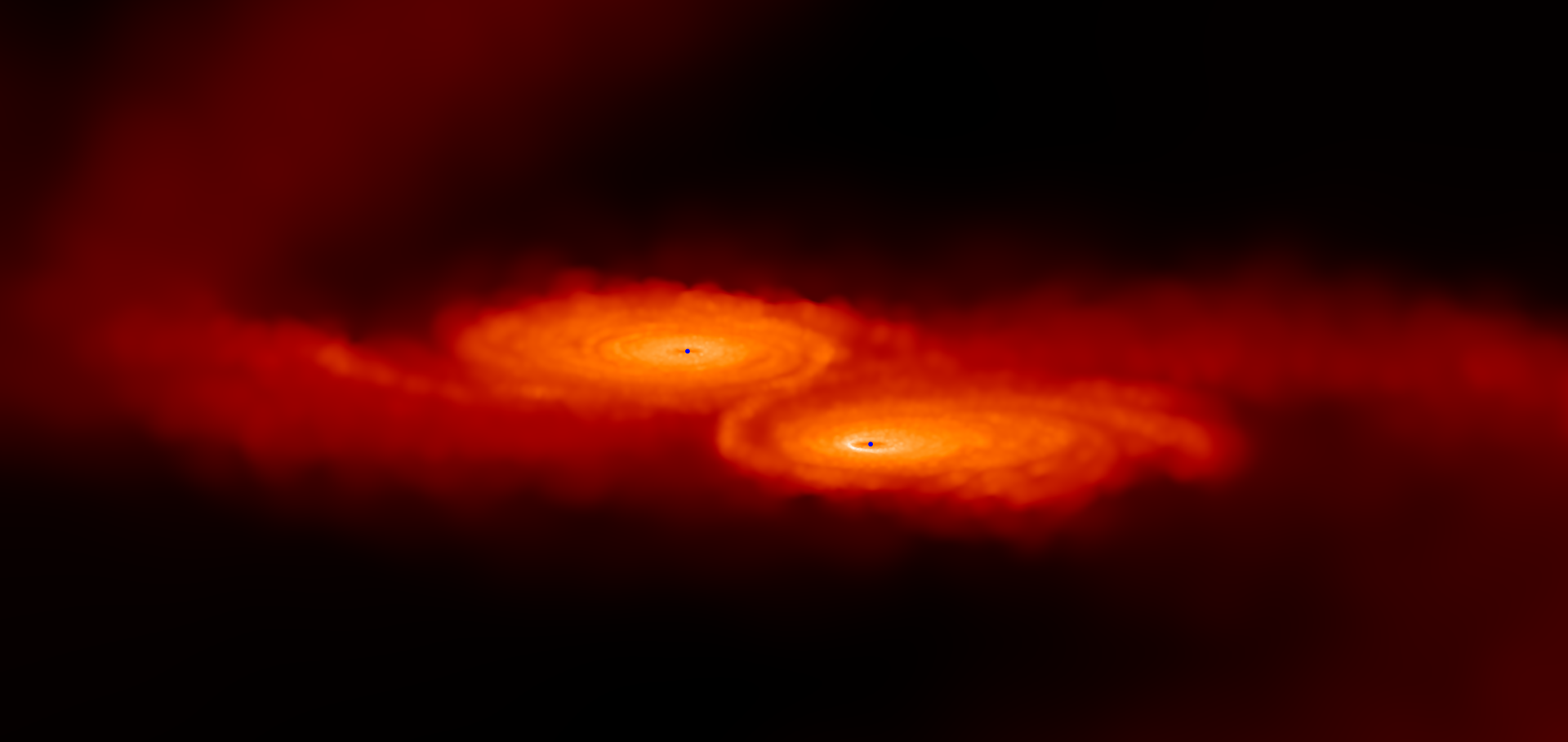
We investigate close encounters by stellar mass black holes (BHs) in the gaseous discs of active galactic nuclei (AGNs) as a potential formation channel of binary black holes (BBHs). We perform a series of 2D isothermal viscous hydrodynamical simulations within a shearing box prescription using the Eulerian grid code Athena ++ . We co-evolve the embedded BHs with the gas keeping track of the energetic dissipation and torquing of the BBH by gas gravitation and inertial forces. To probe the dependence of capture on the initial conditions, we discuss a suite of 345 simulations spanning BBH impact parameter ( b ) and local AGN disc density ( ρ0 ). We identify a clear region in b − ρ0 space where gas assisted BBH capture is efficient. We find that the presence of gas leads to strong energetic dissipation during close encounters between unbound BHs, forming stably bound eccentric BBHs. We find that the gas dissipation during close encounters increases for systems with increased disc density and deeper periapsis passages r p , fitting a power law such that E ∝ ρα 0 r β p , where { α, β} = { 1.01 ± 0.04, −0.43 ± 0.03 } . Alternatively, the gas dissipation is approximately E = 4.3 M d v H v p , where M d is the mass of a single BH minidisc just prior to the encounter when the binary separation is 2 r H (two binary Hill radii), v H and v p are the relative BH velocities at 2 r H and at the f irst closest approach, respectively. We derive a prescription for capture which can be used in semi-analytical models of AGN. We do not find the dissipative dynamics observed in these systems to be in agreement with the simple gas dynamical friction models often used in the literature.Electrostatic microturbulence in W7-X: comparison of local gyrokinetic simulations with Doppler reflectometry measurements
Nuclear Fusion IOP Publishing 64:7 (2024) 076029
Abstract:
The first experimental campaigns of Wendelstein 7-X (W7-X) have shown that turbulence plays a decisive role in the performance of neoclassically optimized stellarators. This stresses the importance of understanding microturbulence from the theoretical and experimental points of view. To this end, this paper addresses a comprehensive characterization of the turbulent fluctuations by means of nonlinear gyrokinetic simulations performed with the code stella in two W7-X scenarios. In the first part of the paper, the amplitude of the density fluctuations is calculated and compared with measurements obtained by Doppler reflectometry (DR) in the OP1 experimental campaigns. It is found that the trend of the fluctuations along the radius is explained by the access of the DR system to different regions of the turbulence wavenumber spectrum. In the second part of the article, frequency spectra of the density fluctuations and the zonal component of the turbulent flow are numerically characterized for comparisons against future experimental analyses. Both quantities feature broad frequency spectra with dominant frequencies of O(1)–O(10) kHz.Determining the difference between local acceleration and local gravity: applications of the equivalence principle to relativistic trajectories
American Journal of Physics American Association of Physics Teachers 92:6 (2024) 444-449