

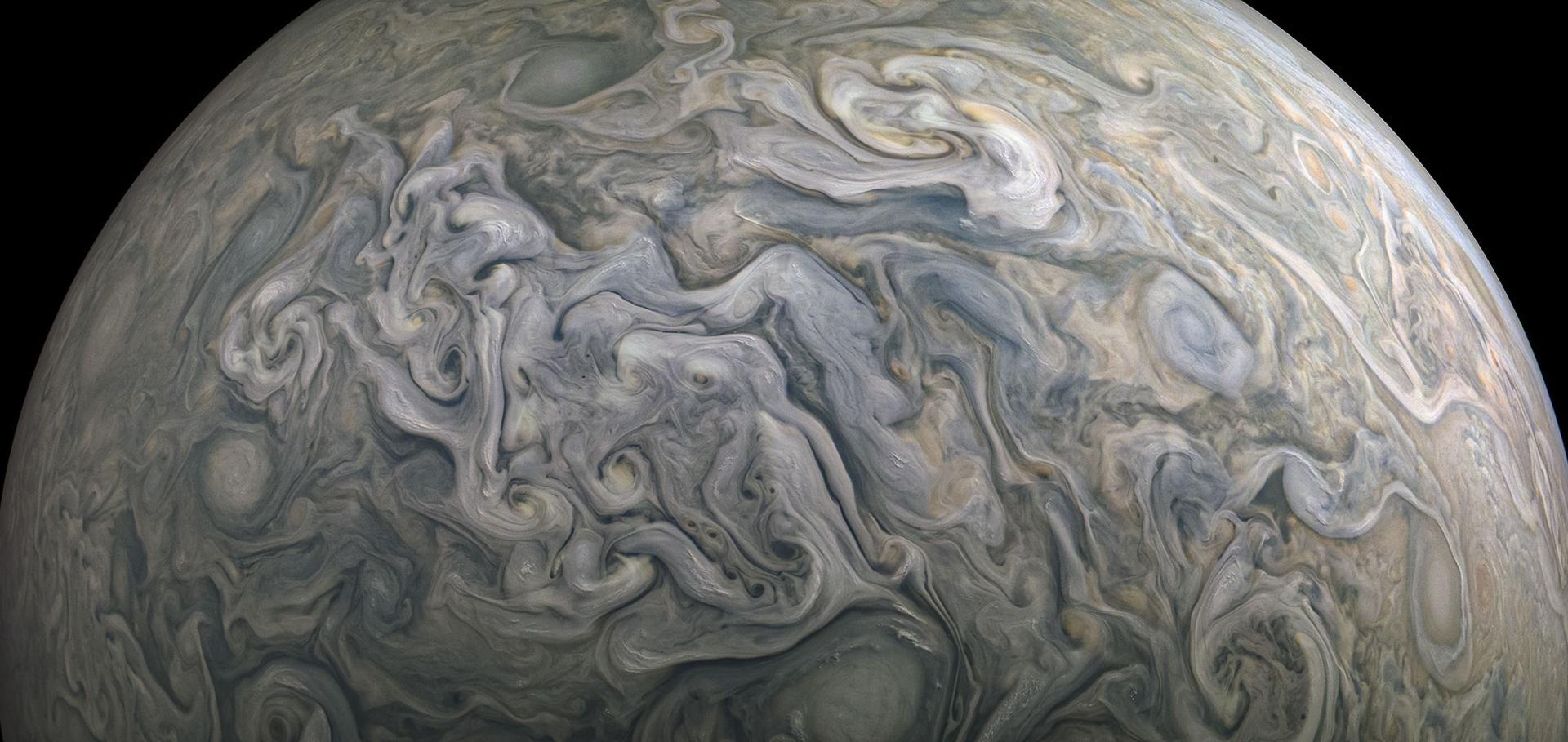

Vertical Structure and Color of Jovian Latitudinal Cloud Bands during the Juno Era
The Planetary Science Journal American Astronomical Society 2:1 (2021) 16-16
Latitudinal variation of methane mole fraction above clouds in Neptune's atmosphere from VLT/MUSE-NFM: Limb-darkening reanalysis
(2021)
Spatial variations in the altitude of the CH4 Homopause at Jupiter’s mid-to-high latitudes, as constrained from IRTF-TEXES Spectra
The Planetary Science Journal IOP Publishing 1:3 (2020) 85
Abstract:
We present an analysis of IRTF-TEXES spectra of Jupiter's mid-to-high latitudes in order to test the hypothesis that the CH4 homopause altitude is higher in Jupiter's auroral regions compared to elsewhere on the planet. A family of photochemical models, based on Moses & Poppe (2017), were computed with a range of CH4 homopause altitudes. Adopting each model in turn, the observed TEXES spectra of H2 S(1), CH4, and CH3 emission measured on 2019 April 16 and August 20 were inverted, the vertical temperature profile was allowed to vary, and the quality of the fit to the spectra was used to discriminate between models. At latitudes equatorward of Jupiter's main auroral ovals (>62°S, <54°N, planetocentric), the observations were adequately fit assuming a homopause altitude lower than ~360 km (above 1 bar). At 62°N, inside the main auroral oval, we derived a CH4 homopause altitude of ${461}_{-39}^{+147}$ km, whereas outside the main oval at the same latitude, a 1σ upper limit of 370 km was derived. Our interpretation is that a portion of energy from the magnetosphere is deposited as heat within the main oval, which drives vertical winds and/or higher rates of turbulence and transports CH4 and its photochemical by-products to higher altitudes. Inside the northern main auroral oval, a factor of ~3 increase in CH3 abundance was also required to fit the spectra. This could be due to uncertainties in the photochemical modeling or an additional source of CH3 production in Jupiter's auroral regions.Colour and tropospheric cloud structure of Jupiter from MUSE/VLT: retrieving a universal chromophore
Icarus Elsevier 338:1 March 2020 (2020) 113589
Abstract:
Recent work by Sromovsky et al. (2017, Icarus 291, 232-244) suggested that all red colour in Jupiter’s atmosphere could be explained by a single colour-carrying compound, a so-called ‘universal chromophore’. We tested this hypothesis on ground-based spectroscopic observations in the visible and near-infrared (480- 930 nm) from the VLT/MUSE instrument between 2014 and 2018, retrieving a chromophore absorption spectrum directly from the North Equatorial Belt, and applying it to model spatial variations in colour, tropospheric cloud and haze structure on Jupiter. We found that we could model both the belts and the Great Red Spot of Jupiter using the same chromophore compound, but that this chromophore must exhibit a steeper blue-absorption gradient than the proposed chromophore of Carlson et al. (2016, Icarus 274, 106–115). We retrieved this chromophore to be located no deeper than 0.2±0.1 bars in the Great Red Spot and 0.7±0.1 bars elsewhere on Jupiter. However, we also identified some spectral variability between 510 nm and 540 nm that could not be accounted for by a universal chromophore. In addition, we retrieved a thick, global cloud layer at 1.4 ± 0.3 bars that was relatively spatially invariant in altitude across Jupiter. We found that this cloud layer was best characterised by a real refractive index close to that of ammonia ice in the belts and the Great Red Spot, and poorly characterised by a real refractive index of 1.6 or greater. This may be the result of ammonia cloud at higher altitude obscuring a deeper cloud layer of unknown composition.Color and aerosol changes in Jupiter after a North Temperate Belt disturbance
Icarus Elsevier BV 352 (2020) 114031