Home
Department Of Physics text logo
  • Research
    • Our research
    • Our research groups
    • Our research in action
    • Research funding support
    • Summer internships for undergraduates
  • Study
    • Undergraduates
    • Postgraduates
  • Engage
    • For alumni
    • For business
    • For schools
    • For the public
  • Support
Menu
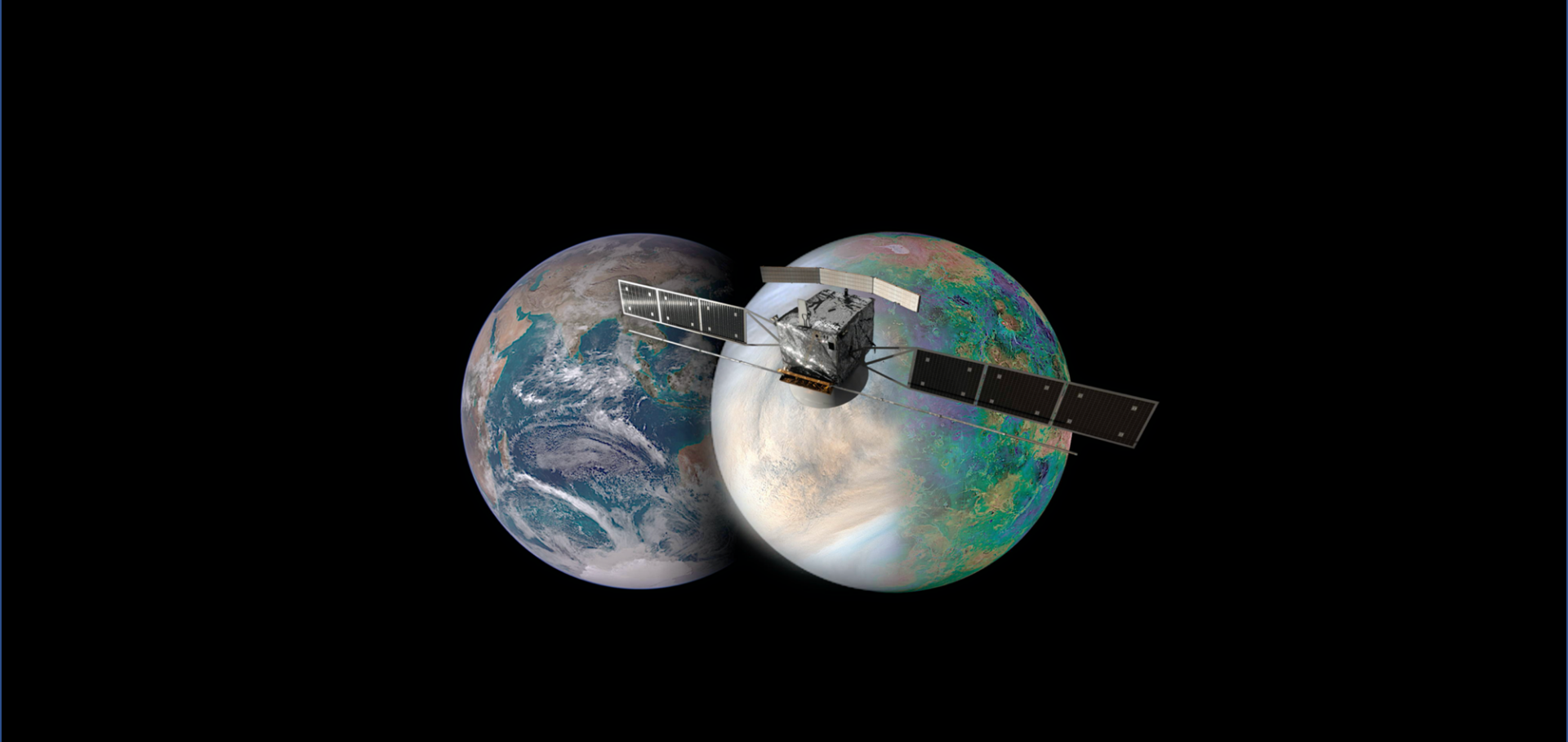
The EnVision Venus orbiter mission, proposed to ESA

Colin Wilson

Visitor

Research theme

  • Exoplanets and planetary physics

Sub department

  • Atmospheric, Oceanic and Planetary Physics

Research groups

  • Planetary atmosphere observation analysis
  • Planetary surfaces
  • Solar system
  • Space instrumentation
Colin.Wilson@physics.ox.ac.uk
Telephone: 01865 (2)72086
Atmospheric Physics Clarendon Laboratory, room 301
  • About
  • Publications

A new, fast and flexible radiative transfer method for Venus general circulation models

Planetary and Space Science Elsevier 105 (2015) 80-93

Authors:

JM Mendonça, PL Read, CF Wilson, C Lee
More details from the publisher

Venus Express: Lessons from 8 years of science operations

American Institute of Aeronautics and Astronautics (AIAA) (2014)

Authors:

Donald R Merritt, Miguel Pérez Ayúcar, Raymond Hoofs, Colin Wilson
More details from the publisher

The DREAMS experiment on the ExoMars 2016 mission for the study of Martian environment during the dust storm season

Institute of Electrical and Electronics Engineers (IEEE) (2014) 167-173

Authors:

C Bettanini, F Esnosito, S Debei, C Molfese, I Arruezo Rodríguez, G Colombatti, A-M Harri, F Montmessin, C Wilson, A Aboudan, S Abbaki, V Apestigue, G Bellucci, J-J Berthelier, JR Brucato, SB Calcutt, F Cortecchia, G Di Achille, F Ferri, F Forget, GP Guizzo, E Friso, M Genzer, P Gilbert, H Haukka, JJ Jiménez, S Jiménez, J-L Josset, O Karatekin, G Landis, R Lorenz, J Martinez, L Marty, V Mennella, D Möhlmann, D Moirin, R Molinaro, E Palomba, M Patel1, J-P Pommereau, CI Popa, S Rafkin, P Rannou, NO Renno, P Schipani, W Schmidt, S Silvestro, F Simoes, A Spiga, F Valero, L Vázquez, F Vivat, O Witasse, R Mugnuolo, S Pirrotta, E Marchetti
More details
More details from the publisher

The CO2 continuum absorption in the 1.10- and 1.18-μm windows on Venus from Maxwell Montes transits by SPICAV IR onboard Venus express

Planetary and Space Science (2014)

Authors:

A Fedorova, A Fedorova, B Bézard, JL Bertaux, O Korablev, O Korablev, C Wilson

Abstract:

© 2014 Elsevier Ltd. One of the difficulties in modeling Venus' nightside atmospheric windows is the need to apply CO2 continuum opacity due to collision-induced CO2 bands and/or extreme far wings of strong allowed CO2 bands. Characterizing the CO2 continuum absorption at near-IR wavelengths as well as searching for a possible vertical gradient of minor species near the surface require observations over different surface elevations. The largest change in altitude occurs during a passage above Maxwell Montes at high northern latitudes. In 2011, 2012 and 2013 the SPICAV instrument aboard the Venus Express satellite performed three sets of observations over Maxwell Montes with variation of surface altitude from -2 to 9km in the 1.10, 1.18 and 1.28-μm windows. The retrieved CO2 continuum absorption for the 1.10- and 1.18-μm windows varies from 0.29 to 0.66×10⁻⁹ cm-1 amagat-2 and from 0.30 to 0.78×10⁻⁹ cm-1 amagat-2, respectively, depending on the assumed input parameters. The retrieval is sensitive to possible variations of the surface emissivity. Our values fall between the results of Bézard et al., (2009, 2011) based on VIRTIS-M observations and laboratory measurements by Snels et al. (2014). We can also conclude that the continuum absorption at 1.28μm can be constrained below 2.0×10⁻⁹ cm-1 amagat-2. Based on the 1.18μm window the constant H2O mixing ratio varying from 25.7+1.4 -1.2 ppm to 29.4+1.6 -1.4 ppm has been retrieved assuming the surface emissivity of 0.95 and 0.6, respectively. No firm conclusion from SPICAV data about the vertical gradient of water vapor content at 10-20km altitude could be drawn because of low signal-to-noise ratio and uncertainties in the surface emissivity.
More details from the publisher

Venus express: Lessons from 8 years of science operations

13th International Conference on Space Operations, SpaceOps 2014 (2014)

Authors:

DR Merritt, RMT Hoofs, MP Ayúcar, CF Wilson

Abstract:

The Venus Express spacecraft was launched in November 2005. This first European mission to Venus arrived at the planet in April 2006, and within a month had completed on-orbit commissioning and was returning science data to Earth. After four mission extensions and eight years, the spacecraft continues to operate successfully. The end of the mission is anticipated to be in 2014, when the on-board fuel supplies are finally exhausted and the required orbit around Venus can no longer be maintained. This paper discusses the lessons learned by the Venus Express Science Operations Centre (VSOC) over the course of the eight year mission, and briefly discusses the plans for the end of the mission.
More details from the publisher

Pagination

  • First page First
  • Previous page Prev
  • …
  • Page 12
  • Page 13
  • Page 14
  • Page 15
  • Current page 16
  • Page 17
  • Page 18
  • Page 19
  • Page 20
  • …
  • Next page Next
  • Last page Last

Footer Menu

  • Contact us
  • Giving to the Dept of Physics
  • Work with us
  • Media

User account menu

  • Log in

Follow us

FIND US

Clarendon Laboratory,

Parks Road,

Oxford,

OX1 3PU

CONTACT US

Tel: +44(0)1865272200

University of Oxfrod logo Department Of Physics text logo
IOP Juno Champion logo Athena Swan Silver Award logo

© University of Oxford - Department of Physics

Cookies | Privacy policy | Accessibility statement

Built by: Versantus

  • Home
  • Research
  • Study
  • Engage
  • Our people
  • News & Comment
  • Events
  • Our facilities & services
  • About us
  • Giving to Physics
  • Current students
  • Staff intranet