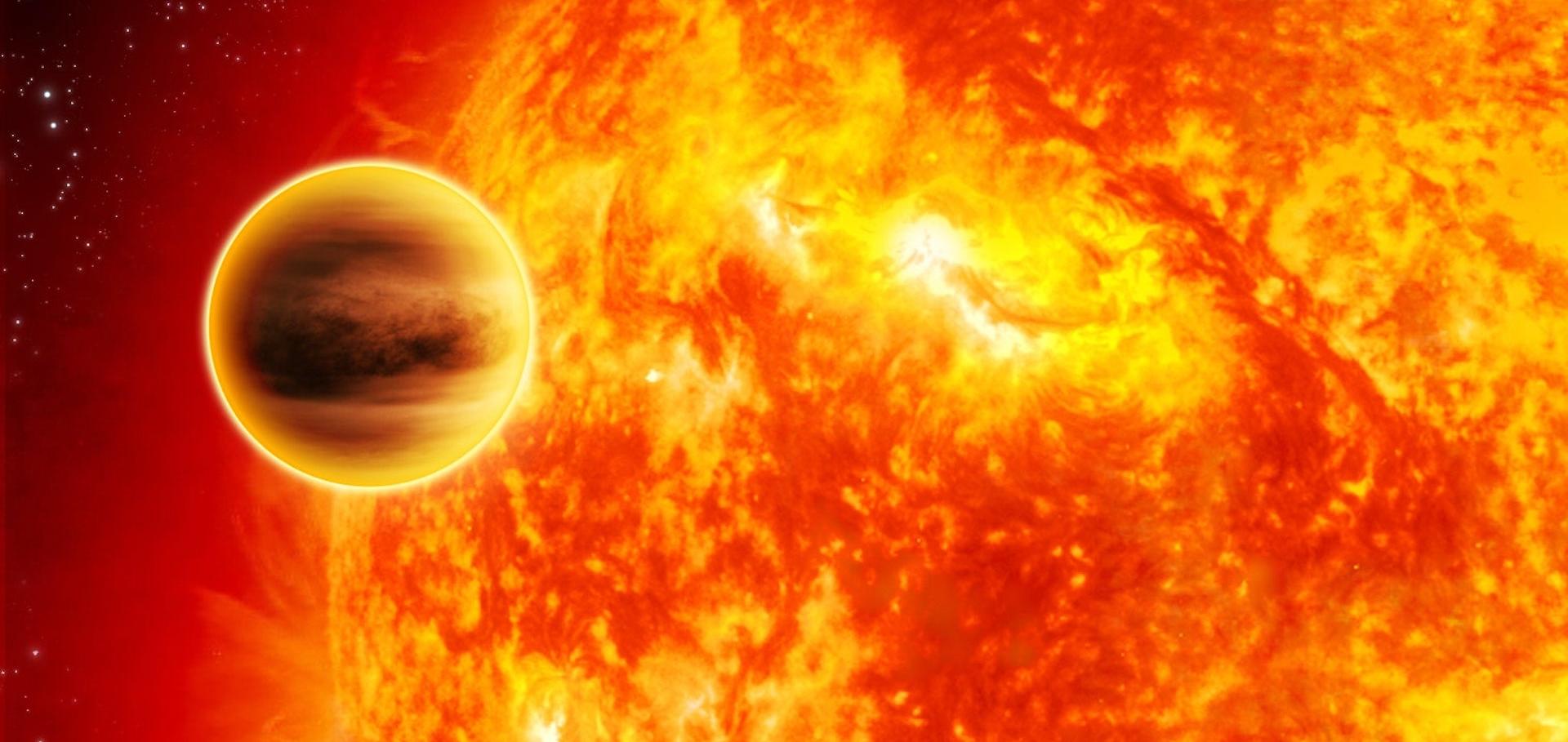
A Thick Volatile Atmosphere on the Ultrahot Super-Earth TOI-561 b
The Astrophysical Journal Letters American Astronomical Society 995:2 (2025) L39
Abstract:
Ultrashort-period (USP) exoplanets—with Rp ≤ 2R⊕ and periods ≤1 day—are expected to be stripped of volatile atmospheres by intense host star irradiation, which is corroborated by their nominal bulk densities and previous eclipse observations, consistent with bare-rock surfaces. However, a few USP planets appear anomalously underdense relative to an Earth-like composition, suggesting an exotic interior structure (e.g., coreless) or a volatile-rich secondary atmosphere increasing their apparent radius. Here, we present the first dayside emission spectrum of the low-density (4.3 ± 0.4 g cm−3) USP planet TOI-561 b, which orbits an iron-poor, alpha-rich, ∼10 Gyr old thick-disk star. Our 3–5 μm JWST/NIRSpec observations demonstrate the dayside of TOI-561 b is inconsistent with a bare-rock surface at high statistical significance, suggesting instead a thick volatile envelope that is cooling the dayside to well below the ∼3000 K expected in the bare-rock or thin-atmosphere case. These results reject the popular hypothesis of complete atmospheric desiccation for highly irradiated exoplanets and support predictions that planetary-scale magma oceans can retain substantial reservoirs of volatiles, opening up the geophysical study of ultrahot super-Earths through the lenses of their atmospheres.3D Modeling of Moist Convective Inhibition in Idealized Sub-Neptune Atmospheres
The Astrophysical Journal American Astronomical Society 995:1 (2025) 41
Abstract:
Atmospheric convection behaves differently in hydrogen-rich atmospheres compared to higher mean molecular weight atmospheres due to compositional gradients of tracers. Previous 1D studies predict that when a condensable tracer exceeds a critical mixing ratio in H2-rich atmospheres, convection is inhibited, leading to the formation of radiative layers where the temperature decreases faster with height than in convective profiles. We use 3D convection-resolving simulations to test whether convection is inhibited in H2-rich atmospheres when the tracer mixing ratio exceeds the critical threshold, while including processes neglected in 1D, e.g., turbulent mixing and evaporation. We run two sets of simulations. First, we perform simulations initialized on saturated isothermal states and find that compositional gradients can destabilize isothermal atmospheres. Second, we perform simulations initialized on adiabatic profiles, which show distinct, stable inhibition layers form when the condensable tracer exceeds the critical threshold. Within the inhibition layer, only a small amount of energy is carried by latent heat flux, and turbulent mixing transports a small amount of tracer upward, but both are generally too weak to sustain substantial tracer or heat transport. The thermal profile gradually relaxes to a steep radiative state, but radiative relaxation timescales are long. Our results suggest stable layers driven by condensation-induced convective inhibition form in H2-rich atmospheres, including those of sub-Neptune exoplanets.Continuous helium absorption from both the leading and trailing tails of WASP-107 b
Nature Astronomy Springer Nature (2025) 1-13
Abstract:
The formation and evolution of giant planets remain incompletely understood, with mounting evidence that many close-in giants may have migrated from their birth locations. The detection of helium escaping the atmosphere of exoplanets has provided a powerful new tracer of atmospheric escape and exoplanetary evolution. Here, using high-precision spectroscopic observations from the James Webb Space Telescope (JWST) Near Infrared Imager and Slitless Spectrograph (NIRISS) in single-object slitless spectroscopy mode (SOSS) mode, we report the detection of substantial helium absorption during the pre-transit phase of WASP-107 b (17σ), as well as in the transit and post-transit phases. This unique continuous helium absorption begins approximately 1.5 h before the planet’s ingress and reveals the presence of an extended thermosphere. The observations show a maximum transit depth of 2.395 ± 0.01% near the helium triplet (36σ; at the NIRISS-SOSS resolution of ~700). Our ellipsoidal model of the planetary thermosphere matches the measured light curve well, suggesting an outflow extending to tens of planetary radii. Furthermore, we confidently detect water absorption (log10H2O = −2.5 ± 0.6), superimposed with a short-wavelength slope that we attribute to a prominent signature from unocculted stellar spots (5.2σ), rather than a small-particle haze slope. We place an upper limit on the abundance of K (log10K < −4.86, or K/H < 75× stellar) at 2σ, which is consistent with the O/H supersolar metallicity estimate. Together with the supersolar water abundance and the evidence for vigorous atmospheric escape, these findings suggest that WASP-107 b has undergone inward migration in its recent past, probably accompanied by strong tidal heating that continues to sustain its inflated atmosphere and mass loss. This investigation underscores the transformative potential of JWST for investigating planetary evolution.Multimodal atmospheric characterization of β Pictoris b
Astronomy & Astrophysics EDP Sciences 704 (2025) a325
Abstract:
Context. Characterizations of giant exoplanets such as β Pictoris b (hereafter β Pic b) are now routinely performed with multiple spectrographs and imagers exploring different spectral bandwidths and resolutions, allowing for atmospheric retrieval of spectra with or without the conservation of the planet spectral continuum. The accounting of data multimodality in the analysis could provide a more comprehensive determination of the planets physical and chemical properties and inform on their formation history. Aims. We present the first VLTI observations at R λ ∼4000 of β Pic b obtained for an exoplanet with GRAVITY at such a high resolution. We upgraded the forward modelling code ForMoSA to account for the data multimodality, including low-, medium-, and high-resolution spectroscopy based on both a direct model-data comparison and an analysis of cross-correlation signals. We used the ForMoSA code to refine the constraints on the atmospheric properties of the exoplanet and evaluated the sensitivity of the retrieved values to the input dataset. Methods. We obtained four high-signal-to-noise (S/N ∼ 20) spectra of β Pic b in the K band with GRAVITY at R λ ∼4000 conserving both the pseudo-continuum and the pattern of molecular absorptions. We used ForMoSA with four grids of self-consistent forward models (Exo-REM, ATMO, BT-Settl, and Sonora) to explore different T e ff , log(g), metallicity, C/O, and 12 CO/ 13 CO ratio values. We then combined the GRAVITY spectra with published 1–5 µm photometry (NaCo, VisAO, NICI, and SPHERE), low-to-mediumresolution ( R λ ≤ 700 broadband, 0.9–7 µm) spectra, and echelle spectra covering narrower bandwidths ( R λ ∼ 100 000, 2.1–5.2 µm). Results. Sonora and Exo-REM are statistically preferred among all four models, regardless of the dataset used. Exo-REM predicts T eff = 1607.45 −6.20 +4.85 K and log(g) = 4.46 −0.04 +0.02 dex when using only the GRAVITY epochs, whereas we have T eff = 1502.74 −2.14 +2.32 K log(g) = 4.00 ± 0.01 dex when incorporating all available datasets. The inclusion of archival data significantly affects all retrieved posteriors. When using all datasets, C/O mostly remains solar (0.552 −0.002 +0.003 ), while [M/H] reaches super-solar values (0.50 ± 0.01). We report the first tentative constraint on the isotopic ratio log( 12 CO/ 13 CO) = 1.12 −0.08 +0.11 in β Pic b’s atmosphere; however, we note that this detection remains inconclusive due to telluric residuals affecting both the GRAVITY and SINFONI data. Additionally, we estimated the bolometric luminosity as log(L/L ⊙ ) = −4.01 −0.05 +0.04 dex. Using a system age of 23 ± 3 Myr, along with this bolometric luminosity and the constraints on the dynamical mass of β Pic b, we were able to constrain the maximum of heavy element content of the planet to be on the order of 5% (20–80 M Earth ). Conclusions. The joint access to the pseudo-continuum and molecular lines in the K band provided by GRAVITY have a significant impact on the retrieved metallicity, possibly owing to the collision-induced absorption driving the continuum shape of the K band. The echelle spectra do not dominate the final fit with respect to lower resolution data covering a broader portion of the spectral energy distribution and the latter keeps encapsulating more robust information on T eff . Future multimodal frameworks should include a weighting scheme to account for the bandwidth and central wavelength of the observations.Long-period Transit Searches Should Use a Wider Range of Durations
Research Notes of the American Astronomical Society IOP Publishing 9:11 (2025) 319