

Corrigendum
Brain Oxford University Press (OUP) 139:2 (2016) e14-e14
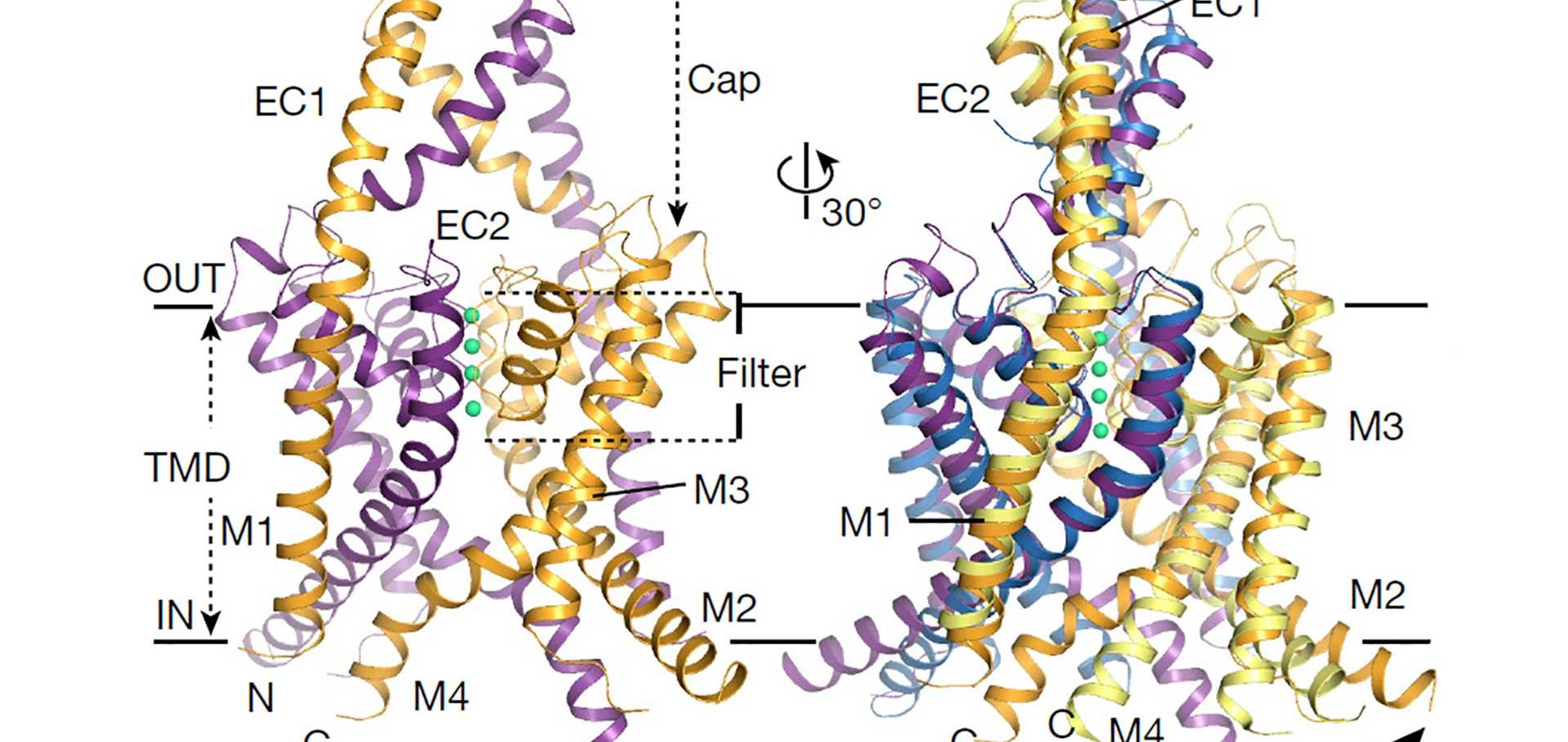
Polymodal Gating of the TREK-2 K2P Potassium Channel Involves Structurally Distinct Open States
Biophysical Journal Elsevier 110:3 (2016) 607a
Dominant-negative effect of a missense variant in the TASK-2 (KCNK5) K+ channel associated with Balkan Endemic Nephropathy
PloS one Public Library of Science 11:5 (2016) e0156456
Abstract:
TASK-2, a member of the Two-Pore Domain (K2P) subfamily of K+ channels, is encoded by the KCNK5 gene. The channel is expressed primarily in renal epithelial tissues and a potentially deleterious missense variant in KCNK5 has recently been shown to be prevalent amongst patients predisposed to the development of Balkan Endemic Nephropathy (BEN), a chronic tubulointerstitial renal disease of unknown etiology. In this study we show that this variant (T108P) results in a complete loss of channel function and is associated with a major reduction in TASK-2 channel subunits at the cell surface. Furthermore, these mutant subunits have a suppressive or 'dominant-negative' effect on channel function when coexpressed with wild-type subunits. This missense variant is located at the extracellular surface of the M2 transmembrane helix and by using a combination of structural modelling and further functional analysis we also show that this highly-conserved threonine residue is critical for the correct function of other K2P channels. These results therefore provide further structural and functional insights into the possible pathophysiological effects of this missense variant in TASK-2.Solution-based single-molecule FRET studies of K(+) channel gating in a lipid bilayer
Biophysical journal Cell Press 110:12 (2016) 2663-2670
Abstract:
Ion channels are dynamic multimeric proteins that often undergo multiple unsynchronized structural movements as they switch between their open and closed states. Such structural changes are difficult to measure within the context of a native lipid bilayer and have often been monitored via macroscopic changes in Förster resonance energy transfer (FRET) between probes attached to different parts of the protein. However, the resolution of this approach is limited by ensemble averaging of structurally heterogeneous subpopulations. These problems can be overcome by measurement of FRET in single molecules, but this presents many challenges, in particular the ability to control labeling of subunits within a multimeric protein with acceptor and donor fluorophores, as well as the requirement to image large numbers of individual molecules in a membrane environment. To address these challenges, we randomly labeled tetrameric KirBac1.1 potassium channels, reconstituted them into lipid nanodiscs, and performed single-molecule FRET confocal microscopy with alternating-laser excitation as the channels diffused in solution. These solution-based single-molecule FRET measurements of a multimeric ion channel in a lipid bilayer have allowed us to probe the structural changes that occur upon channel activation and inhibition. Our results provide direct evidence of the twist-to-shrink movement of the helix bundle crossing during channel gating and demonstrate how this method might be applied to real-time structural studies of ion channel gating.Modular Design of the Selectivity Filter Pore Loop in a Novel Family of Prokaryotic ‘Inward Rectifier’ (NirBac) channels
Scientific Reports Springer Nature 5:1 (2015) 15305