

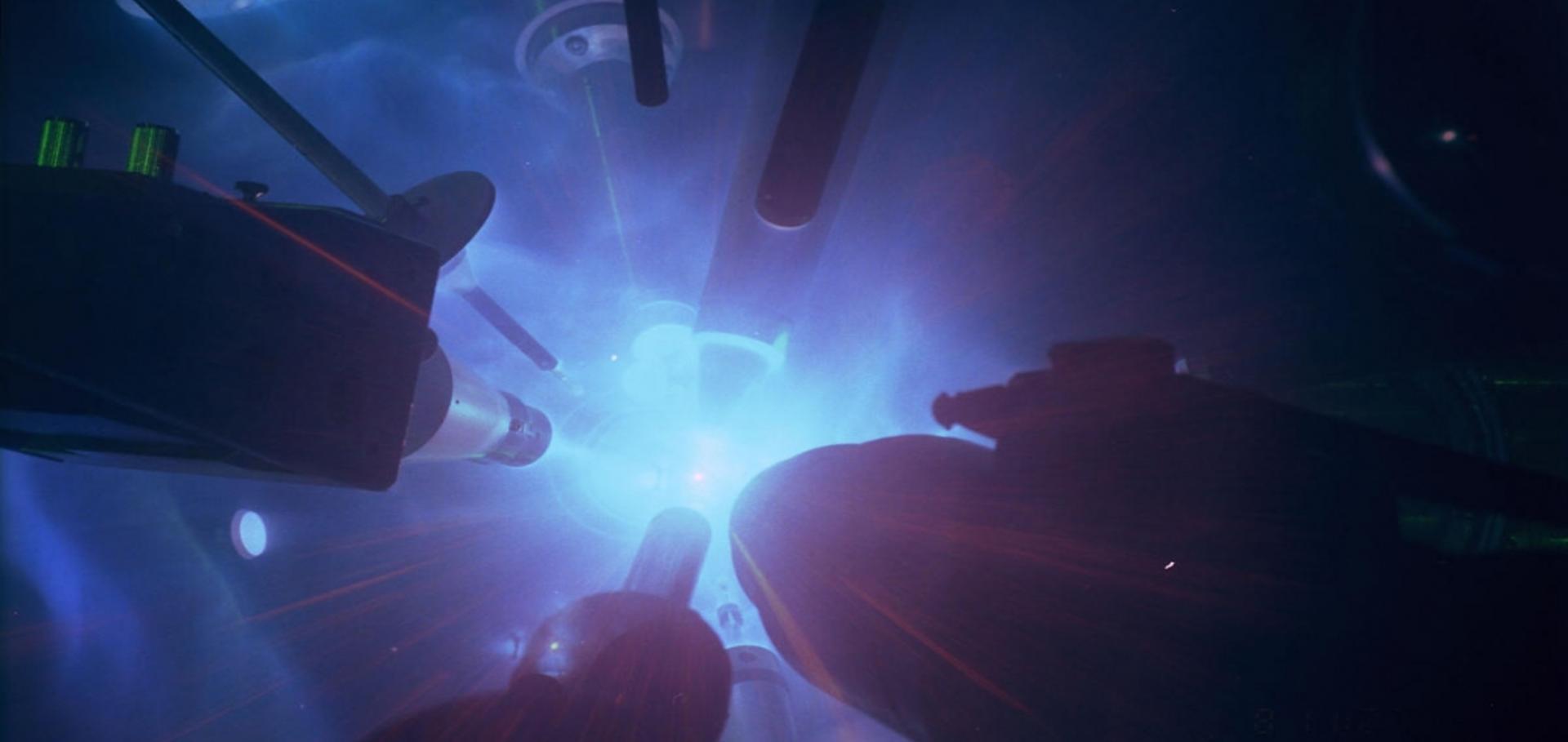
Multi-messenger dynamic imaging of laser-driven shocks in water using a plasma wakefield accelerator.
Nature communications 17:1 (2025) 529
Abstract:
Understanding dense matter hydrodynamics is critical for predicting plasma behavior in environments relevant to laser-driven inertial confinement fusion. Traditional diagnostic sources face limitations in brightness, spatiotemporal resolution, and in their ability to detect relevant electromagnetic fields. In this work, we present a dual-probe, multi-messenger laser wakefield accelerator platform combining ultrafast X-rays and relativistic electron beams at 1 Hz, to interrogate a free-flowing water target in vacuum, heated by an intense 200 ps laser pulse. This scheme enables high-repetition-rate tracking the evolution of the interaction using both particle types. Betatron X-rays reveal a cylindrically symmetric shock compression morphology assisted by low-density vapor, resembling foam-layer-assisted fusion targets. The synchronized electron beam detects time-evolving electromagnetic fields, uncovering charge separation and ion species differentiation during plasma expansion - phenomena not captured by photons or hydrodynamic simulations. We show that combining both probes provides complementary insights spanning kinetic to hydrodynamic regimes, highlighting the need for hybrid physics models to accurately predict fusion-relevant plasma behavior.Structural evolution of iron oxides melts at Earth's outer-core pressures
(2025)
Suppression of pair beam instabilities in a laboratory analogue of blazar pair cascades
Proceedings of the National Academy of Sciences National Academy of Sciences 122:45 (2025) e2513365122
Abstract:
The generation of dense electron-positron pair beams in the laboratory can enable direct tests of theoretical models of γ-ray bursts and active galactic nuclei. We have successfully achieved this using ultrarelativistic protons accelerated by the Super Proton Synchrotron at (CERN). In the first application of this experimental platform, the stability of the pair beam is studied as it propagates through a meter-length plasma, analogous to TeV γ-ray-induced pair cascades in the intergalactic medium. It has been argued that pair beam instabilities disrupt the cascade, thus accounting for the observed lack of reprocessed GeV emission from TeV blazars. If true, this would remove the need for a moderate strength intergalactic magnetic field to explain the observations. We find that the pair beam instability is suppressed if the beam is not perfectly collimated or monochromatic, hence the lower limit to the intergalactic magnetic field inferred from γ-ray observations of blazars is robust.Proposal to use laser-accelerated electrons to probe the axion-electron coupling
Physical Review Letters American Physical Society 135:19 (2025) 195003
Abstract:
The axion is a hypothetical particle associated with a possible solution to the strong CP problem and is a leading candidate for dark matter. In this paper we investigate the emission of axions by accelerated electrons. We find the emission probability and energy within the WKB approximation for an electron accelerated by an electromagnetic field. As an application, we estimate the number of axions produced by electrons accelerated using two counter-propagating high-intensity lasers and discuss how they would be converted to photons to be detected. We find that, under realistic experimental conditions, competitive model-independent bounds on the coupling between the axion and the electron could be achieved in such an experiment.
Modeling partially-ionized dense plasma using wavepacket molecular dynamics
(2025)