

12 May 2026
A fifty-part harmony: how to create light intense enough to break the vacuum
An international team of physicists demonstrates for the first time a practical route to dramatically boosting the intensity of high-power laser light.
Strong-field quantum electrodynamics (SF-QED) represents a frontier in fundamental physics. When an electromagnetic field becomes sufficiently intense, the simple linear behaviour predicted by Maxwell's equations breaks down spectacularly, and gives way to a host of exotic processes such as photon-photon scattering and spontaneous creation of electron-positron pairs. Such strange physics is thought to manifest around extraordinary astrophysical bodies (like magnetars, neutron stars that generate magnetic fields of billion-tesla strength), but getting anywhere near the SF-QED regime on Earth is a formidable experimental challenge.
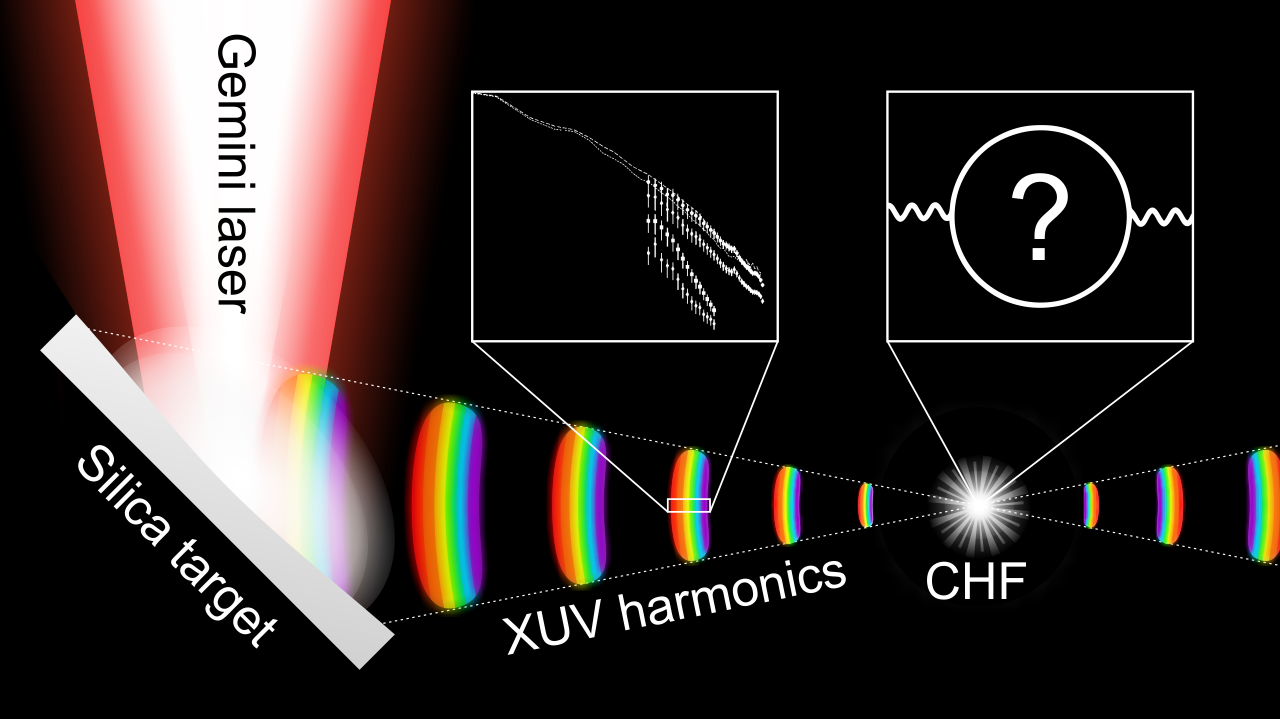
An unexpected route to creating extreme electromagnetic fields in the laboratory comes in the form of high harmonic generation (HHG). When an intense optical laser encounters and rapidly deposits its energy into the surface of a solid, a thin layer of ablation plasma is formed that is both reflective to and oscillated by the incident beam. The laser thus perceives an extremely rapidly oscillating mirror. The upshifted light reradiated by this relativistic mirror comprises a set of high-energy [extreme ultraviolet (XUV)] harmonics. Crucially, these harmonics are spatially and temporally coherent with one another. Hence, if they could be made to constructively interfere while being concentrated into a small focal spot, the resulting electric field would be staggeringly intense.
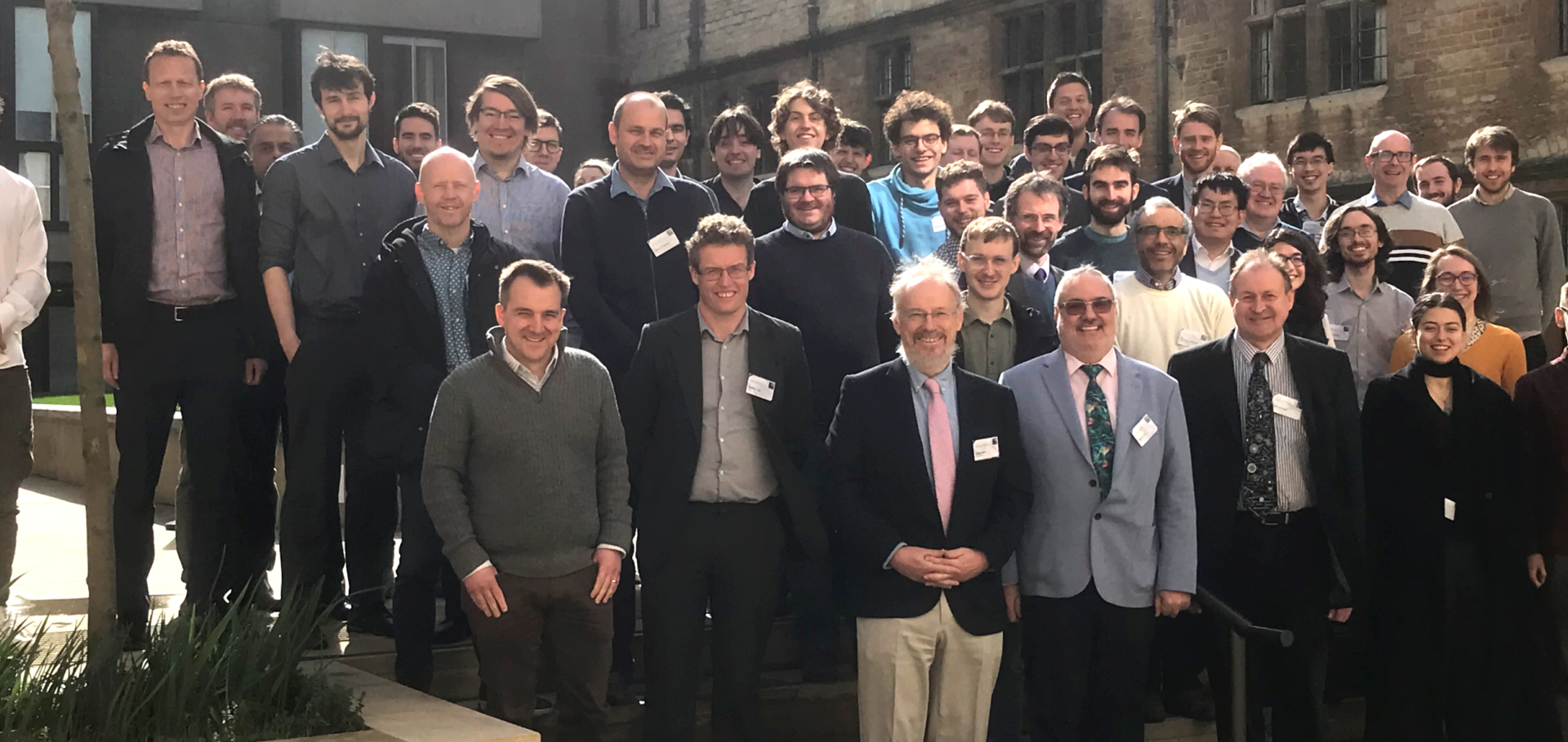
A practical route to creating such a coherent harmonic focus (CHF) has now been realised by an international collaboration headed by Dr Robin Timmis. The team, comprising researchers from the University of Oxford, AWE Aldermaston, Queen's University Belfast, the University of Michigan, and beyond, used the Gemini laser at the Central Laser Facility (CLF) to produce extremely bright XUV harmonics measurable up to the 47th order. By carefully tailoring the shape and intensity of the Gemini pulse, the team managed to produce a CHF with an intensity thought to exceed 1023 Wcm-2. Were the same technique to be deployed at a multi-petawatt laser platform, it would be possible in principle to reach intensities approaching 1029 Wcm-2, the threshold around which the linearity of the vacuum breaks down.
Professor Peter Norreys said: 'We are excited to have realised this extraordinary result in the laboratory. It is a testament to Robin’s exquisite mastery of the subject for her to have obtained the precise experimental conditions that have eluded us for decades. This is a real tribute to the dedication and expertise brought by the other members of my team in Oxford, Brendan Dromey’s and Mark Yeung’s teams in Queen’s University Belfast (especially Jonny Kennedy, Holly Huddleston and Colm Fitzpatrick), CLF Scientists at RAL, AWE Aldermaston, and our esteemed international partners.'
‘The discoveries we have made so far are fascinating and it feels like we are just getting started in terms of understanding the rich and complex physics of this mechanism,’ comments Robin. ‘The simulations suggest that we may have made the most intense source of coherent light ever. I hope we get a chance to return to Gemini soon to confirm this but also to take what we have learnt to larger facilities where we can generate even brighter light.’
Full article: Efficiency-optimized relativistic plasma harmonics for extreme fields by R. J. L. Timmis, C. R. J. Fitzpatrick, J. P. Kennedy, H. M. Huddleston, E. Denis, A. James, C. Baird, D. Symes, D. McGonegle, E. Atonga, H. Martin, J. Rebenstock, J. Neely, J. Lee, J. Redfern, N. Bourgeois, O. Finlay, R. Ruskov, S. Astbury, S. Hawkes, Z. Zhang, M. Zepf, K. Krushelnick, E. Gumbrell, P. P. Rajeev, M. Yeung, B. Dromey, and P. Norreys, Nature 652, 1153-1158 (2026).
Return to HEDLines