

Classical non-relativistic fractons
Abstract:
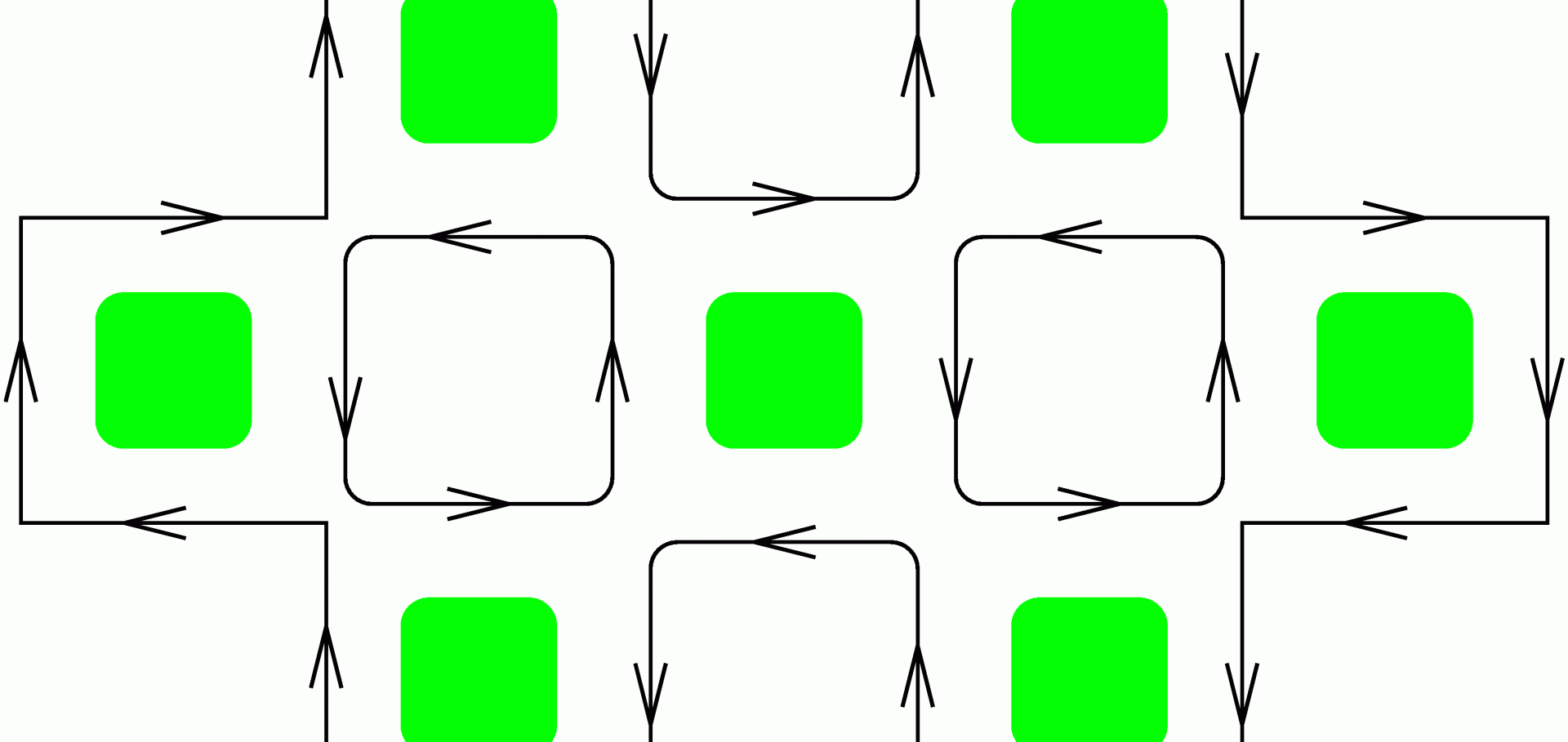
We initiate the study of the classical mechanics of nonrelativistic fractons in its simplest setting—that of identical one-dimensional particles with local Hamiltonians characterized by a conserved dipole moment in addition to the usual symmetries of space and time translation invariance. We introduce a family of models and study the N -body problem for them. We find that locality leads to a “Machian” dynamics in which a given particle exhibits finite inertia only if within a specified distance of another particle. For well-separated particles, this dynamics leads to immobility, much as for quantum models of fractons discussed before. For two or more particles within inertial reach of each other at the start of motion, we obtain an interesting interplay of inertia and interactions. Specifically, for a solvable “inertia only” model of fractons, we find that two particles always become immobile at long times. Remarkably, three particles generically evolve to a late time state with one immobile particle and two oscillating about a common center of mass with generalizations of such “Machian clusters” for N>3. Interestingly, these Machian clusters exhibit physical limit cycles in a Hamiltonian system even though mathematical limit cycles are forbidden by Liouville's theorem.Anomalous thermal relaxation and pump-probe spectroscopy of two-dimensional topologically ordered systems
Abstract:
We study the behavior of linear and nonlinear spectroscopic quantities in two-dimensional topologically ordered systems, which host anyonic excitations exhibiting fractional statistics. We highlight the role that braiding phases between anyons have on the dynamics of such quasiparticles, which as we show dictates the behavior of both linear response coefficients at finite temperatures, as well as nonlinear pump-probe response coefficients. These quantities, which act as probes of temporal correlations in the system, are shown to obey distinctive universal forms at sufficiently long timescales. As well as providing an experimentally measurable fingerprint of anyonic statistics, the universal behavior that we find also demonstrates anomalously fast thermal relaxation: correlation functions decay as a “squished exponential” 𝐶(𝑡)∼exp(−[𝑡/𝜏]3/2) at long times. We attribute this unusual asymptotic form to the nonlocal nature of interactions between anyons, which allows relaxation to occur much faster than in systems with quasiparticles interacting via local, nonstatistical interactions. While our results apply to any Abelian or non-Abelian topological phase in two-dimensions, we discuss in particular the implications for candidate quantum spin liquid materials, wherein the relevant quantities can be measured using pre-existing time-resolved terahertz-domain spectroscopic techniques.