

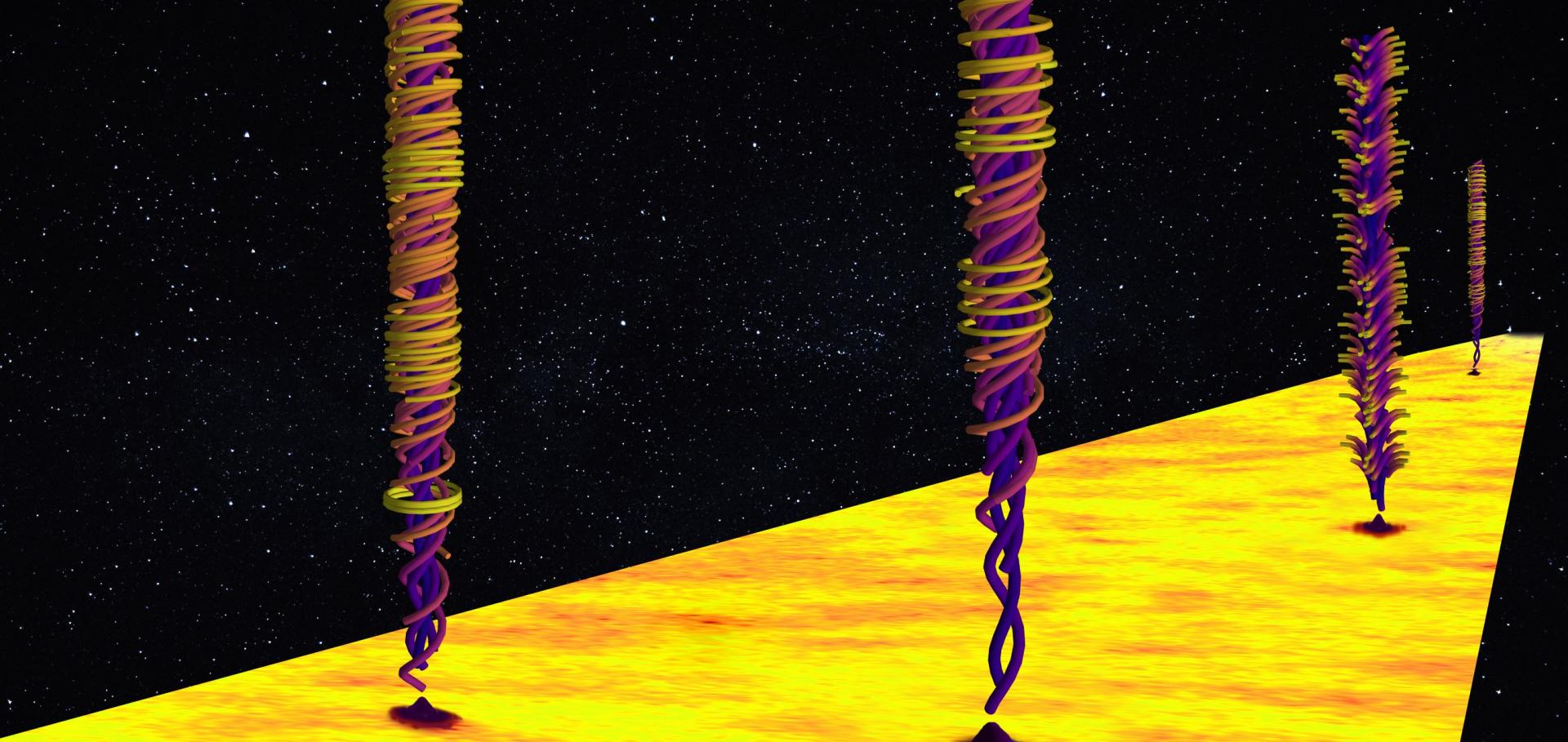


Antiferromagnetic half-skyrmions and bimerons at room temperature
Nature Springer Nature 590:7844 (2021) 74-79
Abstract:
In the quest for post-CMOS (complementary metal–oxide–semiconductor) technologies, driven by the need for improved efficiency and performance, topologically protected ferromagnetic ‘whirls’ such as skyrmions1,2,3,4,5,6,7,8 and their anti-particles have shown great promise as solitonic information carriers in racetrack memory-in-logic or neuromorphic devices1,9,10,11. However, the presence of dipolar fields in ferromagnets, which restricts the formation of ultrasmall topological textures3,6,8,9,12, and the deleterious skyrmion Hall effect, when skyrmions are driven by spin torques9,10,12, have thus far inhibited their practical implementation. Antiferromagnetic analogues, which are predicted to demonstrate relativistic dynamics, fast deflection-free motion and size scaling, have recently become the subject of intense focus9,13,14,15,16,17,18,19, but they have yet to be experimentally demonstrated in natural antiferromagnetic systems. Here we realize a family of topological antiferromagnetic spin textures in α-Fe2O3—an Earth-abundant oxide insulator—capped with a platinum overlayer. By exploiting a first-order analogue of the Kibble–Zurek mechanism20,21, we stabilize exotic merons and antimerons (half-skyrmions)8 and their pairs (bimerons)16,22, which can be erased by magnetic fields and regenerated by temperature cycling. These structures have characteristic sizes of the order of 100 nanometres and can be chemically controlled via precise tuning of the exchange and anisotropy, with pathways through which further scaling may be achieved. Driven by current-based spin torques from the heavy-metal overlayer, some of these antiferromagnetic textures could emerge as prime candidates for low-energy antiferromagnetic spintronics at room temperature1,9,10,11,23.Revealing emergent magnetic charge in an antiferromagnet with diamond quantum magnetometry
Nature Materials Springer Nature 23:2 (2023) 205-211
Abstract:
Whirling topological textures play a key role in exotic phases of magnetic materials and are promising for logic and memory applications. In antiferromagnets, these textures exhibit enhanced stability and faster dynamics with respect to their ferromagnetic counterparts, but they are also difficult to study due to their vanishing net magnetic moment. One technique that meets the demand of highly sensitive vectorial magnetic field sensing with negligible backaction is diamond quantum magnetometry. Here we show that an archetypal antiferromagnet—haematite—hosts a rich tapestry of monopolar, dipolar and quadrupolar emergent magnetic charge distributions. The direct read-out of the previously inaccessible vorticity of an antiferromagnetic spin texture provides the crucial connection to its magnetic charge through a duality relation. Our work defines a paradigmatic class of magnetic systems to explore two-dimensional monopolar physics, and highlights the transformative role that diamond quantum magnetometry could play in exploring emergent phenomena in quantum materials.Route towards stable homochiral topological textures in
A
Physical Review B American Physical Society (APS) 105:22 (2022) 224424
Room Temperature Control of Axial and Basal Antiferromagnetic Anisotropies Using Strain
ACS Nano American Chemical Society 19:50 (2025) 42118-42127
Abstract:
Antiferromagnetic materials are promising platforms for the development of ultrafast spintronics and magnonics due to their robust magnetism, high-frequency relativistic dynamics, low-loss transport, and the ability to support topological textures. However, achieving deterministic control over antiferromagnetic order in thin films is a major challenge due to the formation of multidomain states stabilized by competing magnetic and destressing interactions. Thus, the successful implementation of antiferromagnetic materials necessitates careful engineering of their anisotropy. Here, we demonstrate strain-based, robust control over multiple antiferromagnetic anisotropies and nanoscale domains in the promising spintronic candidate α-Fe2O3 at room temperature. By applying isotropic and anisotropic in-plane strains across a broad temperature–strain phase space, we systematically tune the interplay between magneto-crystalline and magneto-elastic interactions. We observe that strain-driven control steers the system toward an aligned antiferromagnetic state, while preserving topological spin textures, such as merons, antimerons, and bimerons. We directly map the nanoscale antiferromagnetic order using linear dichroic scanning transmission X-ray microscopy integrated with in situ strain and temperature control. A Landau model and micromagnetic simulations reveal how strain reshapes the magnetic energy landscape. These findings suggest that strain could serve as a versatile control mechanism to reconfigure equilibrium or dynamic antiferromagnetic states on demand in α-Fe2O3 for implementation in next-generation spintronic and magnonic devices.Room temperature control of axial and basal antiferromagnetic anisotropies using strain
(2025)