Home
Department Of Physics text logo
  • Research
    • Our research
    • Our research groups
    • Our research in action
    • Research funding support
    • Summer internships for undergraduates
  • Study
    • Undergraduates
    • Postgraduates
  • Engage
    • For alumni
    • For business
    • For schools
    • For the public
  • Support
Menu
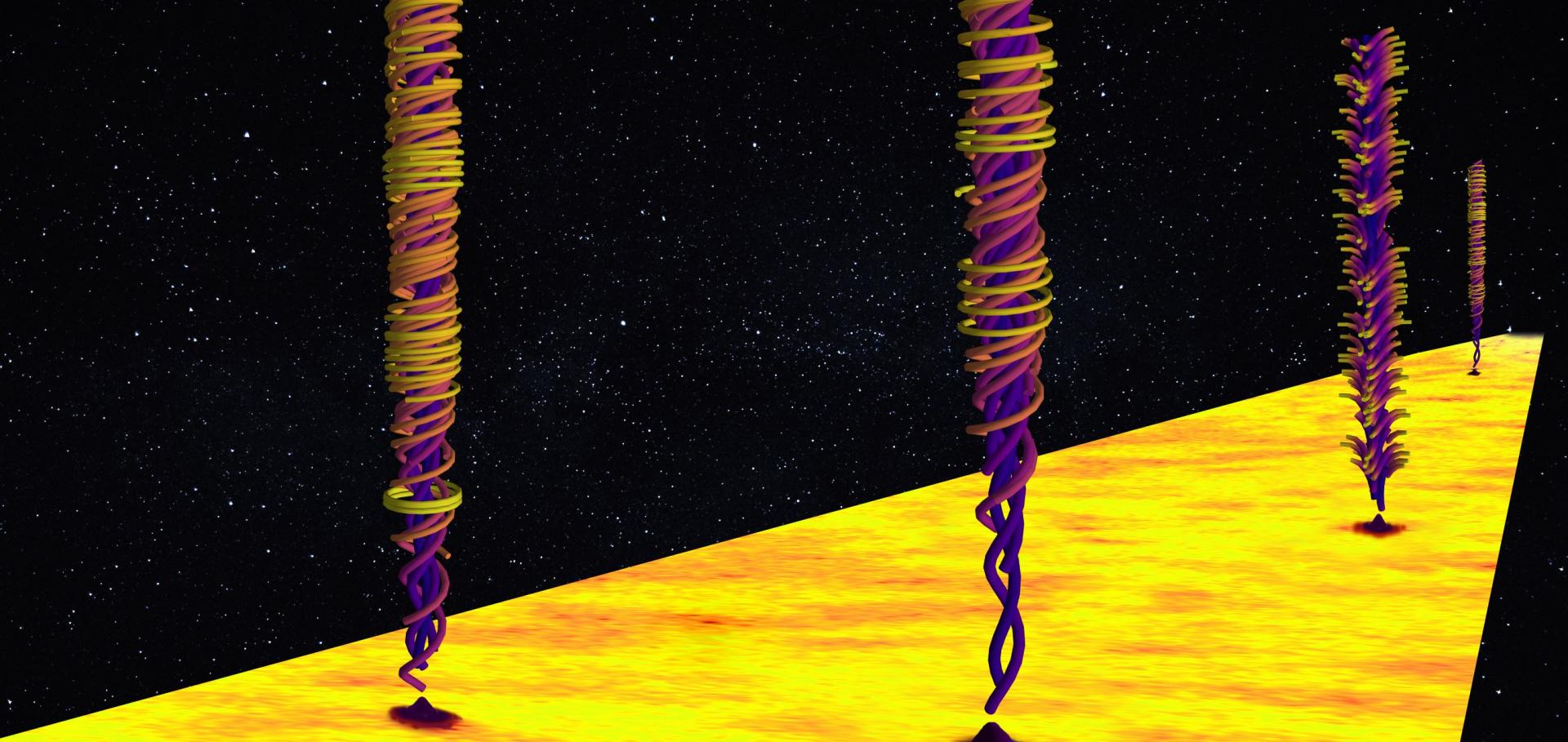
Cosmic whirls in rust
Credit: R Shetty, K Jani, H Jani

Hariom Jani

Royal Society - University Research Fellow

Research theme

  • Quantum materials

Sub department

  • Condensed Matter Physics

Research groups

  • Oxide electronics
  • Designer Quantum Materials for Devices
hariom.jani@physics.ox.ac.uk
Clarendon Laboratory, room 276, Level 2
Google Scholar
Youtube
  • About
  • Open PhD projects
  • Honors & Awards
  • Grants
  • Invited Talks & Lectures
  • Teaching & Outreach
  • Publications

Computing with rust

Harnessing whirls in iron-oxide

Where’s the very last place you would look if you wanted a new material to make computer memory? The compost heap or the scrap yard, probably. So who came up with the idea of using rust? Singapore’s Hariom Jani did. And he’s here to tell you it’s the futu

Cosmic strings in rust

Angular dependence of hump-shape Hall Effects for distinguishing between Karplus-Luttinger and Geometrical Origins

(2021)

Authors:

ZS Lim, LE Chow, KH Khoo, GJ Omar, Z Zhang, Z Luo, H Yan, P Yang, R Laskowski, A Ariando
More details from the publisher

A cost-effective quantum eraser demonstration

Physics Education IOP Publishing 56:3 (2021) 033007

Authors:

Aarushi Khandelwal, Jit Bin Joseph Tan, Tze Kwang Leong, Yarong Yang, T Venkatesan, Hariom Jani
More details from the publisher

Volatile Ultrafast Switching at Multilevel Nonvolatile States of Phase Change Material for Active Flexible Terahertz Metadevices

Advanced Functional Materials Wiley 31:17 (2021)

Authors:

Prakash Pitchappa, Abhishek Kumar, Saurav Prakash, Hariom Jani, Rohit Medwal, Mayank Mishra, Rajdeep Singh Rawat, Thirumalai Venkatesan, Nan Wang, Ranjan Singh
More details from the publisher

Reversible hydrogen control of antiferromagnetic anisotropy in α-Fe2O3

Nature Communications Springer Nature 12:1 (2021) 1668

Authors:

Hariom Jani, Jiajun Linghu, Sonu Hooda, Rajesh V Chopdekar, Changjian Li, Ganesh Ji Omar, Saurav Prakash, Yonghua Du, Ping Yang, Agnieszka Banas, Krzysztof Banas, Siddhartha Ghosh, Sunil Ojha, GR Umapathy, Dinakar Kanjilal, A Ariando, Stephen J Pennycook, Elke Arenholz, Paolo G Radaelli, JMD Coey, Yuan Ping Feng, T Venkatesan
More details from the publisher
More details
More details

Antiferromagnetic half-skyrmions and bimerons at room temperature

Nature Springer Nature 590:7844 (2021) 74-79

Authors:

Hariom Jani, Jheng-Cyuan Lin, Jiahao Chen, Jack Harrison, Francesco Maccherozzi, Jonathan Schad, Saurav Prakash, Chang-Beom Eom, A Ariando, T Venkatesan, Paolo G Radaelli

Abstract:

In the quest for post-CMOS (complementary metal–oxide–semiconductor) technologies, driven by the need for improved efficiency and performance, topologically protected ferromagnetic ‘whirls’ such as skyrmions1,2,3,4,5,6,7,8 and their anti-particles have shown great promise as solitonic information carriers in racetrack memory-in-logic or neuromorphic devices1,9,10,11. However, the presence of dipolar fields in ferromagnets, which restricts the formation of ultrasmall topological textures3,6,8,9,12, and the deleterious skyrmion Hall effect, when skyrmions are driven by spin torques9,10,12, have thus far inhibited their practical implementation. Antiferromagnetic analogues, which are predicted to demonstrate relativistic dynamics, fast deflection-free motion and size scaling, have recently become the subject of intense focus9,13,14,15,16,17,18,19, but they have yet to be experimentally demonstrated in natural antiferromagnetic systems. Here we realize a family of topological antiferromagnetic spin textures in α-Fe2O3—an Earth-abundant oxide insulator—capped with a platinum overlayer. By exploiting a first-order analogue of the Kibble–Zurek mechanism20,21, we stabilize exotic merons and antimerons (half-skyrmions)8 and their pairs (bimerons)16,22, which can be erased by magnetic fields and regenerated by temperature cycling. These structures have characteristic sizes of the order of 100 nanometres and can be chemically controlled via precise tuning of the exchange and anisotropy, with pathways through which further scaling may be achieved. Driven by current-based spin torques from the heavy-metal overlayer, some of these antiferromagnetic textures could emerge as prime candidates for low-energy antiferromagnetic spintronics at room temperature1,9,10,11,23.
More details from the publisher
Details from ORA
More details
More details
Details from ArXiV

Pagination

  • First page First
  • Previous page Prev
  • Page 1
  • Page 2
  • Page 3
  • Page 4
  • Page 5
  • Current page 6
  • Page 7
  • Page 8
  • Page 9
  • Next page Next
  • Last page Last

Footer Menu

  • Contact us
  • Giving to the Dept of Physics
  • Work with us
  • Media

User account menu

  • Log in

Follow us

FIND US

Clarendon Laboratory,

Parks Road,

Oxford,

OX1 3PU

CONTACT US

Tel: +44(0)1865272200

University of Oxfrod logo Department Of Physics text logo
IOP Juno Champion logo Athena Swan Silver Award logo

© University of Oxford - Department of Physics

Cookies | Privacy policy | Accessibility statement

Built by: Versantus

  • Home
  • Research
  • Study
  • Engage
  • Our people
  • News & Comment
  • Events
  • Our facilities & services
  • About us
  • Giving to Physics
  • Current students
  • Staff intranet