Astrophysical Gravitational-Wave Echoes from Galactic Nuclei

(2021)

Authors:

László Gondán, Bence Kocsis

A Poynting theorem formulation for the gravitational wave stress pseudo tensor

International Journal of Modern Physics D World Scientific Publishing 30:14 (2021) 2142003

Relativistic Pythagorean three-body problem

Physical Review D American Physical Society 104:8 (2021) 83020

Authors:

Tjarda CN Boekholt, Arend Moerman, Simon F Portegies Zwart

Abstract:

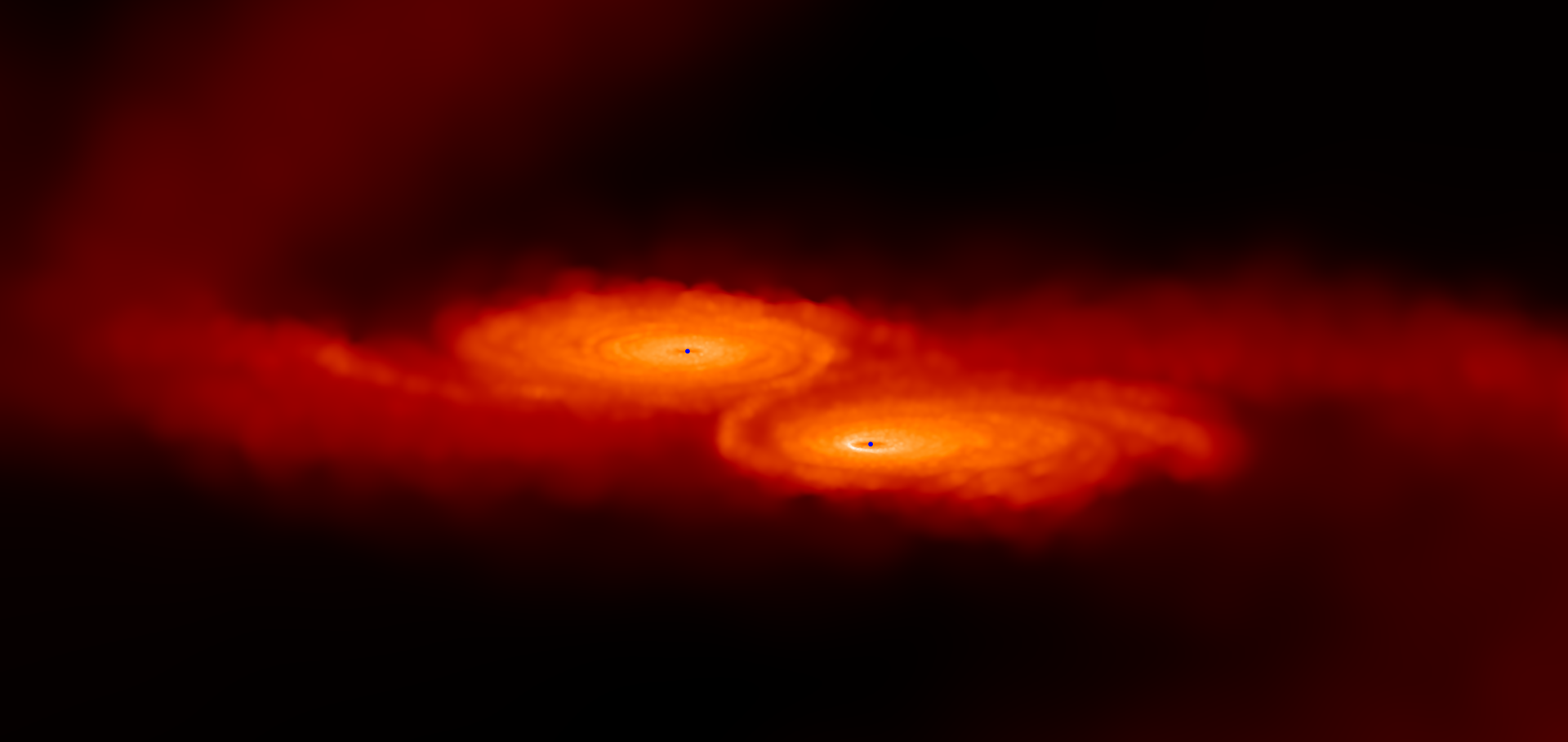
We study the influence of relativity on the chaotic properties and dynamical outcomes of an unstable triple system; the Pythagorean three-body problem. To this end, we extend the brutus N-body code to include post-Newtonian pairwise terms up to 2.5 order, and the first order Taylor expansion to the Einstein-Infeld-Hoffmann equations of motion. The degree to which our system is relativistic depends on the scaling of the total mass (the unit size was 1 parsec). Using the brutus method of convergence, we test for time-reversibility in the conservative regime, and demonstrate that we are able to obtain definitive solutions to the relativistic three-body problem. It is also confirmed that the minimal required numerical accuracy for a successful time-reversibility test correlates with the amplification factor of an initial perturbation, as was found previously for the Newtonian case. When we take into account dissipative effects through gravitational wave emission, we find that the duration of the resonance, and the amount of exponential growth of small perturbations depend on the mass scaling. For a unit mass , the system behavior is indistinguishable from Newton’s equations of motion, and the resonance always ends in a binary and one escaping body. For a mass scaling up to , relativity gradually becomes more prominent, but the majority of the systems still dissolve in a single body and an isolated binary. The first mergers start to appear for a mass of , and between and all systems end prematurely in a merger. These mergers are preceded by a gravitational wave driven in-spiral. For a mass scaling , all systems result in a gravitational wave merger upon the first close encounter. Relativistic three-body encounters thus provide an efficient pathway for resolving the final parsec problem. The onset of mergers at the characteristic mass scale of potentially leaves an imprint in the mass function of supermassive black holes.

Resonant dynamical friction in nuclear star clusters: rapid alignment of an intermediate-mass black hole with a stellar disk

Astrophysical Journal American Astronomical Society 919:2 (2021) 140

Authors:

Akos Szolgyen, Gergely Mathe, Bence Kocsis

Abstract:

We investigate the dynamical evolution of an intermediate-mass black hole (IMBH) in a nuclear star cluster hosting a supermassive black hole (SMBH) and both a spherical and a flattened disk-like distribution of stellar-mass objects. We use a direct N-body (φGPU) and an orbit-averaged (N-ring) numerical integrator to simulate the orbital evolution of stars and the IMBH. We find that the IMBH's orbit gradually aligns with the stellar disk if their mutual initial inclination is less than 90°. If it is larger than 90°, i.e., counter-rotating, the IMBH does not align. Initially, the rate of orbital reorientation increases linearly with the ratio of the mass of the IMBH over the SMBH mass, and it is orders of magnitude faster than ordinary (i.e., Chandrasekhar) dynamical friction, particularly for high SMBH masses. The semimajor axes of the IMBH and the stars are approximately conserved. This suggests that the alignment is predominantly driven by orbit-averaged gravitational torques of the stars, a process that may be called resonant dynamical friction. The stellar disk is warped by the IMBH, and ultimately increases its thickness. This process may offer a test for the viability of IMBH candidates in the Galactic Center. Resonant dynamical friction is not limited to IMBHs; any object much more massive than disk particles may ultimately align with the disk. This may have implications for the formation and evolution of black hole disks in dense stellar systems and gravitational wave source populations for LIGO, VIRGO, KAGRA, and LISA.

Turbulent transport of impurities in 3D devices

Nuclear Fusion IOP Publishing 61:11 (2021) 116019

Authors:

Jm Garcia-Regana, M Barnes, I Calvo, A Gonzalez-Jerez, H Thienpondt, E Sanchez, Fi Parra, Da St-Onge

Abstract:

The evidence of a large diffusive turbulent contribution to the radial impurity transport in Wendelstein 7-X (W7-X) plasmas has been experimentally inferred during the first campaigns and numerically confirmed by means of gyrokinetic simulations with the code stella. In general, the absence of strong impurity accumulation during the initial W7-X campaigns is attributed to this diffusive term. Given the large variety of possible stellarator configurations, in the present work the diffusive contribution is also calculated in other stellarator plasmas. In particular, a numerical cross-device comparison is presented, where the diffusion (D) and convection (V) coefficients of carbon and iron impurities produced by ion-temperature-gradient (ITG) turbulence are obtained. The simulations have been performed for the helias W7-X, the heliotron LHD, the heliac TJ-II and the quasi-axisymmetric stellarator NCSX at the radial position r/a = 0.75. The results show that, although the size of D and V can differ across the four devices, inward convection is found for all of them. For W7-X, TJ-II and NCSX the two coefficients are comparable and the turbulent peaking factor is surprisingly similar. In LHD, appreciably weaker diffusive and convective impurity transport and significantly larger turbulent peaking factor, in comparison with the other three stellarators, are predicted. All this suggests that ITG turbulence, although not strongly, would lead to negative impurity density gradients in stellarators. Then, considering mixed ITG/trapped electron mode (TEM) turbulence for the specific case of W7-X, it has been quantitatively assessed to what degree pellet fueled reduced turbulence scenarios feature reduced turbulent transport of impurities as well. The results for trace iron impurities show that, although their turbulent transport is not entirely suppressed, a significant reduction of the convection and a stronger decrease of the diffusion term are found. Although the diffusion is still above neoclassical levels, the neoclassical convection would gain under such conditions a greater specific weight on the dynamics of impurities in comparison with standard ECRH scenarios without pellet fueling.